Welcome to the largest mall and retail history site on the internet!

Showing posts with label The Big Three. Show all posts

A Preamble

The present state of the retail industry is calamitous. Colossal, coast-to-coast merchandising chains, once thought virtually impregnable, now teeter on the brink of collapse. Each round of store closings brings the fear that the next announcement may signal the bitter end of a company, or companies, that have provided the needs of Americans for well over a century. Add to this the Covid-19 pandemic and its retail repercussions, and you have a recipe for disaster.

Given the current state of affairs, we thought it fitting to commemorate America's Big Three mega merchandisers. The forthcoming section will provide brief histories of the Big Three, as their complete stories are already well-documented on the internet. For those interested, links to three web destinations may be found at the end of this section.

For our particular spin, we'll cover some aspects that have not been explored in depth in other write-ups. For instance, here you will find details about Wards', Sears' and Penney's so-called "private label" brands of appliances and electronics. Moreover, we delve into the Big Three retailer's mid-20th century move into shopping mall-based stores, a subject never covered until now.
ICONIC INSTITUTIONS

During the later half of the 20th century, Montgomery Ward, Sears and J.C. Penney were all things to all people. Their stores were hives of activity and monumentally profitable. It was unthinkable, then, to consider that any of these three powerhouses could ever go under, but this is just what happened to one of them at the turn of the 21st century.

Our Big Three merchandisers had grown to prominence in an era dominated by several regional department store chains; many of these dating back to the 19th century. Although each regional department store chain was indigenous to a particular city, most were eventually operated (more or less behind the scenes) as parts of large, national holding companies.

For example, a store such Cincinnati's Shillito's, while serving the Queen City (and eventually a few Kentucky locations), was but a cog in a gigantic, coast-to-coast department store grid. In this case, the holding company was operated by Cincinnati-based Federated Stores.

Regional department stores of the time were often upscale, "carriage trade" concerns. They sold general merchandise, as well as luxury items that were geared toward the more discriminating shopper. These stores became known for their superlative customer service. They were often beloved by customers and considered to be a pillar of the community.

MID-TIER MERCHANDISING


At the forefront of so-called "mid-tier" merchandising were three department store chains which catered more to the needs of the general public. Sears, Roebuck & Company and Montgomery Ward & Company started out as catalog-based retailers and eventually expanded into national "brick & mortar" chains. The J.C. Penney Company had a humble beginning operating stores in the Rocky Mountains of the western United States. They expanded nationwide in the 1920s.
Montgomery Ward & Company

Circa-1880

The first of our Big Three merchandisers originated in, and operated out of, Chicago. Aaron Montgomery Ward started a mail-order business in August 1872, with George R. Thorne becoming a business partner 2 years later. The target Montgomery Ward customer was the rural farmer.

At the time, those living outside larger cities had few shopping options, with prices charged for merchandise often being exorbitant. Goods sold by Montgomery Ward were much cheaper. The economy of purchasing from Wards brought the fledgling firm a great deal of business, as did the introduction of an unconditional money-back guarantee, in 1875.


Aaron Montgomery Ward (1844-1913), who originally hailed from Chatham, New Jersey. He went on the establish "The Cheapest Cash House on Earth."
Photo from Wikipedia

Competition from Sears, Roebuck & Company, another Chicago-centric mail-order house, intensified in the 1890s. By the turn of the century, Sears had gained a competitive edge. At the time, both Montgomery Ward and Sears shipped merchandise to customers via railroad.

In 1913, the U.S. Post Office instituted its parcel post system, which was of great benefit to both Wards and Sears. To handle all of the new mail order business, Wards built large, multistory Mail Order Plants. These warehouses could encompass up to 700,000 square feet. By 1924, there were "branch houses" in Chicago, Fort Worth, Kansas City, Oakland, Portland and Saint Paul. 

By 1922, so-called Retail Stores were operating in Mail Order Plants. Each unit covered around 30,000 square feet. A new concept was introduced four years later. The first Chain Store (or "merchandise display") opened, in Marysville, Kansas, in August 1926. Whereas the Wards Retail Store provided goods to customers in large cities, a Chain Store would serve patrons in small towns across America.

The inaugural Chain Store in Kansas encompassed only 5,000 square feet. Its function was to display an ever-changing selection of the thousands of items carried by Montgomery Ward. Only automobile tires, inner tubes, batteries and radiators were sold over the counter. Any other merchandise had to be ordered out of the Wards catalog. This concept was abandoned in February 1928, when customers were permitted to purchase -and possess- all merchandise carried by the store.  


The Kansas City Mail Order Plant was completed in July 1914. By 1928, there was a coast-to-coast network of eight major "branch house" facilities. Each one contained a Wards Retail Store. 
Photo from the Montgomery Ward & Company Annual Report 1928


A depiction of the very first Montgomery Ward Chain Store, which opened, in Marysville, Kansas, on August 14, 1926. 
Drawing from Montgomery Ward & Company
Circa-1920

Circa-1928

Circa-1933

Circa-1942

Montgomery Ward carried out a massive expansion in the late 1920s. There were only 3 Chain Stores in 1927. By late 1928, 244 were in business. In 1930, the chain was operating an astounding 556! This number fell to 409 as a result of The Great Depression, but had rebounded to 625 by 1940.

At the end of World War II, Wards' top level management was (mistakenly) convinced that another economic depression was going to hit the nation. As a result, the chain's move into the burgeoning suburban marketplace was delayed for several years. 

No new Wards stores would be opened between 1941 and 1957. The first shopping center-centric location was finally dedicated in 1958. By this time, arch rivals Sears & Roebuck and J.C. Penney were well-entrenched in America's booming suburbs.

Montgomery Ward was slow in adapting to the mid-century mall model. Their first "mall" store opened for business, at Greater Denver's LAKESIDE CENTER, in August 1958. This new generation Wards comprised approximately 110,000 square feet, with its freestanding Wards Auto Center housing 19,900.
Photo from Montgomery Ward & Company Annual Report 1958 
Circa-1956

Wards' new suburban shopping center stores featured a snack bar and carried lines of apparel, fashion accessories, shoes, home furnishings, large & small appliances, electronics, floor coverings, hardware & paint, building supplies, lawn & garden equipment and sporting goods. Stores also had a catalog order department and an attached -or freestanding- Wards Auto Center.

EARLY MONTGOMERY WARD SHOPPING MALL STORES:

*BLUE RIDGE CENTER, Kansas City, MO (1958)

*BIG TOWN MALL, Mesquite, TX (1959)
*WONDERLAND CENTER, Livonia, MI (1959)


The Wards at San Diego's MISSION VALLEY CENTER was the chain's largest western store when it opened its doors, in February 1961. It encompassed 219,000 square feet.


During the mid-century push to build new suburban shopping center stores, Wards was still opening a freestanding location here and there. This is evidenced by the Middletown, Ohio Wards, which was dedicated in 1964. The single-level operation, which replaced a 1920s-vintage, downtown store, housed 80,000 square feet.


One of the first fully-enclosed malls in Orange County California was anchored by Wards. Here we see the 169,000 square foot HUNTINGTON CENTER location. It opened, in Huntington Beach, in October 1966.
Circa-1967

America's Big Three retailers were at their peak in the mid-20th century. In 1950, Sears was the largest, followed by Montgomery Ward and J.C. Penney. The number two and three companies had changed places by 1968, with Wards bumped down to the number three position.


A physical layout of the "Monkey Wards" that anchored Plattsburgh, New York's PYRAMID MALL between April 1975 and December 1997. The store encompassed this single level, housed 84,000 square feet, and featured over 50 departments.
-Click on image for a larger view-


A visual history of of Montgomery Ward trademarks. These date from 1956 to the demise of the chain, in early 2001.
Sears, Roebuck & Company

Circa-1897

In 1886, Richard Warren Sears established the R.W. Sears Watch Company in a former railroad station, in North Redwood, Minnesota. In 1887, he moved operations to Chicago and hired Alvah Curtis Roebuck as a watch repairman. The first mail-order catalog was issued in 1887, with the Sears Roebuck & Company moniker being established in 1893.


Richard Warren Sears (1863-1914) was born in Stewartville, Minnesota. He eventually founded "The Cheapest Supply House on Earth."
Photo from Sears, Roebuck & Company Annual Report 1940


The North Redwood railroad station, in Minnesota, housed the original R.W. Sears Watch Company.
Drawing from Sears, Roebuck & Company Annual Report 1940


Alvah Curtis Roebuck (1864-1948) hailed from Tippecanoe County, Indiana. He was hired by Richard Sears to repair watches and eventually became a co-founder of the Sears enterprise.
Photo from Sears, Roebuck & Company Annual Report 1940  

Soon after the turn of the century, Sears followed Montgomery Ward's lead by establishing an unconditional money-back guarantee. Between 1908 and 1920, business increased six-fold, outstripping Montgomery Ward, by then Sears' primary competitor.

To facilitate Sears' burgeoning mail order business, a national network of Merchandise Buildings was established. Each of these distribution plants eventually housed a Sears Retail Department Store. The first opened, at the Chicago Merchandise Building, on February 2, 1925. 

A Kansas City Merchandise Building was dedicated on September 20, 1925. In total area, it covered 1,500,000 square feet, with the Retail Department Store encompassing 2 levels and 98,000. Said store sold "anything from a paper of pins to a $10,000 residence." On the second floor was a full-size model home, complete with furnishings from the Sears Catalog. 

Circa-1921


Sears' first Retail Department Store opened in February 1925. It was installed in the company's Merchandise Building headquarters & distribution center, in Chicago. By late 1925, there were also Sears Merchandise Building plants in Kansas City, Dallas and Seattle.
Photo from Sears, Roebuck & Company


The first freestanding Retail Department Store began business, in Evansville, Indiana, on October 5, 1925. It was installed in a former hardware store and was promoted with this logo. 
Graphic from Sears, Roebuck & Company
Circa-1931

Circa-1943

Sears expanded operations in spite of the Great Depression. In 1930, there were 351 stores. By 1933, this number had grown to 400. 595 stores were in business by 1941. A move to suburban-type shopping center stores commenced in 1947, with a new Sears at Kansas City, Missouri's COUNTRY CLUB PLAZA. This was followed by the chain's first full-line mall-format store, which opened in 1954. With its dedication, Sears operated 702 stores.
Circa-1950

By the mid-20th century, Sears was working with three retail store formats. Catalog & Appliance locations were no larger than 24,000 square feet. They sold only home appliances, tools, lawn & garden equipment and bicycles. Naturally, there was also a catalog order department.

A somewhat larger full-line store encompassed between 25,000 and 99,000 square feet. These generally carried lines of apparel, shoes, fashion accessories, home furnishings, large and small appliances, electronics, floor coverings, hardware & paint. They also included a Catalog sales desk and sometimes had a freestanding or attached Sears Auto Center. 

Even larger full-line Sears locations ranged from 100,000 to 373,000 square feet and featured expanded lines of merchandise carried by the smaller full-line store. These larger locations also had a coffee shop and always included a Sears Auto Center.

EARLY SEARS SHOPPING MALL STORES (Catalog & Appliance):

*SHOPPERS' WORLD, Framingham, MA (1951)
*LEVITTOWN SHOP-A-RAMA, Bucks County, PA (1955)
*LOS ALTOS CENTER, Long Beach, CA (1955)

Sears anchored Greater Los Angeles' POMONA VALLEY CENTER. The store, encompassing 111,500 square feet, commenced operation in November 1954. We have determined, by a process of elimination, that this was the chain's very first full-line, shopping mall store.
Photo from Sears, Roebuck & Company

EARLY SEARS SHOPPING MALL STORES (Full-line):


*MONDAWMIN CENTER, Baltimore (City), MD (1956)
*ALA MOANA CENTER, Honolulu, HI (1959)
*MERLE HAY PLAZA, Des Moines, IA (1959)


The iconic Sears script nameplate was used on Annapolis, Maryland's PAROLE PLAZA store. It opened its doors in May 1962 and covered 73,000 square feet of selling space.
Circa-1964


The Sears that anchored Grand Forks, North Dakota's SOUTH FORKS PLAZA was a high-end Mid-Century Modern structure. The 50,000 square foot store began business in October 1964.


Virginia Beach's first shopping mall formally opened in March 1966. The 157,700 square foot Sears, at PEMBROKE MALL, made its debut in July of the same year. 


A visual history of Sears trademarks. These span from 1950 to the present day.
The J.C. Penney Company

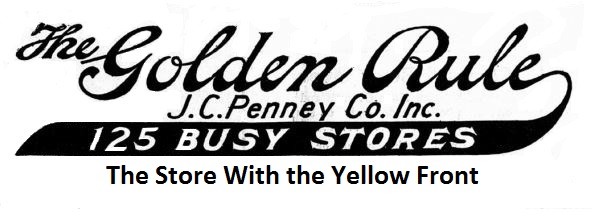
Our third Big Three retail chain was founded by James Cash Penney. The original location, called the Golden Rule, opened for business, in Kemmerer, Wyoming, on April 14, 1902.


A latter-day portrait of James Cash Penney (1875-1971), who hailed from Hamilton, Missouri. Known as "King of the Soft Goods," he was the only Big Three founding father to live long enough to see the retail chain he created reach its full potential.
Photo from http://www.biography.com


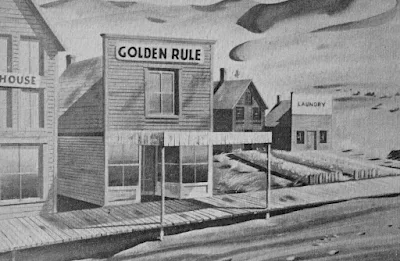
Penney's first Golden Rule store, circa-1902. In 1904, it was moved to a new location in Kemmerer.  
Drawing from the J.C. Penney Company


An interior view of a Golden Rule mercantile. That's a very young James Cash Penney on the right.
Photo from the J.C. Penney Archives, DeGolyer Library


J.C. Penney's present-day Kemmerer, Wyoming unit -or Mother Store- is often said to have been in business since 1904. However, the company did not operate out of this building until 1929. There have been three different Kemmerer locations over the years. The Mother Store was slotted for closure in 2020, but has been given a retail stay of execution.
Photo from Wikipedia / "Bernd00"

Business went well at the first Kemmerer store. By 1907, 3 Golden Rule mercantiles were in operation in Wyoming. A fourth location opened in Utah in 1908. 34 stores had been established, in 8 western states, by 1912. Soon after, Golden Rule stores began to operate under a combination Golden Rule-J.C. Penney Company masthead.

The corporate headquarters was located in Salt Lake City, Utah between 1909 and 1914, when it was moved to New York City. The first stores east of the Mississippi followed, in 1915, with new operations in Wausua and Watertown, Wisconsin. The Golden Rule co-branding had been dropped by 1919.

 Circa-1916

Circa-1919

Growth of the chain was explosive during the 1920s. By 1921, the J.C. Penney Company had become the nation's first transcontinental retail chain. In 1927, 750 stores were in operation in 45 states. The 1,000th was dedicated, in Beloit, Kansas, in April 1928.

In spite of The Great Depression, the company continued to expand. The store count in 1936 had reached 1,496. By August 1956, there were 1,709 J.C. Penney stores across the 48 states.
Circa-1921


Customers line up at the grand opening of a new Penney's. At the time of this 1922 rendering, there were 371 "busy stores."
Drawing from the J.C. Penney Company

 Circa-1932

Circa-1937

"The Penney Company," as J.C. himself referred to it, weathered an anti-chain store movement, which was underway by 1925. In certain circles, it was opined that chain stores were "ruining small communities." Fortunately for Penney's, Sears and Wards, a Congressional anti-chain store bill failed to pass in 1940, putting an end to said movement.
Circa-1942 

Circa-1946

Penney's first suburban shopping center stores opened in Whitehall, Ohio's TOWN & COUNTRY CENTER (1950) and Greater New York City's LEVITTOWN CENTER (1951). At the time, all stores were so-called dry goods only operations. Unlike Sears and Montgomery Ward, who operated some full-line stores, Penney's carried only apparel, shoes, linens and other "soft lines."


The "J.C. Penney Co." store that anchored Greater New Orleans' LAKESIDE CENTER mall opened in March 1960. It encompassed approximately 43,200 square feet and typified the standard "dry-goods-only" Penney's store.

EARLY J.C. PENNEY SHOPPING MALL STORES (dry goods only):

*LOS ALTOS CENTER, Long Beach, CA (1955)
*163rd STREET CENTER, Dade County, FL (1956)
*STEWART-LAKEWOOD CENTER, Atlanta, GA (1959)


A promotion for the new J.C. Penney at WHITTIER DOWNS MALL, in today's Santa Fe Springs, California. The store -and mall- opened in August 1955. The ad lists all of the departments found in a "dry-goods-only" Penney's store.
Advert from the J.C. Penney Company 

In November 1961, "Penney's Audobon" opened in Camden County, New Jersey. Encompassing approximately 80,000 square feet, it epitomized the larger Penney's stores that had begun to appear in the late 1950s. It was followed by the company's first full-line store, the 152,000 square foot "J.C. Penney Co." unit at Greater Philadelphia's KING OF PRUSSIA PLAZA. The KOPP store was dedicated, on August 15, 1962, as largest in the chain.


"Penney's Audobon," which was an anchor of Camden County, New Jersey's BLACK HORSE PIKE CENTER. It, and the subsequent KING OF PRUSSIA PLAZA store, were stepping stones. They bridged the gap between early "dry goods only" mercantiles and newer full-line "Penneys" locations.
Drawing from the J.C. Penney Company

Circa 1962

A new corporate identity and logo were unveiled in November 1962. Greater Philadelphia's KING OF PRUSSIA PLAZA store, while featuring expanded lines of merchandise and new departments, was still branded as a (quote-unquote) "J.C. Penney Co." unit. 

Subsequent full-line -or "New Generation"- stores would include most -or all- of the expanded departments and be branded with the new (sans-apostrophe) Penneys logo. The first such store, anchoring Central Florida's WINTER PARK MALL, welcomed shoppers on August 20, 1964.

EARLY J.C. PENNEY SHOPPING MALL STORES (full-line):

*WHITE LAKES MALL, Topeka, KS (1964)
*SOUTHLAND CENTER, Hayward, CA (1964)
*SHEPHERD MALL, Oklahoma City, OK (1964)
The New Generation store featured greatly-expanded lines of merchandise. There were now departments carrying lawn & garden items, sporting goods, housewares, home furnishings, large appliances and electronics. A standard-size Penneys, which opened at Melbourne, Florida's BREVARD MALL in August 1963, included the very first "Penneys Auto Center."


A typical New Generation Penneys store would feature these departments. 
Graphic from the J.C. Penney Company


A standard Penneys Auto Center sold and installed the Penneys house brand of tires, batteries and auto accessories. Note: A full-line Sears store would have included an attached or freestanding Sears Auto Center. After 1958, full-line Montgomery Ward stores also featured an attached or freestanding Wards Auto Center.  
Graphic from the J.C. Penney Company
 

Most New Generation Penneys stores included a Penneys Beauty Salon. The store might also have a cafeteria or coffee shop, photo studio and outdoor lawn & garden center.
Graphic from the J.C. Penney Company


By the late '60s, the J.C. Penney chain was building new full-line stores at a rapid clip. The example depicted here anchored South Florida's PALM BEACH MALL. Encompassing 220,000 square feet, the store commenced operation in October 1967.