
Showing posts with label New York City Centers. Show all posts
Showing posts with label New York City Centers. Show all posts
The present-day political jurisdiction of the City of New York came into existence on January 1, 1898. Before this date, New York City consisted of Manhattan Island and a part of Westchester County known as "Morrisania" or the "Annexed District."
With the creation of the City of New York, the municipal limits were extended to take in more of Westchester County, as well as Queens County (including the incorporated Long Island City), the incorporated city of Brooklyn and the entirety of Richmond County (a.k.a. Staten Island).
Five "boroughs" were created; Manhattan, The Bronx, Queens, Brooklyn and Richmond. Manhattan and the Bronx formed New York County. Queens comprised Queens County. Brooklyn was conterminous with Kings County and Richmond with Richmond County.
Three eastern towns in Queens-Queens County were incorporated out of the boundaries of the City of New York in 1899. They became Nassau County. In 1914, the borough of The Bronx became Bronx County. Richmond was renamed the Borough of Staten Island in 1975 (but was still under the jurisdiction of Richmond County).
With the creation of the City of New York, the municipal limits were extended to take in more of Westchester County, as well as Queens County (including the incorporated Long Island City), the incorporated city of Brooklyn and the entirety of Richmond County (a.k.a. Staten Island).
Five "boroughs" were created; Manhattan, The Bronx, Queens, Brooklyn and Richmond. Manhattan and the Bronx formed New York County. Queens comprised Queens County. Brooklyn was conterminous with Kings County and Richmond with Richmond County.
Three eastern towns in Queens-Queens County were incorporated out of the boundaries of the City of New York in 1899. They became Nassau County. In 1914, the borough of The Bronx became Bronx County. Richmond was renamed the Borough of Staten Island in 1975 (but was still under the jurisdiction of Richmond County).


The five Boroughs of New York City. Manhattan is the epicenter. The "Outer Boroughs" are The Bronx, Queens, Brooklyn and Staten Island. Three suburban-style shopping malls are located within the city's corporate limits; KINGS PLAZA (1), STATEN ISLAND MALL (2) and QUEENS CENTER (3). The initial IRT subway is indicated in black.
Original map from Wikipedia

A map of the original IRT system appeared in the October 27, 1904 issue of The (New York) Evening Post.
New York City's, 9.1 route mile IRT (Interborough Rapid Transit) line began revenue service in October 1904. The system was extended to The Bronx and Brooklyn in 1905 and reached Queens in 1915. The Borough of Richmond (Staten Island) was never connected -via subway- with the four other boroughs.
The boroughs of Manhattan, The Bronx, Brooklyn and Queens were eventually served by three separate subway systems. The privately-owned BRT (Brooklyn Rapid Transit Company) was established in January 1896, with its first subway station opening in June 1908. The BRT was renamed BMT (Brooklyn-Manhattan Transit Corporation) in 1923. A city-owned system commenced revenue service in September 1932. It was renamed IND (Independent System) in June 1940.
All three networks were consolidated under a single management at this time. The unified system was renamed, as the New York City Subway, in 1967. Today, it is the world's fifth-longest rail rapid transit network, with 248 route miles and 472 stations. Note: as of mid-2025, the world's longest subway system, the Shanghai Metro, stretched for 516 route miles, with 508 stations.
Greater New York City's first suburban-style shopping mall, Westchester County's CROSS COUNTY CENTER, was dedicated in April 1954. This was joined by Long Island's first mall, ROOSEVELT FIELD CENTER, in August 1956. New Jersey's first major shopping mall, GARDEN STATE PLAZA, welcomed first customers in May 1957.
The first regional-class, suburban-style mall within the corporate limits of New York City was built in the Borough of Brooklyn. KINGS PLAZA was completed in September 1970. Next in line was STATEN ISLAND MALL, in the Borough of Richmond, which debuted in August 1973. The third of New York City's regional malls, QUEENS CENTER, opened for business in September of the same year.
There were also many office tower shopping gallery-type malls within the confines of Manhattan; the most noteworthy being the MALL AT THE WORLD TRADE CENTER (1973-2001). This complex was followed by WESTFIELD WORLD TRADE CENTER in August 2016. In addition to this, there are MANHATTAN MALL (1989) and TIME WARNER CENTER (2003).
New York City's Kings Plaza

This suburban-style shopping hub, the first built within the corporate limits of New York City, opened for business in September 1970. By 1976, it was being promoted as The Great American Shopping Center.
Graphic from R.H. Macy & Company


This suburban-style shopping hub, the first built within the corporate limits of New York City, opened for business in September 1970. By 1976, it was being promoted as The Great American Shopping Center.
Graphic from R.H. Macy & Company
The fully-enclosed shopping hub included a 5-level parking garage as one of its many amenities. The garage is seen in the upper left of this aerial snapshot.
Photo from R.H. Macy & Company Annual Report 1970


The mall has most of its shipping and receiving done via a rooftop loading dock. This is similar to overhead freight receiving systems at Houston's MEYERLAND PLAZA and Miami's NORTHSIDE CENTER.
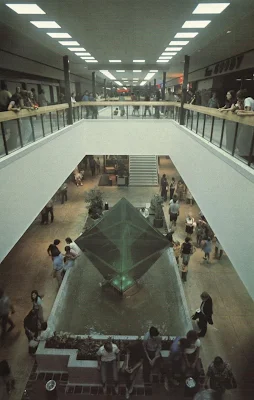
An area along the double-decked shopping concourse includes a provocative water feature.
Photo from R.H. Macy & Company Annual Report 1970

KINGS PLAZA was developed by a joint venture of R.H. Macy and Alexander's. The 4-level Macy's store is seen in the background of this Avenue U view.
Photo from R.H. Macy & Company Annual Report 1970

The snapshot above, and the one that follows, show the interior of the KINGS PLAZA Macy's. The Scene, seen here, sold young ladies' attire.
Photo from R.H. Macy & Company Annual Report 1970

Photo from R.H. Macy & Company Annual Report 1970

An Alexander's department store anchored the south side of KINGS PLAZA. The store was in operation between the mall's September 1970 grand opening and August 1992.
Photo from http://www.flickr.com / "SiteRide"

Photo from https://www.flickr.com / Robert S

The Marina at KINGS PLAZA, a unique feature of the mall. A boat-docking facility had existed at the same location as recently as the mid-1950s...but had been removed by the early 1960s. It was rebuilt, along with the construction of the shopping center, in 1968-1971.
Photo from Wikipedia / Jim Henderson

KINGS PLAZA TENANTS 1989:
MACY'S (with Beauty Salon and restaurant) / ALEXANDER'S (with restaurant) / Accesory Place ladies' wear / Aeropostale apparel / Adler Shoes / Alan's Arts / Albert's hosiery / Athlete's Foot / Attitude ladies' wear / Au Colon ladies' wear / Bakers Shoes / Baldwin Piano & Organ / Barnes & Noble / Baskin-Robbins Ice Cream / Beauty World / Belden Jewelers / Benneton ladies' wear / Bibi Jewelers / Bond's Clothes / Bowery Lighting / Brooks ladies' wear / Bun N Burger / Burger King / Buster Brown Shoes / Butlers Shoes / CVS / Century's Kings Plaza Quad / Chandlers Shoes / Cherry Tree ladies' wear / Cheese Caravan / Christine B ladies' wear / Cohen's Fashion Optical / Complete Athlete / DeJaiz men's wear / Dime Bank / Dime Bank / Docktor Pet Center / Eddie Arcaro's Clubhouse / Electronic Boutique / Everything Yogurt / Fan Club ladies' & children's wear / Five Continents restaurant / Formal Den men's wear / Free Fall men's wear / Fluf N Stuf cards & gifts / Frankels Home Furnishings / G & G Shop ladies' wear / GNC / Giani men's wear / Gilson's Uniforms / Haagen Dazs / Hair House / Hallmark Party Basket / Hallmark Party Tree / Hardy Shoes / Harwyn-Florsheim Shoes / Herman's Sporting Goods / Hodor Dinnetes / Hoffritz Cutlery / Hong Kong Express restaurant / Impulse Jewelry / Innovation luggage / Jarman Shoes / Joyce Leslie ladies' wear / Just Shirts men's wear / Kaufman Carpets / Kay-Bee Toys / Kay Jewelers / Kings Plaza Dental / Kings Plaza Footcare / Lady Madonna ladies' wear / Lane Bryant ladies' wear / Leading Male men's wear / Lechter's housewares / Lerner Shops ladies' wear / Lerner Woman / Malson's Jewelry / Merry Go Round apparel / Michael's Shoes / Moshells Shoes / Moss Twins Photography / Nathan's Famous Hot Dogs / National Shoes / Naturalizer Shoes / No Name ladies' wear / Pants Place Plus ladies' wear / Parklane Hosiery / Pella Cuir apparel / Pine Factory Home Furnishings / Plymouth Shops ladies' wear / Radio Shack / Raphael's men's wear / Red Robin Burger & Spirits Emporium / Regal Shoes / Richfield Clothes men's wear / Riva Photos / Roy Rogers restaurant / Sam Goody Music / Save Mart electronics / Sbarro Italian Eatery / Seaford Marine (outparcel) / Selby Fifth Avenue shoes / Sid's Pants men's wear / Skins ladies' wear / Smitty's ladies' wear / Smoke & Read / Smoke & Read / Star Dust Gifts / Sterling Optical / Stride-Rite Shoes / Stuarts Ladies Ready-to-Wear / The Bakery Plus / The Gap apparel / The Wild Pair shoes / Thom McAn Shoes / Tie City / Undercover Agent ladies' wear / Vincent's Jewelry / Waldenbooks / Wade West Services / Wicks 'n Sticks / Wilson's House of Suede / Xtras ladies' wear / Young Set children's wear
KIOSKS:
Battery One Stop / Cookie House / Hillary's Ice Cream / Kings Plaza Newstand / Piercing Pagoda / Plaza Floral Gardens / Plaza Sweet / Things Remembered / Vitamin Health Center

KINGS PLAZA was given a major makeover between 1999 and 2001. The mall's Main Entrance, seen here, was refurbished as part of the project.
Photo from www.vno.com / Vornado Realty Trust

Photo from www.vno.com / Vornado Realty Trust

The mall's interior was also reconfigured and redecorated. New escalator-stairways, skylights and flooring were installed.
Photo from www.kingsplazaonline.com


Sears' shuttering, in September 2016, freed nearly 300,000 square feet for redevelopment. The 4-level space was divided between new Primark, Zara, J.C. Penney and Burlington stores. Above, we see a rendering of the mall's Flatbush Avenue facade, which was rebuilt to accommodate the new retailers.
Drawing from www.macerich.com / The Macerich Company

As the mall's exterior frontage was being remodeled, the interior was also redecorated. New soft seating was installed.
Drawing from www.macerich.com / The Macerich Company

KINGS PLAZA
Flatbush Avenue and Avenue UNew York, New York (Brooklyn Borough)
New York's first in-city, regional-class shopping mall was developed by a joint venture of R.H. Macy & Company and the John Hancock Mutual Life Insurance Company. The 2-level facility was built on 26 acres, located 22 miles southeast of Times Square, in the Mill Basin section of Brooklyn.
KINGS PLAZA was designed by New York City's Emery Roth & Sons. Ground was broken on July 8, 1968. An official dedication for the 50 million dollar venue was held September 11, 1970, with forty-two stores and services opening their doors. Attending the grand opening were Sebastian Leone (Interim Borough President), Louis J. Lefkowitz (State Attorney General), David Yunich (President of R.H. Macy & Company) and Ruth L. Farkas (Director of Alexander's).
In addition to being New York City's first enclosed, suburban shopping complex, KINGS PLAZA was the city's first combination retail center and marina. The mall, which encompassed 1,078,700 leasable square feet, was anchored by a 4-level (325,000 square foot) Macy's and 4-level (330,000 square foot) Alexander's. By December 1970, the mall housed seventy-nine stores. In December 1971, there were 118.
Charter tenants included Sbarro the Italian Eatery, Chess King, Sam Goody Music, Waldenbooks, Bun 'n Burger, Orange Bowl, Roaman's, Barracini Candy, Zum Zum Deli and the twin-screen Century's Kings Plaza North & South. This venue was quaded in 1983 and reconfigured as a 6-plex in 1995.
Meanwhile, in 1985, R.H. Macy had sold its 50-percent share of KINGS PLAZA to Paramus, New Jersey-based Alexander's, Incorporated. 3 years later, Alexander's established full ownership. The Paramus-based Vornado Realty Trust absorbed the holdings of Alexander's, Incorporated in 1992.
The Alexander's department store was shuttered in August 1992. The empty space was sectioned into three stores. A 4-level (289,200 square foot) Sears opened for business on October 25, 1997. Remaining First Level space was configured as a (16,800 square foot) Modell's Sporting Goods. Second Level space became a (28,100 square foot) Old Navy.
A 50 million dollar, mall-wide face lift got underway in May 1999. Large skylights were installed in court areas. Four obtrusive stairways were removed and replaced by new escalators. Floors were recovered in terrazzo and carpet.
The remodeled KINGS PLAZA, which now housed 130 stores and services, was re-dedicated on January 18, 2001. Its tenant list included Ann Taylor Loft, American Eagle Outfitters, New York & Company and Avenue. Later in the decade, a 1-level (94,000 square foot) Lowe's Home Improvement Center was added to the north end of the mall site. The freestanding store opened for business on July 23, 2010. The 6-plex cinema had been shuttered earlier in the year.
On the level below, an existing H & M was shifted north, taking in space previously leased by Washington Mutual Bank and Payless ShoeSource. Area vacated by the move became the first floor of a new Best Buy, whose second floor occupied the old cinema. The (56,400 square foot) store opened for business in the spring of 2011.
Southern California's Macerich Company bought the shopping hub from the Vornado Realty Trust in October 2012. Within a few years, the mall would lose one of its anchor stores. Sears went dark in September 2016. The vacant space was gutted and reconfigured as four stores; a 3-level, (57,900 square foot), Primark, 2-level Zara, 2-level (75,000 square foot) J.C. Penney and 1-level (52,900 square foot) Burlington.
Primark opened for business on July 7, 2018; J.C. Penney on August 10th. The mall's Flatbush Avenue facade was also rebuilt to accommodate new tenants, while its courts and concourses were refurbished with new elevators, escalators, soft seating areas and lighting. J.C. Penney was short-lived. The KINGS PLAZA store was shuttered on September 27, 2020, after only 2 years of operation. Target assumed the Penney's space and welcomed first customers on August 13, 2023. The new Target included CVS Drug and Starbucks Coffee departments.
Sources:
The New York Times
The New York Daily News
The Patent Trader (Mount Kisco, New York)
http://www.kingsplazaonline.com (website on Internet Archive Wayback Machine)
http://www.kingsplazaonline.com (website on Internet Archive Wayback Machine)
https://www.kingsplazaonline.com
https://www.amny.com
https://www.cinematreasures.org
https://www.macerich.com / The Macerich Company
https://www.cinematreasures.org
https://www.macerich.com / The Macerich Company
"Kings Plaza" article on Wikipedia


The 40 million dollar mall encompassed approximately 840,000 leasable square feet, with 5,000 for-free parking spaces. It was conceived as the first phase of a criss-cross layout complex. This would have had four anchor stores, with one at each end of North, South, East and West wings. Only three wings (and three anchor stores) would ever be built.
Click on image for a larger view
At the far end of the North Wing stood the aforementioned Macy's. The store's mallway entry faced a recessed fountain.
Photo from https://www.silive.com / Staten Island Live

That venerable Chicago-centric chain anchored the South Wing of STATEN ISLAND MALL. This store's mall entry opened onto an octagonal water feature.
Photo from https://www.silive.com / Staten Island Live

Photo from https://www.silive.com / Staten Island Live

During Rouse's 1982 indoor face lift, The Honeycomb (a mall-within-a-mall) was removed. New escalators, flooring and landscaping were put in place.
Graphic from The Rouse Company

An East Wing (in medium gray) was completed in late 1993. Housing forty-one stores, it was anchored by J.C. Penney (who relocated from SHOPPERS TOWN, in the Westerleigh section of the borough). The existing shopping concourse has also been refurbished. With these improvements, STATEN ISLAND MALL covered 1,150,000 leasable square feet and contained 185 store spaces.
Click on image for a larger view

In a circa-2009 layout, we see the Macy's Furniture Gallery (in medium gray). It had opened in 2003. In 2009, a large-scale mall expansion was being considered. A 110,000 square foot lifestyle component was going be built along the west side of the complex. However, The Great Recession, and bankruptcy of General Growth Properties, slammed the brakes on any prospective mall renovation...at least for the time being.

A detail image of the 2009 layout shows locations of sixteen contemporary stores and services.
Click on image for a larger view

In this aerial view from the early 2000s, we see the length and breadth of the tri-anchor complex. It stretches from the Macy's Furniture Gallery (at lower left) over to THE CROSSING freestanding strip plaza (in upper right).
Photo from www.ggp.com / General Growth Properties

BCBGMaxAzria, or "Bon Chic Bon Genre" ("good style, good attitude"). This fashion-forward merchandiser established a STATEN ISLAND MALL store in 2014. It was joined by other high-end boutiques, such as L'Occitane En Provence, Aveda, Soma Intimates and M.A.C. Cosmetics.
Photo from www.ggp.com / General Growth Properties

Ireland's Primark opened several Stateside locations during the late 2010s. A store was dedicated at STATEN ISLAND MALL in early 2017. It occupied 73,000 square feet in the upper level of a downsized Sears.
Photo from www.primark.com / Primark Stores, Limited

EMPIRE OUTLETS, a retail-based development adjacent to the Staten Island Ferry St. George Terminal. News of this up-and-coming shopping venue may have prodded the owner of STATEN ISLAND MALL to go ahead with a long-delayed renovation and expansion of their property.
Drawing from http://www.empireoutletsnyc.com

The first stores in the new expansion opened for business in April 2018, with dedications continuing into 2019. When all construction dust settled, STATEN ISLAND MALL encompassed approximately 1,392,000 leasable square feet, cementing its position as largest suburban-type shopping mall in the five boroughs.
Drawing from www.ggp.com / General Growth Properties

This view of Center Court was taken before the area was reconfigured. During the 2016-2019 expansion, tenants such as Bebe, Cricket Wireless and The Disney Store were shuttered. They were replaced by Zara, It's Sugar and BoxLunch.
Photo from www.brookfieldproperties.com / Brookfield Properties

A circa-2021 layout shows the very latest additions. These include a new Food District, 11,000 square foot Public Plaza, multilevel parking garage, several "first-to-market" retail stores and an 11-plex "dine-in" cinema. There are now 217 tenants in operation at STATEN ISLAND MALL and 6,300 free parking spaces.
Click on image for a larger view
Click on image for a larger view
STATEN ISLAND MALL TENANTS 2021:
MACY'S (with freestanding Furniture & Mattress Gallery) / J.C. PENNEY (with InStyle Beauty Salon, Optical department and Portrait Studio) / LIDL supermarket / PRIMARK / 3D Innovation cards & gifts (kiosk) / Adore Me ladies' wear / Aerie ladies' wear / Aeropostale apparel / Against All Odds / Aim Point / Aldo Shoes / Alluvxx ladies' wear / American Eagle Outfitters / Animal Friends On The Go / Apple Bank / Apple Store / Applebee's Neighborhood Grill & Bar / Archie Jacobson men's wear / Ardene ladies' wear/ AT&T / Auntie Anne's Pretzels (kiosk) / A|X Armani Exchange apparel / BabyGap / Bandstand Watches & Fine Jewelry / Banter / Barnes & Noble Booksellers / Bath & Body Works / Body Jewel (kiosk) / Bonsai Art Gallery / BoxLunch cards & gifts (kiosk) / Brighton Collectibles / Build-A-Bear Workshop / CardTronics (ATM) / Carter's babies & kids / Caviar Mist 3 (kiosk) / Cellairis / Champs Sports / Charley's Philly Steaks (outparcel) / Chase Bank / Chico's ladies' wear / Chipotle Mexican Grill (outparcel) / Cinnabon (kiosk) / Claire's / Clientele men's wear / Club Pilates / Cohen's Fashion Optical / Cosmo cards & gifts / Cotton On apparel / Crocs shoes / Crystal Energy / Custom Apparel Company / Custom Tees (kiosk) / David's Cookies (kiosk) / David's Cookies-Hershey's Ice Cream (kiosk) / Davis Visionworks / Dine-In Staten Island 11 / Dunkin' Donuts / Dynamite ladies' wear / East Meets West cards, accessories & gifts / East Pacific Chinese & Pan Asian Cuisine / Emblem Health / Embroidery Creations / Express ladies' wear / Fast Fix Jewelry & Watch Repairs / Finish Line / Footaction / Foot Locker / Forever 21 young ladies' wear / Foxy Lady ladies' wear / GameStop / GapKids / Garage ladies' wear / Gerald Peter's Gold Mine jewelry / Giorgio's Fine Jewelry / Gloria Jean's Gourmet Coffees / Go! Calendars & Games / Goff Jewelers / Gong Cha (kiosk) / Guess? apparel / H & M apparel / H & R Block / Helzberg Diamonds / Hollister Company apparel / Hot Topic apparel / Icing accessories / It's Sugar snack bar / Jimmy Jazz apparel / Joseph Jacob Jewelers / Journeys Shoes / Kay Jewelers / Kids Foot Locker / Kids Palace / LA7 ladies' wear / Lands' End / Leggings World / LensCrafters / Lids / Lovisa jewelry / Lush cosmetics / Lynda Fajas Columbianis & Spa / M.A.C. cosmetics / Metro Mart / Metro PCS (kiosk) / Michael Kors shoes & accessories / Mikoma / Miniso accessories / Mon Cherie Nail Salon / Newberry Comics / Opinions, Limited / Pandora jewelry / Pepper Palace cards & gifts / Perfect Pictures / Perfume Palace / Perfuroma / Piercing Pagoda (kiosk) / Pink ladies' wear / Polar X cards & gifts (kiosk) / Porch Blitz / Pop It (kiosk) / Quality Life Shoppers / Rack Room Shoes / / Rever / Richmond Relaxation Station salon / Rita's Italian Ice / Robert Wayne Footwear / Rose Valenti Fragrance / Royal Coins & Gold, Incorporated / Rumi cards & gifts / Safety Products (kiosk) / Santander Bank / Sapphire health & beauty aids (kiosk) / Sephora / Shake Shack (outparcel) / Shatter & Case electronics (kiosk) / Shoe Department Encore / Showcase cards & gifts / Skechers shoes / Sleep Number housewares / Socks To Be You / Sofia's Guac Bar (kiosk) / Solstice Sunglass Boutique / Spencer Gifts / Starbucks Coffee / Sterling Optical / Steve Madden shoes / Sugar Bear candy / Sunglass Hut / Superdry Store apparel / Swarovski / T-Mobile / The Body Shop / The Children's Place / The Container Store / The Fix electronics / The Juice Bar / The Lego Store / Things Remembered / Threading Station Spa / Tommy's Tavern + Tap / Torrid young ladies' wear / Toys Toys / Ulta Beauty / Ultimate Fashions apparel / Unisex Hair Design / Urban Planet ladies' wear / Vans Off The Wall apparel / Vegmi Electronics / Verizon Wireless / Victoria's Secret / White Barn Candle Company / White House Black Market ladies' wear / Windsor shoes & accessories / Wu Art Studio (kiosk) / Yankee Candle Company / Zagg protective coverings for electronics / Zales Jewelers / Zara ladies' wear / Zumiez apparel
IN THE FOOD DISTRICT:
Bistro Thai / Burger King hamburgers / Chick-fil-A / Dave & Buster's Grand Sports Cafe / Green Leaf's Grill-Taco Bell-Villa / Master Wok / Melt Shop / Popeye's Louisiana Kitchen / Poukei / Sarku Japan / Taheni Mediterranean Grill
IN THE CROSSING CONVENIENCE CENTER:
A Dollar / Angelina's Kitchen / Carvel Ice Cream / HSBC Bank / Massage Envy / Mon Amiee Nail Salon / Outback Steakhouse / Panera Bread

The new Main Entrance at STATEN ISLAND MALL.
Photo from Wikipedia / "J Dahlia"

Photo from Brookfield Properties
STATEN ISLAND MALL
Richmond and Platinum Avenues
New York, New York (Richmond-Staten Island Borough)
Ground was broken for New York City's second suburban-style shopping mall on October 30, 1970. The 2-level retail hub, developed by the Newark-based Feist & Feist Realty Corporation, was designed by Los Angeles' Welton Becket & Associates. The facility, which encompassed 840,000 leasable square feet, was built on land originally serving as the Staten Island Airfield.
The STATEN ISLAND MALL site encompassed 105 acres, located 25 miles southwest of Times Square. It was in a section of the Borough of Richmond known as New Springville (the Borough of Richmond would morph into the Borough of Staten Island in 1975).
A 3-level (239,500 square foot) Macy's opened -as the mall's first operational tenant- on October 5, 1972. This was the chain's seventh location within New York City proper. A 2-level (190,500 square foot) Sears debuted on March 8, 1973. A mall-wide dedication was held on August 9th. Participating in the festivities were John J. Marchi (New York State Senator) and Robert T. Conner (Borough President).
Charter mall tenants included Waldenbooks, Flagg Brothers Shoes, Lerner Shops, Karmelkorn, Fifth Avenue Cards, Thom McAn Shoes, Parnassus Boutique, Animals & Things pets, Ann's Nut House, A Touch of Elegance Gifts, Goff Jewelers, Spencer Gifts, Bun 'n Burger and a Roaman's junior department store.
Richmond and Platinum Avenues
New York, New York (Richmond-Staten Island Borough)
Ground was broken for New York City's second suburban-style shopping mall on October 30, 1970. The 2-level retail hub, developed by the Newark-based Feist & Feist Realty Corporation, was designed by Los Angeles' Welton Becket & Associates. The facility, which encompassed 840,000 leasable square feet, was built on land originally serving as the Staten Island Airfield.
The STATEN ISLAND MALL site encompassed 105 acres, located 25 miles southwest of Times Square. It was in a section of the Borough of Richmond known as New Springville (the Borough of Richmond would morph into the Borough of Staten Island in 1975).
A 3-level (239,500 square foot) Macy's opened -as the mall's first operational tenant- on October 5, 1972. This was the chain's seventh location within New York City proper. A 2-level (190,500 square foot) Sears debuted on March 8, 1973. A mall-wide dedication was held on August 9th. Participating in the festivities were John J. Marchi (New York State Senator) and Robert T. Conner (Borough President).
Charter mall tenants included Waldenbooks, Flagg Brothers Shoes, Lerner Shops, Karmelkorn, Fifth Avenue Cards, Thom McAn Shoes, Parnassus Boutique, Animals & Things pets, Ann's Nut House, A Touch of Elegance Gifts, Goff Jewelers, Spencer Gifts, Bun 'n Burger and a Roaman's junior department store.
The Honeycomb, a 22-unit mall-within-a-mall, was situated on a sub-level beneath Center Court. It was in operation between April 1974 and the early 1980s. A 313,000 square foot Convenience Center was built in the mall's southeastern periphery. This store strip was also completed in 1974.
Maryland's Rouse Company established an ownership interest in the mall in November 1980. In 1981 and 1982, they performed an interior face lift. Envisaged by the Hellmuth, Obata & Kassabaum (HOK) firm, the renovation included the installation of the 13-bay PicNic Food Court. The mall's Center Court was also refurbished with new escalators, landscaping, a "Dancing Waters" fountain and skylight.
A 50 million dollar expansion got underway in July 1992. The project, designed by Boston's D'Agostino, Izzo & Quirk firm, was conducted in two phases. The first consisted of a renovation of the existing mall. Fountains were removed and replaced with seating areas. Entrances were also rebuilt. Phase II was comprised of a 310,000 square foot addition, which was built on the east side of the center. Among fifty new tenants were Athletic Express, B. Dalton Bookseller, Carlton Cards, Frederick's of Hollywood, Limor Jewelers, Musicland, Victoria's Secret and a Warner Brothers Studio Store.
The new East Wing was officially dedicated on November 5, 1993. Its anchor, a 2-level (180,000 square foot) J.C. Penney, opened on March 2, 1994. STATEN ISLAND MALL now encompassed around 1,150,000 leasable square feet and housed 185 retailers and restaurants. It surpassed Brooklyn's KINGS PLAZA as the largest suburban-style shopping mall within the physical limits of New York City.
Maryland's Rouse Company established an ownership interest in the mall in November 1980. In 1981 and 1982, they performed an interior face lift. Envisaged by the Hellmuth, Obata & Kassabaum (HOK) firm, the renovation included the installation of the 13-bay PicNic Food Court. The mall's Center Court was also refurbished with new escalators, landscaping, a "Dancing Waters" fountain and skylight.
A 50 million dollar expansion got underway in July 1992. The project, designed by Boston's D'Agostino, Izzo & Quirk firm, was conducted in two phases. The first consisted of a renovation of the existing mall. Fountains were removed and replaced with seating areas. Entrances were also rebuilt. Phase II was comprised of a 310,000 square foot addition, which was built on the east side of the center. Among fifty new tenants were Athletic Express, B. Dalton Bookseller, Carlton Cards, Frederick's of Hollywood, Limor Jewelers, Musicland, Victoria's Secret and a Warner Brothers Studio Store.
The new East Wing was officially dedicated on November 5, 1993. Its anchor, a 2-level (180,000 square foot) J.C. Penney, opened on March 2, 1994. STATEN ISLAND MALL now encompassed around 1,150,000 leasable square feet and housed 185 retailers and restaurants. It surpassed Brooklyn's KINGS PLAZA as the largest suburban-style shopping mall within the physical limits of New York City.
By August 2003, the Rouse Company had established full ownership of the center. The next year, the entire Rouse portfolio was bought by Chicago-based General Growth Properties. News of an open-air, lifestyle-type expansion of STATEN ISLAND MALL surfaced in January 2008. This 110,000 square foot addition was to include upscale boutiques and casual dining restaurants, along with a relocation of the existing Food Court. However, The Great Recession and General Growth Properties' 2009-2010 bout with bankruptcy caused plans for the renovation to be temporarily shelved.
For over 40 years, STATEN ISLAND MALL had enjoyed its enviable position as the borough's preeminent shopping center. By the year 2014, this was being placed in jeopardy. News had surfaced about the prospective EMPIRE OUTLETS {6.5 miles northeast, in the St. George section of the borough}. The first phase of this "category-defining retail destination" was to encompass 470,000 square feet and open for business in November 2017.
As a countermeasure, it was announced that the long-delayed expansion of STATEN ISLAND MALL would, at last, be undertaken. The 2 level project would add 242,000 leasable square feet to the existing complex and include a (40,000 square foot) Dave & Buster's Grand Sports Cafe. An indoor-outdoor Streetscape along the west-facing front of the mall would house retail and restaurant space. The existing Food Court would be relocated to a 12-bay Food District. Moreover, a multilevel parking garage would be built at the northwest corner of the complex.
Construction commenced in September 2016. As work was proceeding, a new junior anchor joined the tenant list. Dublin, Ireland's Primark, a high fashion men's, women's and children's clothier, leased a section of the STATEN ISLAND MALL Sears. The downsized (49,400 square foot) Sears occupied half of the lower level of the building. The (73,600 square foot) Primark took in most of the upper floor. The store was inaugurated on March 16, 2017.
The first stores in the mall expansion opened for business in April and May of 2018. These included Zara, Ulta Beauty, Land's End and Tommy's Tavern & Tap. Tenants in the new Food District included Burger King, Melt Shop and Sarku Japan. Two freestanding restaurants, Shake Shack and Chipotle Mexican Grill, were also built as part of the expansion. STATEN ISLAND MALL now encompassed approximately 1,392,000 leasable square feet.
Brookfield Property Partners, based in Hamilton, Bermuda, acquired a share of General Growth Properties in 2016. In August 2018, Brookfield established 100 percent ownership of the corporation. Hence, STATEN ISLAND MALL became part of the Brookfield retail center portfolio.
For over 40 years, STATEN ISLAND MALL had enjoyed its enviable position as the borough's preeminent shopping center. By the year 2014, this was being placed in jeopardy. News had surfaced about the prospective EMPIRE OUTLETS {6.5 miles northeast, in the St. George section of the borough}. The first phase of this "category-defining retail destination" was to encompass 470,000 square feet and open for business in November 2017.
As a countermeasure, it was announced that the long-delayed expansion of STATEN ISLAND MALL would, at last, be undertaken. The 2 level project would add 242,000 leasable square feet to the existing complex and include a (40,000 square foot) Dave & Buster's Grand Sports Cafe. An indoor-outdoor Streetscape along the west-facing front of the mall would house retail and restaurant space. The existing Food Court would be relocated to a 12-bay Food District. Moreover, a multilevel parking garage would be built at the northwest corner of the complex.
Construction commenced in September 2016. As work was proceeding, a new junior anchor joined the tenant list. Dublin, Ireland's Primark, a high fashion men's, women's and children's clothier, leased a section of the STATEN ISLAND MALL Sears. The downsized (49,400 square foot) Sears occupied half of the lower level of the building. The (73,600 square foot) Primark took in most of the upper floor. The store was inaugurated on March 16, 2017.
The first stores in the mall expansion opened for business in April and May of 2018. These included Zara, Ulta Beauty, Land's End and Tommy's Tavern & Tap. Tenants in the new Food District included Burger King, Melt Shop and Sarku Japan. Two freestanding restaurants, Shake Shack and Chipotle Mexican Grill, were also built as part of the expansion. STATEN ISLAND MALL now encompassed approximately 1,392,000 leasable square feet.
Brookfield Property Partners, based in Hamilton, Bermuda, acquired a share of General Growth Properties in 2016. In August 2018, Brookfield established 100 percent ownership of the corporation. Hence, STATEN ISLAND MALL became part of the Brookfield retail center portfolio.
Lower Level space in the downsized Sears was taken by a (37,400 square foot), Neckarsulm, Germany-based Lidl supermarket. It welcomed first shoppers on December 12, 2018. The American Multi-Cinema Dine-In Staten Island 11 was installed in newly-built Upper Level space. The megaplex showed first features on February 7, 2019. Sears closed for good on September 15, 2019, ending nearly 46 years of operation. The freestanding Macy's Furniture & Mattress Gallery was shuttered in March 2025.
Sources:
The New York Times
The New York Daily News
The New York Times
The New York Daily News
http://www.therousecompany.com (website on Internet Archive Wayback Machine)
https://www.ggp.com / General Growth Properties (website on Internet Archive Wayback Machine)
https://www.ggp.com / General Growth Properties (website on Internet Archive Wayback Machine)
http://statenisland-mall.com (website on Internet Archive Wayback Machine)
http://www.silive.com / Staten Island Live
http://www.empireoutletsnyc.com
http://www.empireoutletsnyc.com
https://www.statenislandmall.com
"Staten Island Mall Enlargement Environmental Assessment Statement" / June 2014
https://www.primark.com
"Staten Island Mall Enlargement Environmental Assessment Statement" / June 2014
https://www.primark.com
"Staten Island Mall" article on Wikipedia
Subscribe to:
Posts (Atom)


