Welcome to the largest mall and retail history site on the internet!

Showing posts with label Dayton (Ohio) Malls. Show all posts
Southwestern Ohio's Dayton Mall


The original DAYTON MALL logo, circa-1970.
Graphic from the Edward J. DeBartolo Corporation


The grand entry into the Gem City's gargantuan DAYTON MALL. Going through its glass doors, one came upon two sweeping semicircular stairways that ascended to a Mezzanine Level.


No vintage photos of DAYTON MALL are available, so I created some images from memory. The mall's Center Court had 2 levels and fronted on Rike's. As originally built, DAYTON MALL was a spartan, no-frills structure with few interior embellishments and no natural lighting of any kind. The wavy ceiling treatment, spanning Center Court, was made of strips of paper.


The south-facing facade of Rike's. Two exterior entries brought customers into its Budget Basement Store (which wasn't in a basement). In its original state, Rike's Dayton Mall included The Amber Lantern, an upscale restaurant.


Penneys anchored the west end of the mall between February 1970 and March 1996. In its original state, the store featured a coffee shop restaurant, beauty salon, lawn & garden center and freestanding Penneys Auto Center. 

A DAYTON MALL logo montage is composed of trademarks of seven charter stores and services. These opened for business in 1969 and 1970.
 

DAYTON MALL, circa-1970. To a budding mallophile such as myself, this 1.2 million square foot facility seemed huge. Of course -in the pre-internet age- I was unaware of larger complexes that existed in the 'burbs of Chicago, Denver, San Francisco-Oakland or New York City.

DAYTON MALL TENANTS 1970:

RIKE'S (with Amber Lantern Restaurant, Snack Bar, Budget Basement Store, Beauty Salon and freestanding Tire Center) / J.C. PENNEY (with Coffee Shop, Lawn & Garden Center, Beauty Salon and freestanding Auto Center) / SEARS (with Coffee House and freestanding Auto Center) / LIBERAL supermarket / Baker's Shoes / Baynham Shoes / Bernard's Wigs / Bresler's 33 Flavors Ice Cream / Brijette Fashions / Brooks Fashions / Birkhardts / Burt's Shoes / Butler's Shoes / Camelot Music / Card Cage / Carousel Snack Bar / Cassano Pizza King / Chess King / Craig's ladies' wear / Dayton Mall Cinema (single screen) / Docktor Pet Center / Dolly Madison Beauty Salon / Donenfeld's ladies' wear / Dunhill's men's wear / Fabric Mart Draperies / Fanny Farmer Candies / Firestone Tire & Appliance / First National Bank / Fitzharris Shoes / Florsheim Shoes / Forum Cafeteria / Foxmoor Casuals / Frederick's of Hollywood / Gallery Three / Ganz Custom Furriers / Gem City Savings / Giddings-Jenny / Gray Drug / Hanover Shoes / Harolde's sportswear / Harris' Beautiful Shoes / Hickory Farms of Ohio / Hobby Center Toys / Hot Sam Pretzels / House of Nine ladies' wear / J.G. McCrory 5 & 10 (with restaurant, snack bar & cafeteria) / Jaccard Jewelers / Joan Bari / Jo-Ann Fabrics / Kinney Shoes / Lane Bryant / Lerner Shops / Leroy's Keepsake Diamonds / London Bobby Fish & Chips / Marshalls Fashions / Mary Jane Shoes / Mayor Jewelers / Mayor Records / Merle Norman Cosmetic Studio / Miles Shoes / Miscellaneous, Incorporated / Mobil Shoes / National Shirt Shops / Parklane Hosiery / Partycard / Regal Shoes / Richman Brothers men's wear / Russell Stover Candies / Schiff Shoes / Spencer Gifts / Thal's ladies' wear / The Children's Photographer / The Fatted Calf restaurant / The Golden Razor barber shop / The Limited / The Metropolitan apparel / The Tie Bar / Thom McAn Shoes / Tobacco Village / Waldenbooks / Walker's men's wear / Wicker World 


The mall's second level Mezzanine, as it was configured during the early years. The area fronting on Rike's, and overlooking Center Court, was a dark, empty dead zone for several years. It would be utilized as a Food Court in 1984.


In the early 1970s, an urban legend circulated saying that reputed psychic Jeane Dixon had predicted that DAYTON MALL was going to come tumbling down. Of course, it never did. I have read that the same "prediction" was made for Georgia's CUMBERLAND MALL, North Carolina's FOUR SEASONS MALL and Tennessee's 100 OAKS MALL.
Photo from Wikipedia / http://paranormal-corner.blogspot.com


The very first renovation of DAYTON MALL was completed in October 1984. Shopping concourses were re-floored, fountains removed or replaced and an upper floor Food Court built. A glass-enclosed elevator was also installed in Center Court.  
Drawing from the JMB Property Management Corporation


In late 1984, the mall has just emerged from its first renovation. Interior spaces have been altered considerably. Liberal Markets pulled up stakes in January 1979, with its vacant store being divided 5-ways. McCrory's was downsized and sub-divided in 1982 (the store would close in 1991). The Metropolitan was shuttered in August 1983 and sectioned 7-ways.

The mall was given another makeover in the mid-1990s. Penney's relocated from the west end of the mall into a newly-built store at front center. On the periphery of DAYTON MALL, the grand Southland 75, a cool, Mid-Century Modern drive-in, had been bulldozed. The land became too valuable to "waste" as a lowly outdoor movie theater.


After J.C. Penney moved out of the west anchor store, McAplin's moved in. This store was rebranded by Elder-Beerman in July 1998. It is ironic that this chain ever operated in DAYTON MALL. In 1968, Elder-Beerman (then Dayton-based) was blocked -by Federated Stores and Edward J. Debartolo- from being included as a mall anchor. 
 

A circa-2005 aerial, with a section of Elder-Beerman in the upper right. The mall's northwest parking area has been excavated in preparation for a new lifestyle addition.
Photo from www.glimcher.com / Glimcher Realty Trust


A bird's-eye view of the new VILLAGE AT DAYTON MALL lifestyle center. Charter stores opened between September 2006 and December 2007.
Photo from www.glimcher.com / Glimcher Realty Trust

In a circa-2008 layout, the VILLAGE AT DAYTON MALL is shown in light gray. Its construction included new (freestanding) P.F. Chang's China Bistro and Jared The Galleria of Jewelry stores. The mall, excluding its outparcel VILLAGE, now spanned approximately 1,352,600 leasable square feet.


Ann Taylor Loft was a charter VILLAGE AT DAYTON MALL tenant. The store was in operation between October 2006 and January 2009.
Photo from www.glimcher.com / Glimcher Realty Trust


Bravo! Cucina Italiana was another original VILLAGE AT DAYTON MALL store.
Photo from www.glimcher.com / Glimcher Realty Trust


Borders Books was located in an extension of space that had been occupied by The Metropolitan (a large apparel store) in the 1970 mall. The bookstore and cafe were shuttered in April 2011.
Photo from www.glimcher.com / Glimcher Realty Trust

Abercrombie & Fitch occupied space that was part of a large Donenfeld's apparel store in the 1970 mall.
Photo from www.glimcher.com / Glimcher Realty Trust


In this view, we see the center anchor and a bit of the mall's Atrium area. This store, originally the Rike's depicted above, had stints as Shillito Rikes, Lazarus and Lazarus-Macy's before receiving a Macy's nameplate, in March 2005.
Photo from https://www.flickr.com / "GameKing3"  


Sears was a fixture on the east end of DAYTON MALL for several years. The mall's final original store, it opened in September 1970 and closed for good in November 2018.
Photo from https://www.flickr.com / "GameKing3"  


As stated, J.C. Penney has operated out of two different DAYTON MALL buildings over the years. The second store, seen here, was built in front of the original mall's Main Entrance.
Photo from https://www.flickr.com / "GameKing3"  


This second store welcomed first shoppers in March 1996.
Photo from https://www.flickr.com / "GameKing3"  

In a contemporary aerial view, J.C. Penney is at front center. Sears would have been on the left.
Photo from http://washingtonprime.com / Washington Prime Group


In December 2015, a 2.2 square mile area of retail stores surrounding (and including) DAYTON MALL was officially designated as the Miami Crossing District.
Graphic from http://miamicrossingdistrict.com 


In September 2020, DAYTON MALL achieved its 50th year in business. At this time, it is saddled with vacant anchors on its east and west ends. In spite of this, the 1,442,600 square foot buying behemoth houses over 170 stores and services.

DAYTON MALL
Miamisburg-Centerville Road and Dayton-Springboro Pike
Montgomery County, Ohio

News of a major south Dayton shopping mall began to surface in August 1967. The complex would be built on a 102-acre site, located 8 miles south of downtown Dayton, in an unincorporated section of Montgomery County known as Miami Township. The land parcel was situated at the intersection of State Routes 725 and 741 and was adjacent to the Interstate 75 expressway.

Construction commenced on the DAYTON MALL project in September 1968. The complex, which was to encompass 1,270,000 leasable square feet, was developed by Youngstown, Ohio's Edward J. DeBartolo Corporation. Plans were drawn by the firm of Lorenz-Williams-Williams-Lively & Likens. Promoted as the "biggest enclosed mall in the Midwest," the shopping hub had a center section, with an upper level Mezzanine. Two single-level concourses extended toward the east and west, with a fountain situated at the center point of each.

Stores at DAYTON MALL opened in several stages. A 2-level (182,000 square foot), Dayton-based Rike's was dedicated on September 22, 1969. Cassano Pizza King, Hickory Farms of Ohio and The First National Bank were in business by December 1969. The single-screen Chakeres Dayton Mall Cinema showed its first feature on December 25th.

A 2-level (250,000 square foot) J.C. Penney opened its doors on February 11, 1970, with a 2-level (185,000 square foot) Sears dedicated on September 2nd. The Sears store had 2 levels, but only the main mall level was used for retail. A basement housed corporate offices. 

In March 1970, a Preview Opening for the mall was held. Twenty-five stores were up and running. A Formal Opening got underway on September 24th, with a total of 106 operational stores. When fully leased, the 18 million dollar complex contained 118.

Charter tenants included Chess King, Thal's ["thallz"] ladies' wear, Donenfeld's ladies' wear, Mayor's Jewelry & Records, Hot Sam Pretzels, Docktor Pet Center, Leroy's Keepsake Diamonds and Camelot Music. There were also a (20,400 square foot) Liberal supermarket, (60,000 square foot) J.G. McCrory 5 & 10 and (37,500 square foot) Metropolitan apparel.

Stores in the upper floor Mezzanine began opening on July 6, 1970. When fully-tenanted, the area housed twenty retail spaces. These were leased by Wicker World, Maternity Modes, Town & Country, Card Cage, Brendamour's Sporting Goods and Cassano's Commodore restaurant & Lounge.

The Southland 75 Drive-in, located directly west of DAYTON MALL on State Route 741, had opened July 13, 1964. At the time, the theater had the largest outdoor screen in the Buckeye State. It was twin-screened in the early 1980s, closed for good on July 13, 1986, and was bulldozed soon after. The Southland 75 was replaced by the fifteen-store SOUTHLAND 75 SHOPPING CENTER.

Three mini-cinemas were installed on the DAYTON MALL Mezzanine. Cinema 2 showed a first feature on August 4, 1972Cinema 3 and Cinema 4 opened on October 6, 1976. The McCrory 5 & 10, on the East Wing of the mall, was downsized. Cinemas 5-8, installed in former McCrory space, were officially dedicated on July 30, 1982.

Meanwhile, the Liberal supermarket was shuttered on January 20, 1979. Ownership of the mall changed soon after. The DeBartolo Corporation sold the complex to Chicago's JMB Property Management Corporation in January 1983. JMB announced plans for a 6 million dollar face lift in April 1984. 

As part of the project, new terra cotta tile was placed over original terrazzo flooring. A Food Court was built in unused space on the Mezzanine. Moreover, Center Court was refurbished with a glass elevator, reflecting pool and soft seating area. In other sections of the mall, new stairs, ceilings and skylights were installed. Lastly, mall entrances adjacent to Sears and Penney's were closed off, with new retail space created. The revitalized mall was re-dedicated on October 26, 1984.

Federated Department Stores had merged their Shillito's and Rike's divisions in April 1982, with Shillito-Rike's nameplates being installed on stores in June. Further consolidation merged Federated's Shillito-Rike's and Columbus-based Lazarus divisions. This merger was announced in January 1986, with Shillito-Rike's units being Lazarus-branded in March. Stores morphed into Lazarus-Macy's in August 2003 and became bona fide Macy's on March 6, 2005.

Meanwhile, a second renovation of DAYTON MALL was underway by the mid-1990s. This 20 million dollar endeavor was done to keep the center competitive with the new MALL AT FAIRFIELD COMMONS (1993) {12.4 miles northeast, in Beavercreek}. A third floor was added to the DAYTON MALL Lazarus. Now encompassing 253,000 square feet, the expanded store held its grand re-opening on January 14, 1994. 

Sears' (35,000 square foot) lower level became an additional sales floor. When the store reconfiguration was completed, Sears encompassed 224,000 square feet. J.C. Penney moved into a new 2-level (179,000 square foot) unit. This was built in front of what had been the mall's Main Entrance. The new Penney's was dedicated on March 6, 1996. The original store, at the end of the West Wing, re-opened as a Cincinnati-based McAlpin's on October 30, 1996.

During the mid-'90s renovation, shopping concourses were refurbished, using a garden motif. New flooring, trellises, park benches, landscaping and a bird bath fountain were installed. Tenants such as Eddie Bauer, Pacific Sunwear, Men's Wearhouse and Rogers Jewelers were brought into the mall. Likewise, the Upper Level Food Court was doubled in size. New vendors included Bagel Cafe, Subway, Sweet Factory, Great Burger & Potato Company and Frullatli.

A revitalized DAYTON MALL was officially dedicated during a 3-day grand opening celebration. This commenced on November 3, 1995. The complex now encompassed approximately 1,221,900 leasable square feet and contained 160 stores and services under its roof. The Columbus-based Glimcher Realty Trust acquired DAYTON MALL in April 1997. McAlpin's was rebranded as a Dayton-based Elder-Beerman in July 1998.

By the early 21st century, several shopping complexes in the DAYTON MALL trade area were in decline. SALEM MALL, Middletown's CITY CENTRE MART and Franklin Township's TOWNE MALL were virtually vacant, or had been demolished all together. DAYTON MALL had to strive to keep a competitive edge. The latest thing in retail was trendy, upscale and open-air; this exemplified by THE GREENE TOWN CENTER {7.3 miles northeast, also in Beavercreek}, which opened in August 2006. News of this complex initiated plans for a open-air "lifestyle component" to be added to DAYTON MALL.

In June 2005, Glimcher initiated construction on the 20 million dollar (90,000 square foot) VILLAGE AT DAYTON MALL. This complex was built in the northwest parking area, along State Route 725. It was to add twenty-five tenants to the mall's retail roster.

Bravo! Cucina Italiana served first meals on September 22, 2006. Ann Taylor Loft began business on October 3rd. As the VILLAGE was built, the north-facing facade of DAYTON MALL was remodeled and enlarged. A new Borders Books was created, which opened in May 2006. The grand opening of this store was followed by one for Orvis Sporting Trends, which was dedicated in November of the same year.

The mall and its peripheral open-air VILLAGE now housed 184 tenant spaces. The shuttering of Borders Books, in early 2011, created a vacancy that was filled when DSW, in the mall's East Wing, closed and moved. The new store held its grand opening on February 23, 2012. With the old DSW space now vacant, plans were finalized for a new Dick's Sporting Goods. The old DSW, and an adjacent space previously occupied by FYE, were expanded by an additional 19,000 square feet. The (50,000 square foot) Dick's opened for business on November 7, 2012.

DAYTON MALL and VILLAGE AT DAYTON MALL now encompassed around 1,442,600 leasable square feet. By this time, another potential competitor had come on the scene. AUSTIN LANDING {2 miles southwest, in Montgomery County} was an open-air, mixed-use complex. Segments of its retail component opened for business between 2011 and 2014.

Indiana's Simon Property Group created a spin-off Real Estate Investment Trust in May 2014. Known as the Washington Prime Group, it merged with the Glimcher Realty Trust in early 2015. As a result, DAYTON MALL was brought under the ownership and management of the Columbus, Ohio-based Washington Prime Group.

The mall lost one of its four anchors on August 29, 2018. Elder-Beerman, an operative of the Bon Ton Stores conglomerate since 2003, shuttered its 20-year-old DAYTON MALL store. Soon after, another anchor went dark. 
 
Sears closed for good on November 25, 2018. The abandoned building was repurposed as the Crossroads Church, which housed a 1,500-seat auditorium and day care center. A grand opening was held on April 20, 2025. The Hull Property Group, headquartered in Augusta, Georgia, bought DAYTON MALL in  October 2025.
 
Sources:

The Journal Herald (Dayton, Ohio)
Personal recollection of the author
http://www.daytonmall.org  (website on Internet Archive Wayback Machine)
https://www.daytonmall.com
https://www.cinematour.com
https://www.cinematreasures.org
http://www.glimcher.com / Glimcher Realty Trust (website on Internet Archive Wayback Machine)
http://www.whio.com / WHIO-TV
http://www.fds.com / Federated Department Stores
http://www.thegreene.com
https://www.daytondailynews.com
http://www.daytonhistorybooks.citymax.com
https://www.hullpg.com / Hull Property Group

DAYTON MALL MUSINGS:

My fascination with shopping malls began in the late "classic mall era," when I was still living in southwestern Ohio (between Dayton and Cincinnati). Until 1969, I had never visited an enclosed shopping mall. At this time, I was a wide-eyed kid, infatuated with drawing house plans, building plans and structural renderings. I didn't have a clue about shopping meccas in the nearby "big city."

This all changed when -in 1969- my stepfather took me on an insider tour of the site where he had been doing electrical wiring over the past year. When I first visited DAYTON MALL, construction was about three-quarters complete. The Rike's department store was ready to open. As I recall, it was a stipulation of Federated Stores, that their Rike's was to be the first store opened in the mall. Rike's originally had 2 levels. It was larger than its sibling shopping center store, which had opened, on Salem Avenue, 6 years before.  

What I recall most about the DAYTON MALL Rike's was the optical illusion-design carpeting in the men's clothing section. It could made you dizzy if you stared at its patterns while walking through the department, lol.

In keeping with the times, the DAYTON MALL Rike's was a full-service department store. There was a snack bar on the first level, and electronic / tv department on the second. This was back in "the day," before big box stores cornered the electronics / tv marketplace, and made such a retail section in a mid-tier department store obsolete.

I also recall venturing to (what would be) the DAYTON MALL Sears. The store was still under construction and didn't -yet- have walls. It wouldn't be opening for nearly a year. 

The mall's three shopping concourses converged upon a 2-story Atrium, in front of Rike's. Upon my first visit to "The Mall," workmen were polishing new terrazzo floors. The huge ceiling fixture above had been completely installed. It extended the length and breadth of the area and was made of strips of PAPER (I don't know if many people visiting the original DAYTON MALL were aware of this).

In fact, the mall, as it was opened in 1969 and '70, was built in a very spartan fashion. There were no skylights anywhere. There were two rather basic, no frills, fountains at the midpoint of the East and West Wings, with no water feature in the Atrium.

It was as if the builders of the original mall wanted it to be BIG....really BIG. In order to do this, corners were apparently cut, in regard to architectural embellishment of the interior spaces. In 1970, the major feature of the brand-new DAYTON MALL was its physical SIZE. With nearly 120 stores, and over 1 million leasable square feet, it was larger than any of the malls that existed in the suburbs of Cincinnati or Dayton.

Although interiors were rather sterile and plain, the Main Entrance at DAYTON MALL was built on a grand scale. It was an imposing, 2-story edifice, something like a '70s Mod southern mansion. There was a sheet of glass across the entire front of the 2-level entry corridor, behind a stand of pillars. 

Upon entering through the main doors, one stood in a 2-story concourse. There was a hallway going off to the right, with a Liberal supermarket at its end. Looking ahead, there were two, sweeping, semi-circular stairways; one on either side of the mallway. Stores on this first level included Cassano Pizza King, Docktor Pet Center, Hot Sam Pretzels and Chess King (what major shopping mall in 1970 didn't have one?).

At the end of the entry concourse was the 2-level Atrium and an imposing, brick and stone, Rike's storefront. On the Upper Level Mezzanine were lots of stores, but I can only recall a coin shop. The area in front of Rike's was a dark, dead zone. There was floor space enough for all sorts of kiosk-type retailers.......but, in 1970, such a "specialty leasing" concept was not being utilized.

Going off to the right of the Atrium, on the Lower Level, was the West Wing, which included the (single-screen) Dayton Mall Cinema. Farther on was a large Metropolitan apparel store, with a Spencer Gifts across the mall. At the end of the West Wing was a 2-level J.C. Penney.

The East Wing extended from the other end of the Atrium. Along its length were a Donenfeld's apparel store, McCrory 5 & 10, Hickory Farms of Ohio and -my favorite store out of the other 115- Camelot Music. Walking into this store in 1970, one would find no compact discs and no home video. The first major home video format, VHS (video home system), would come on the market 7 years later. Compact discs were not to be seen for another 7 years.

Camelot Music had lots of LP record albums (selling for around 5 to 6 dollars each). 45 rpm singles were going for 79 cents. One would also have seen several cases filled with 8-track cartridge tapes and pre-recorded cassettes.

Walking out of Camelot, and heading farther east in the mall, one would eventually come to Sears, which sat at the end of the East Wing. At this time, the retail area of this store had only 1 level. There was a basement (which had frontage on a lower level parking lot), but this was used as office space until the mid-'90s.

DAYTON MALL 2000 +

As one might expect, a trip to the DAYTON MALL in the new millennium would reveal quite a different shopping center. The blandly-built interior spaces were spruced up in the mid-1980s and (again) in 1994-1995, with a glass elevator installed in the Atrium area.

A 14-bay Food Court was built in the empty Upper Level Mezzanine "dead zone." Of course, the Rike's store no longer goes by that name. After going through two nameplate changes, it was rebranded by Macy's" on March 6, 2005.

J.C. Penney, once at the end of the West Wing, moved into a brand new store. This was built in front of the original Main Entrance in 1995-1996. The previous Penney's became a McAlpin's and then operated, as an Elder-Beerman, for 20 years. The original cinema folded in 2001. With the shuttering of Sears, in late 2018, no original mall stores remain.  
Southwestern Ohio's Salem Mall


The "very '60s" SALEM MALL logo.
Graphic from the Community Research & Development Corporation

Rike's Salem was the second branch in the Dayton-based chain. It was completed, in the summer of 1963, as a freestanding unit. SALEM MALL was eventually added to the store's east-facing wall.
Drawing from Federated Department Stores, Incorporated


The Metropolitan, another Dayton-based mercantile, had a large SALEM MALL store.
Drawing from The Metropolitan


Here we see the mall's North Arcade and Liberal supermarket mallway entrance.
Drawing from the Community Research & Development Corporation

The shiny-new SALEM MALL, as it stood in 1966. It housed sixty stores and services. At the center of the center was a tropical Garden Court with fountain. Lush foliage was a standard fixture of early James Rouse Company malls. A single-screen cinema was an imposing feature at the front of the complex.

SALEM MALL TENANTS 1966:

RIKE'S (with Snack Bar, beauty salon and freestanding Tire Center) / SEARS (with Coffee House and attached Auto Center) / THE METROPOLITAN / LIBERAL supermarket / A Shop Called East / Baker's Shoes / Barricini Candies / Baynham's Shoes / Brook's Fashions / Cassano Pizza King / Custom Electronics / Donenfeld's / Gem City Savings Association / Hickory Farms of Ohio / Hot Shoppes Cafeteria / Household Finance Corporation / La Petit Cafe / Lerner Shops / Lowe Brothers / Mary Lester Fabrics / Maternity Modes / Maud Muller Candies / Mayor's Jewelry / Ned Karns Beauty Salon / Nobil Shoes / Parklane Hosiery / Salem Mall Cinema (single screen) / Singer Sewing Center / Spencer Gifts / The Bombay Shop / The Card Mart / The Four Bees / The Limited / Thrift Drugs / Treasure Chest / Vicki's Uniform Center / Waldenbooks / Walker's men's wear / Winters National Bank   

A 2-level North Wing (in medium gray) was added to SALEM MALL in 1981, which included a new J.C. Penney. The west anchor, originally a Rike's, was also enlarged and rebranded. Picnic, a second food court, was installed in the center of the complex in 1985. With these modifications, the facility encompassed approximately 858,000 leasable square feet, housed 124 stores, and maintained free parking for 4,600 autos.


Shillito's and Rike's stores were merged in April 1982 and rebranded in June. The original logo read "Shillito/Rike's." In a newer trademark, the backslash and apostrophe have been omitted. The SALEM MALL store received a Lazarus nameplate in March 1986.
Graphics from Federated Department Stores


The shopping hub entered a downward spiral in the mid-1990s. There had been over 120 stores and services in 1985. By 1998, this number had dwindled to eighty-five.
Graphic from CIGNA Investments


Lazarus closed for good in 1998. In 2001, the abandoned store was demolished and replaced by a "shadow anchor" Home Depot. This store, built with hopes that it would incite a retail revival, failed to stop the mall's decline.
Original drawing from http://www.therousecompany.com (website on the Internet Archive Wayback Machine)

Above and below are views of the 2-level North Wing, which was added to the original 1-level mall in 1980-'81.
Photo from Wikipedia / Dave Lansing


The mall had been shuttered by the time these photos were taken. It sits abandoned and awaiting a wrecking ball renovation. This got underway in May 2005.
Photo from Wikipedia / Dave Lansing


The SALEM MALL Sears survived the demolition of the shopping center in 2005 but ended up being shuttered in January 2014. The building, a fine example of Mid-Century Modern architecture, has not been structurally compromised by renovation. It was officially listed on the National Register of Historic Places in September 2023.
Photo from https://www.ohiohistory.org

THE LANDMARK lifestyle center was supposed to have replaced SALEM MALL. The shopping center was demolished -except for Sears- in 2005. The LANDMARK redevelopment was proposed at this time, but had been abandoned by 2010. A 2011 prospectus, for a TECH CONNECTION BUSINESS PARK, met the same fate.
Drawing from Trotwood Chamber of Commerce

SALEM MALL
Salem Avenue and Shiloh Springs Road
Montgomery County (Trotwood), Ohio

Greater Dayton's first mall-type shopping complexes were open-air in format. HILLS & DALES CENTER {in Kettering} and FOREST PARK PLAZA {in unincorporated Montgomery County} both opened for business in 1960.

SALEM MALL was the area's first fully-enclosed shopping center. It was situated on a 51-acre parcel, located 6 miles northwest of downtown Dayton. The complex, designed by Lorenz & Williams, was built by Maryland's James W. Rouse Company under the auspices of the Community Research & Development Corporation.

The mall was added to a freestanding, Dayton-based Rike's, which had opened for business on August 22, 1963. The original store encompassed 1 level and approximately 115,000 square feet. Later, a sixty-store mall was completed, which was anchored by Rike's and a 2-level (121,700 square foot) Sears.

A formal grand opening commenced on October 26, 1966, when fifty stores opened their doors. Major inline tenants were a (12,000 square foot) Donenfeld's, (12,000 square foot) Liberal supermarket and (43,000 square foot) Metropolitan. Charter inline stores included A Shop Called East, Spencer Gifts, Mayor's Jewelers, a Hot Shoppes Cafeteria and Cassano Pizza King. The Mid-States Theaters Salem Mall Cinema showed its first feature on November 23, 1966.

The mall was basically a cross shape, with four arcades converging on a tropical Center Court and water feature. In its original state, Southwestern Ohio's "complete shopping city" spanned approximately 520,000 leasable square feet.

SALEM MALL was located in an unincorporated section of Montgomery County known as Madison Township. In May 1969, the Village of Trotwood annexed it. Over the ensuing years, the City of Dayton made several unsuccessful attempts to annex the shopping center, which, at the time, was the second-largest in the region. A second Greater Dayton shopping mall was developed by the Edward J. DeBartolo Corporation. DAYTON MALL {19.5 miles south, in unincorporated Montgomery County} was officially dedicated in 1970.

A 15 million dollar renovation of SALEM MALL commenced in April 1980 and was finished in August 1981. The project added a 2-level North Wing concourse that extended from the center of the existing complex to a 2-level (167,200 square foot) J.C Penney.

This store was dedicated on August 12, 1981. Fifty-eight new inline stores opened and Rike's had been expanded to 196,500 square feet. A 9-bay Upper Gallery Food Court enticed shoppers. 3 years later, The Metropolitan was shuttered. The space was refashioned into Picnic, a 20-bay food court. Its vendors opened on February 28, 1985. 

Following this 4 million dollar renovation, SALEM MALL encompassed approximately 858,000 leasable square feet and contained 124 stores and services. The mall thrived for several years after the remodeling. However, by 1994, its image was being tarnished by reports of alleged kidnappings, shootings and gangland brawls. The completion of a new competitor only exacerbated the situation. MALL AT FAIRFIELD COMMONS {12.2 miles southeast, in Beavercreek} was dedicated in October 1993.

The Rouse Company announced plans for a fourth anchor store in June 1994, but this new McAlpin's would never be built. In the meantime, Sears performed a 4 million dollar store renovation and expansion. When rededicated on November 5, 1994, the SALEM MALL Sears encompassed 139,700 square feet.

By 1997, SALEM MALL was on life support. There were twenty-one vacant tenant spaces. To add insult to injury, J.C. Penney closed for good on December 27, 1997. Lazarus went dark in January 1998. The Rouse Company defaulted on their mall loan in May. The lender, the Philadelphia-based CIGNA Corporation, assumed ownership of the struggling shopping center under the auspices of CIGNA Investments, a retail-based subsidiary. Iowa's General Growth Management, Incorporated was hired to manage the property.

The mall's decline gained momentum. By late 2000, the lower level of the north concourse -and the west concourse- had been closed off. This left fifty stores in the upper level of the north concourse -and stores in the east concourse- still in business. A California-based consulting firm recommended that the moribund mall be redeveloped as an open-air power center. The vacant Lazarus was sold to Atlanta's Home Depot chain in September 2000. The abandoned Lazarus was demolished. A 1-level (134,000 square foot) Home Depot, built as a "shadow anchor," opened on April 28, 2001.   

Meanwhile, the New York City-based R.E. Management Company acquired the mall in December 2000. A name change, rebranding SALEM MALL as RENAISSANCE PLAZA, was proposed in March 2001, but never carried out. A face lift refurbishment was also proposed. This project was eventually abandoned. By April 2002, the complex contained just twenty-two operational stores. 

SALEM MALL changed hands in October 2004, when the City of Trotwood purchased the property. Another name change -to NEW TOWN CENTER- was proposed and eventually abandoned. The past-its-prime property was shuttered in November 2004, with demolition commencing in May 2005.

Sears was all that remained. It, and Home Depot, were to be incorporated into THE LANDMARK, an open-air, lifestyle center. This would include shoppes, a 14-screen multiplex, offices, housing units, a public library, higher education branch campus and new city hall for Trotwood. THE LANDMARK was originally scheduled for completion in 2008. However, budget problems with the City of Trotwood, and The Great Recession, delayed the start of construction.

A financial scandal related to the LANDMARK deal caused the resignation of Trotwood Mayor Darreyl Davis in February 2010. By 2011, a new prospectus for a TECH CONNECTION BUSINESS PARK had been drawn up. Unfortunately, this plan would also be abandoned. In January 2014, Sears shuttered their 47-year-old store.  

Sources:

The Dayton Daily News
The Journal Herald (Dayton, Ohio)
http://departmentstoremuseum.blogspot.com
http://www.therousecompany.com (website on Internet Archive Wayback Machine)
http://www.trotwood.org
http://www.urbanohio.com
https://www.cinematreasures.org
https://www.cinematour.com
Southwestern Ohio's Hills & Dales Center


Greater Dayton's first mall-type shopping complex was built in the city's southern hinterlands. The original strip center had four partly-enclosed Arcades. A long shopping concourse faced an open parking area.
Drawing from Columbia Building Company  

Like many a mid-century mall, HILLS & DALES CENTER was anchored by two supermarkets. A Dayton-based Liberal, depicted above, sat on its north end. A Cincinnati-based Kroger presided over the south.


At the time of a circa-1960 plan, HILLS & DALES CENTER is anchored by the aforementioned grocery stores. The largest space in the mall belongs to G.C. Murphy. The shopping complex, formally opened in June 1960, spanned around 260,000 leasable square feet and contained twenty-six stores and services. Free parking was provided for 2,500 autos.

HILLS & DALES CENTER TENANTS 1960:

G.C. MURPHY 5 & 10 (with Modern Snack Bar) / KROGER supermarket (with Custom Bakery and Delicatessen)  / LIBERAL supermarket / Adeline Shops ladies' wear / Cale's Book Shop / Cheerheart Cleaners / Easy Wash Laundry / Kiddie Land apparel / Gray Drug (with luncheonette) / Hills & Dales Beauty Shop / Hills & Dales Jewelers / Jim Flynn's, Incorporated sporting goods / Jon's Ice Cream Parlour / King Korn Stamps Redemption Center / Kirk's Gift Shop / Mann's Barber Shop / Maud Muller Candies / Music Land / Nobil Shoes / Orientally Yours Gifts / People's Bank & Trust / Porter Shoe Repair / Schiff's Shoes / Sherwin-Williams Paints / Singer Sewing Center / Top Value Stamps Redemption Center

LOWER LEVEL TENANTS:
Dayton Public Library / San Snead School of Golf 

The Gem City's second shopping mall was built north of downtown. FOREST PARK PLAZA, and its J.C. Penney, began business in November 1960.
Drawing from Forest Park Development Company


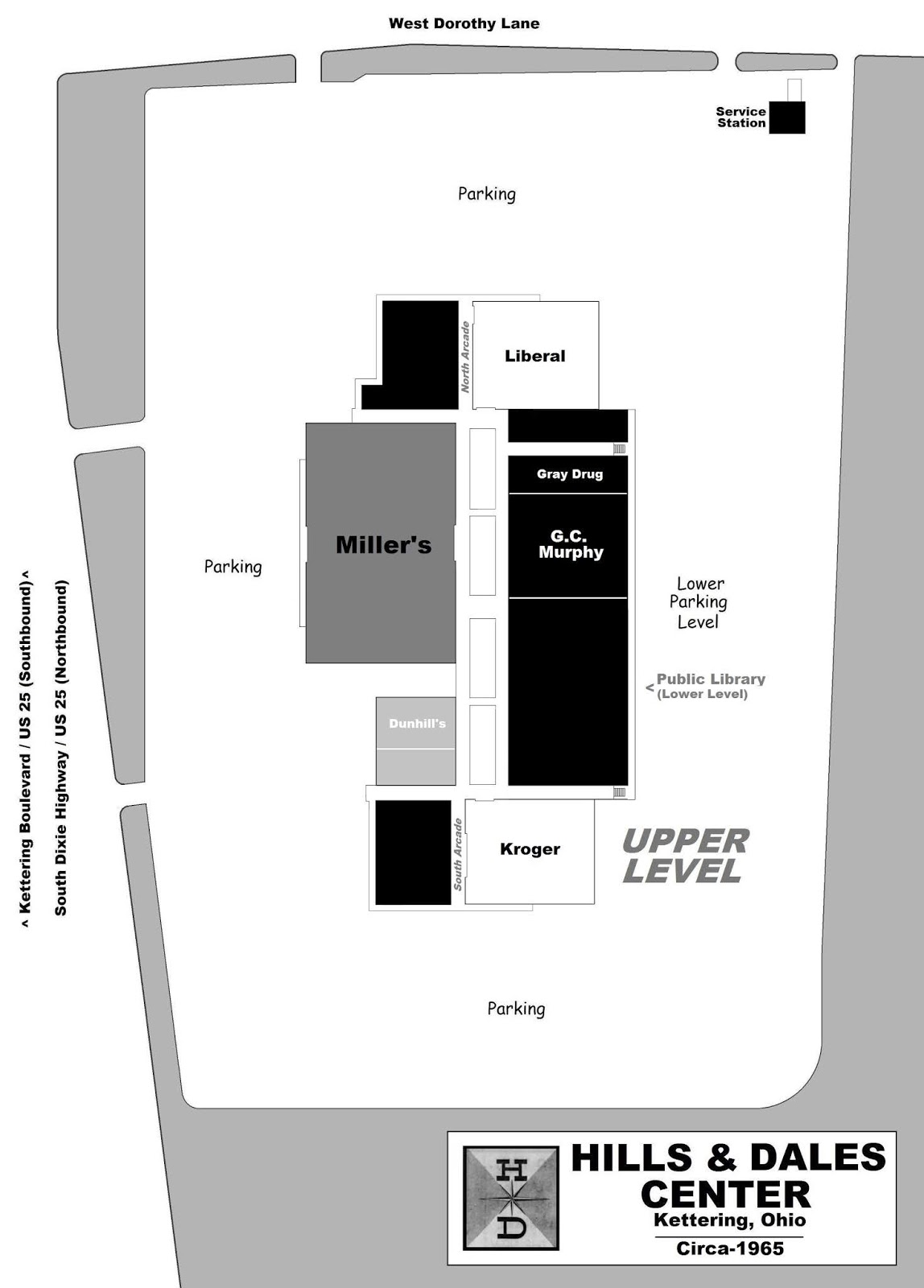
To remain competitive, the Kettering complex was expanded on two occasions. The first project (in medium gray) added a Miller's discount mart. In 1965, a small block of stores (light gray) was completed. HILLS & DALES CENTER now encompassed approximately 267,300 leasable square feet.


A HILLS & DALES logo montage shows stores operating in -or around- the mall during the 1970s.

Competition from South Side shopping centers, such as TOWN & COUNTRY and DAYTON MALL, had put the hurt on HILLS & DALES by the late 1970s. Big-name stores pulled up stakes. What eventually remained was a run down, virtually abandoned hulk. The past-its-prime property was knocked down in late 1999.
Photo from https://docs.google.com


A freestanding Ponderosa Steakhouse, in the northwest corner of the mall site, was renovated into a bank branch in late 1997. 
Photo from Montgomery County, Ohio


One of twelve freestanding structures that make up today's Governor's Place. The office park was built on the old HILLS &  DALES CENTER site in the early 2000s.
Photo from www.loopnet.com