Wednesday, April 15, 2009

Hawaii's Ala Moana Center


The first shopping mall in "Huh-vah-ee" opened in August 1959, just
17 days before the islands became our 50th state. By the way, "Ala
Moana" means "Path to the Sea" in the native tongue.
Photo from Malls of America Blogspot


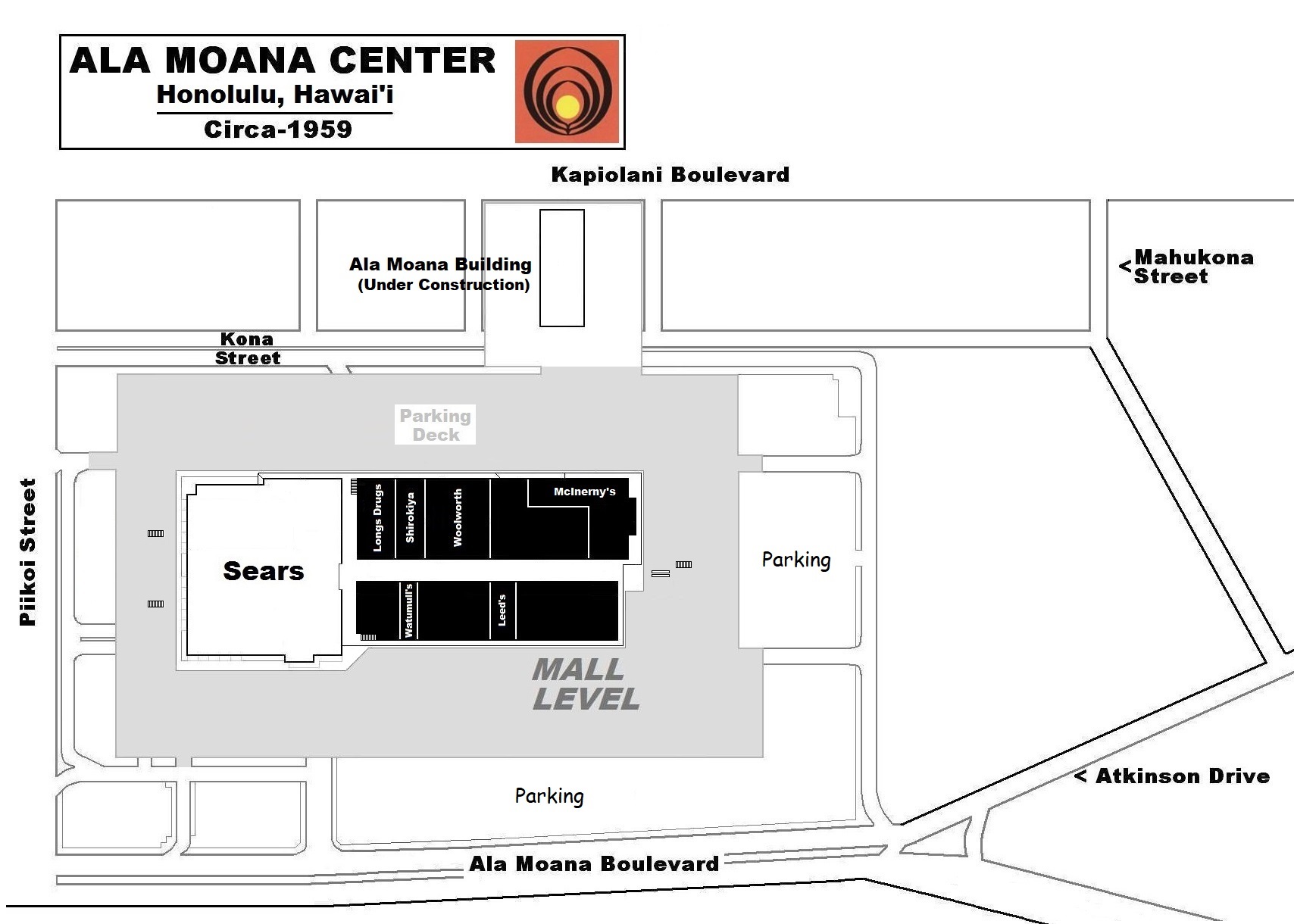
ALA MOANA CENTER in 1959. The 680,000 square foot, fully open-
air complex was anchored by a 2-level (250,000 square foot) Sears.
There were eighty-seven inline stores, including an F.W. Woolworth
5 and 10.


*
Two views of the Aloha State's first shopping mall, soon after its
August 1959 grand opening.
Photos From Malls Of America Blogspot.

*
A 1960s view of an open court area on the Mall Level of the complex.
The Ala Moana Building towers in the distance.
Photo from Malls of America Blogspot


ALA MOANA in 1966. The new Diamond Head Wing had just been
completed. The complex now encompassed 1.3 million square feet,
making it one of the largest retail centers in the fifty states.


The newly-expanded mall in 1966. Far in the distance is the center's
second anchor, Honolulu-based Liberty House. Upon its completion,
the new store became the chain's flagship location.
Photo from Malls of America Blogspot


One of many water features operating in the mall in
the 1960s.
Photo from Malls of America Blogspot


A shot taken on the Mall Level, in the new Diamond Head Wing. Note the
"New Look" Penney's on the left. At the time, it was the shopping center's
third anchor store. It closed in January 2003; a part of Penney's pull-out
from Hawaii.
Photo from Malls of America Blogspot


Now we zoom up to 2008 and a physical layout of the present-day mall.
The old Penney's spot (indicated in light gray) was subdivided into thirty-
five new boutiques and bistros in 2003. The Mauka Wing, dedicated in
March 2008, is indicated in medium gray. With it, the center's retail
roster expanded to two hundred and ninety stores, with a GLA of
2,100,000 square feet.


A circa-2000 aerial shot of the sprawling shopping complex, reputed to
be the planet's largest open-air mall.
Photo from www.ggp.com (General Growth Properties)


Today's ALA MOANA CENTER. During its 50 years in business, the
complex has remained entirely open-air.
Photo from www.ggp.com (General Growth Properties)


Another view of a mallway at the sprawling retail complex.
Poster "Hushpuppy" shares the impression of many who
live (or have lived) on the islands. It is felt that, over the
years, ALA MOANA has got too big, too crowded and too
toney. Locals tend to never go near the place, which now
seems to define the term "tourist trap".
Photo above from Wikipedia / "JMC Strav"
HAWAIIAN SHOPPING MALLS RANKED BY BY SIZE 2009:

1. ALA MOANA CENTER (2,100,000) [1959], Honolulu [O'ahu]
2. PEARLRIDGE CENTER (1,250,000) [1972], Aiea [O'ahu]
3. KA'AHUMANU CENTER (572,896) [1972], Kahului [Maui]
4. KAHALA MALL (542,000) [1970], Waialae [O'ahu]
5. WINDWARD MALL (518,100) [1982], Kaneohe [O'ahu]


ALA MOANA CENTER
Ala Moana Boulevard and Piikoi Street
Honolulu, Hawaii

In August, 2009, as the Aloha State celebrated the 50th anniversary of its admission into the Union, it could also have commemorated the grand opening of its first shopping mall. The islands were officially admitted into the Union August 21st, 1959 and the first shopping mall in the newly-formed state had held its grand opening on August 4.

ALA MOANA ["ah-lah mow-ah-nah"] CENTER was built on the island of O'ahu ("The Gathering Place") , within the city of Honolulu. It was situated on a 44 acre tract, midway between Waikiki Beach and downtown.

The complex was erected upon reclaimed swampland and developed by the Dillingham Land Company, who commissioned Seattle's John Graham, Jr. to design the structure. It cost 25 million dollars, encompassed 680,000 leasable square feet and was anchored by a 2-level (250,000 square foot) Sears.

The open-air mall had two levels and featured eighty-seven tenants. These included F.W. Woolworth, Longs Drug, a Foodland supermarket and Japan-based Shirokiya department store. The retail core of the mall was surrounded by a bi-level parking deck that accomodated over four thousand cars.

The first expansion of ALA MOANA CENTER was completed in 1966. This tri-level addition, referred to as the Diamond Head Wing, included a 3-level (245,000 square foot), Honolulu-based Liberty House (the new flagship of the chain), as well as a 3-level (180,000 square foot) J.C. Penney.

Shirokiya also relocated into a new 53,000 square foot store in the new wing. In addition, the existing Sears was expanded with a full third level. The store now encompassed 341,100 square feet.

Commercial competition arrived in September 1970, with the completion of KAHALA MALL, which was located 4.7 miles southeast, in the Waialae section of the city. Added to a circa-1958 Liberty House, KAHALA MALL is noteworthy as being the first enclosed shopping center in the state. Next in line was ROYAL HAWAIIAN CENTER (1979), 1.2 miles southeast, in Waikiki.

Liberty House at ALA MOANA CENTER was enlarged, with a fourth level, in 1980. The store now encompassed 326,600 square feet. The next renovation of the shopping venue took place in 1987. The Makai Market Food Court, one of the world's largest, was added to the Street Level of the mall and existing stores on the south side of this lower level were extended into the parking area.

In 1990, an extended Third Level was built atop the original bi-level part of the mall. The fourth expansion of ALA MOANA CENTER added a new 3-level (161,000 square foot) Neiman Marcus to the south side and new retail space to the Third Level. This project was completed in 1999. In May of the year, the center was purchased by Chicago-based General Growth Properties.

The new century brought more changes. Liberty House was "Macy-ated" November 22, 2001. J.C. Penney closed January 10, 2003, with its area being sectioned into thirty new stores and restaurants. Moreover, a fourth mall level, the Ho'okipa Terrace, came inline in 2004 and 2005.

In 2006, work began on the Mauka Wing, a sixth addition to ALA MOANA CENTER, which consisted of a 3-level (220,000 square foot) Nordstrom and 80,000 square feet of new stores.

The expansion was dedicated March 7, 2008. It increased the gross leasable area of the mall to 2,100,000 leasable square feet, confirming its position as the largest open-air mall in the world.

Sources:

"Ala Moana Center" article on Wikipedia
www.historylink.org / Essay # 140 / "Graham, John Jr. (1908-1991)" / Article by Heather MacIntosh
"Liberty House" article on Wikipedia
"Hawaii" article on Wikipedia
"Shirokiya" article on Wikipedia
www.alamoanacenter.com
www.ggp.com (General Growth Properties)
Hawaii's Pearlridge Center


Liberty House became the first store to open at the mall, in 1971. It
was the fourth location in the Honolulu-based chain.


A circa-1974 physical layout of PEARLRIDGE CENTER. The original
PHASE I structure, anchored by Liberty House and J.C. Penney, was
dedicated in 1972. A freestanding Sears, on the south side of the mall
site, has just come inline.


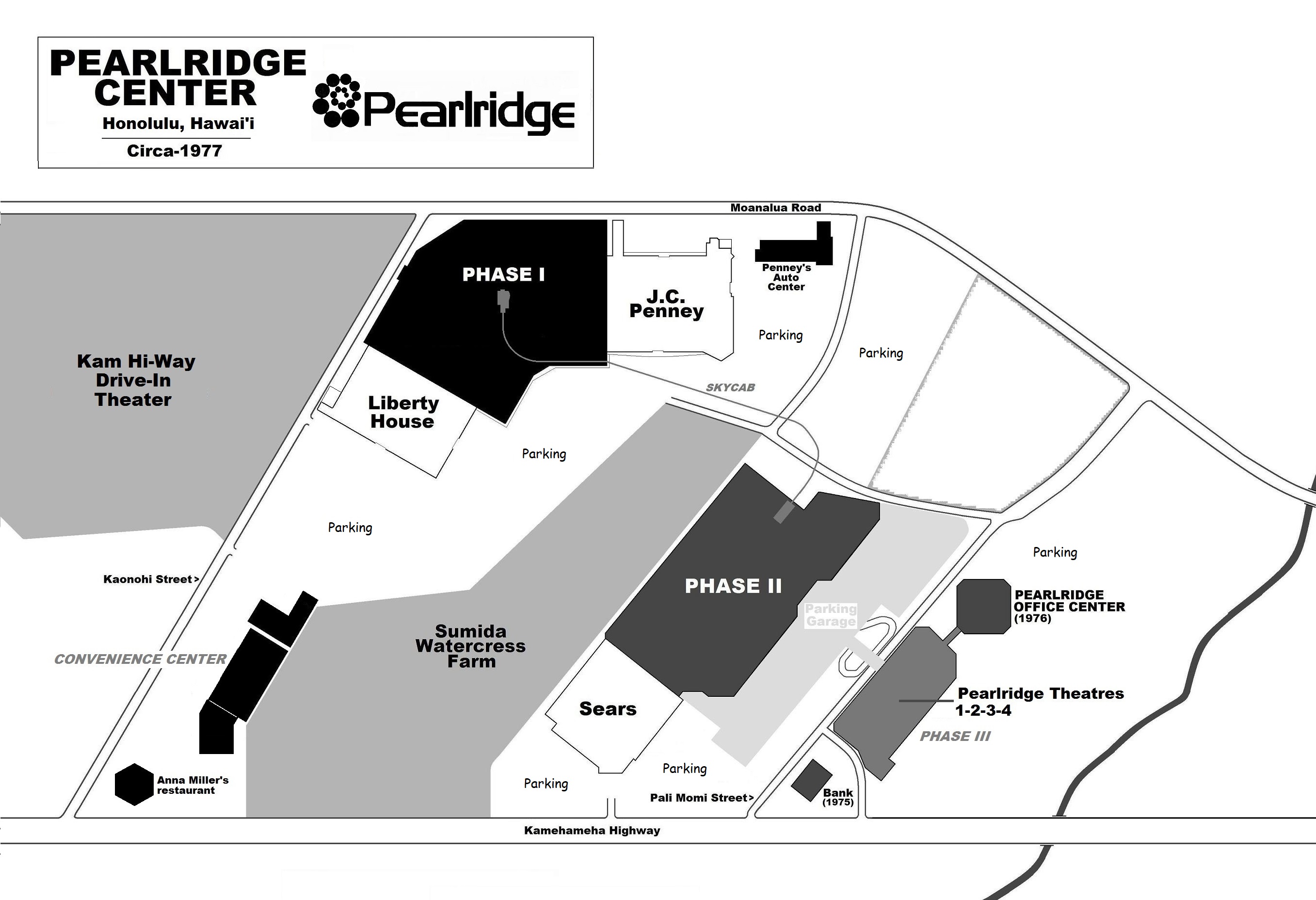
1977 and the basic shopping complex is completed. The Phase I and
Phase II buildings are now connected via a monorail line and a the
PHASE III structure is inline.


Photo from "Api_user_11797_lionrpride71"


Two shots of the SkyCab monorail system that connects the two
main sections of PEARLRIDGE. The .2 mile tramway is the only
remaining shopping center transit system in the nation (the
WESTLAKE CENTER connection with the Seattle Center Monorail
doesn't quite qualify as a "shopping center transit system").
Photo directly above from Wikipedia / "Musashi"


An aerial of Honolulu's sprawling PEARLRIDGE complex, which overlooks
Pearl Harbor and the USS Arizona Memorial.
Photo from www.pearlridgeonline.com


Circuit City took up shop in the western annex, officially known as
Pearlridge West, in 1996. The store was shuttered in early 2009.
Photo from "Api_user_11797_lionpride71"


Opening, as a 12-screen venue, in 1990, the cinema seen
here was the second theatrical venue at the mall. It was
expanded into a 16-plex in 2000.
Photo from Api_user_11797_lionpride71"


A current site plan of PEARLRIDGE. The Uptown and Downtown
structures (known as "Phase I" and "Phase II" before 1996) comprise
the largest fully-enclosed shopping center on the islands.


Exterior and interior views of "Uptown II", the renovated, previous
Penney's location. The 2-level, 102,900 square foot store was sub-
divided into twenty-nine retail spaces in 2004.
Photos from www.loopnet.com


More shots of the interior of PEARLRIDGE CENTER. During
a 1996 facelift, several "city life" theme areas were created in
the mall.
Photos from www.labelscar.com / "Prangeway"
PEARLRIDGE CENTER
Kamehameha Highway and Kaonohi Street
Honolulu County (Aiea), Hawaii

The third shopping mall on the island of O'ahu was built 7.5 miles northwest of the Hawaii Statehouse, in the Aiea ["iy-ahh-ay"] area of Honolulu. It was adjacent to the the western section of the Queen Liliuokalani ["lee-lee-oo-oo-kuh-lah-nee"] Freeway / Interstate H-1, opened to traffic in 1972.

PEARLRIDGE CENTER was to eventually occupy 51.8 acrea of a 67.9 acre plot. The land parcel was shared with the 13.3 acre Sumida (watercress) Farm. An additional 2.8 acres were eventually utilized for the Kapi'olani Medical Center (1988).

A 2-level (150,000 square foot), Honolulu-based Liberty House became the first store to open at the mall, in 1971. It featured plexiglass "fashion capsules" with two mannequins in each. These capsules moved up and down along the store's escalator.

Liberty House anchored the 2-level PHASE I mall structure, dedicated in 1972. PHASE I included a 2-level (102,900 square foot) J.C. Penney, as well as Ritz Store, Playwell Toys, Daiei Asian Market, Lum's Restaurant, DJ's Sound City Records, Foxmoor Casuals, Hickory Farms of Ohio, Farrell's Ice Cream, Hartfield's, See's Candies and Spencer Gifts.

A 2-level (185,000 square foot) Sears opened at the site in 1974. Built as a freestanding store on the southern section of the property, it became the anchor of the PHASE II mall complex when it was completed in 1976. PHASE II consisted of three retail levels and included Longs Drugs and Japan-based Shirokiya.

With the completion of PHASE II in 1976, a third level opened in the PHASE I structure, which consisted of a station for the mall's new Skycab monorail system.

The .2 mile Skycab connected the PHASE I and PHASE II structures. It joined Fort Worth, Texas' Tandy Center Subway (1963-2002) and the ACTS (1976-1989), at Dearborn, Michigan's FAIRLANE TOWN CENTER, as the third shopping mall transit system in the nation.

The Pearlridge Cinema IV opened, in the PHASE I mall, in the summer of 1976. The PHASE III structure, a 1-level, strip center, opened in 1977. By this time, PEARLRIDGE CENTER included the 8-story Pearlridge Office Center, an outparcel bank building and 163,000 square foot retail annex, at the west end of the mall site.

Aside from ALA MOANA CENTER (1959), KAHALA MALL (1970) and ROYAL HAWAIIAN CENTER (1979) [these between 9 and 13.7 miles southeast, in sections of Honolulu], commercial competition came from WINDWARD MALL (1982), 9 miles northeast, in / around Kane'ohe, on the eastern shore of O'ahu.

A multi-level parking structure was built along with the PEARLRIDGE CENTER PHASE II mall. It extended, over Pali Momi Street, to the PHASE III building. A second parking garage was added, west of Liberty House, in 1989. Third and fourth garages were completed, at the east end of the mall site, in 1990.

With all components now in place, PEARLRIDGE CENTER encompassed 1,250,000 leasable square feet. The mall was to feature a second cinema complex when the Pearlridge 12 opened (in the PHASE III structure) in 1990. It was expanded to a 16-plex in 2000. At this time, the original cinema, in PHASE I, was shuttered and converted to office spaces.

The 1990s brought another commercial competitor for PEARLRIDGE CENTER. The open-air WAIKELA CENTER, built 4.3 miles northwest, in / around Waipahu, was completed in 1993.

During 1996, the entirety of PEARLRIDGE CENTER was given a 3.5 million dollar facelift renovation. At this time, the PHASE I mall was renamed UPTOWN...PHASE II as DOWNTOWN. PHASE III became PEARLRIDGE EAST and the western outparcel (with a new Circuit City) became PEARLRIDGE WEST.

Anchor store rebrandings commenced November 22, 2001, with the conversion of Liberty House to Macy's. J.C. Penney, who closed all stores in the Aloha State on January 10, 2003, left a vacant anchor on the east end of DOWNTOWN.

The store sat vacant for over a year. It was eventually subdivided into twenty-nine inline store spaces, with the newly-refurbished area referred to as UPTOWN II. Retailers began opening in November 2004. Tenants included Sharper Image, Guess?, Hollister, Abercrombie and Borders.

Built upon land owned by the Bernice Pauahi Bishop Trust Estate and leased by Honolulu-based Watercress-Pearlridge Associates, LP, PEARLRIDGE CENTER is the state's largest fully-enclosed shopping center. It currently features one hundred and seventy stores and services.

Sources:

"Pearlridge Center" article on Wikipedia
www.pearlridgeonline.com
www.hawaiithreads.com
www.hawaiistores.com
Honolulu County, Hawaii property tax assessor website
Hawaii's Queen Ka'ahumanu Center


The main entrance into today's partially-enclosed, 572,800 square foot
shopping venue. It was the fifth mall built in Hawaii and currently holds
the position of the third-largest on the islands.
Photo from vccusa.com (VCC General Contractor Construction)


The original, 343,000 square foot, single level shopping complex. It
shared a 58 acre site -overlooking Kahului Bay- with a pineapple
cannery. The center featured the first "neighbor island" Liberty
House, as well as the first -and only- Sears on the island of Maui.


Hawaii's first female monarch, Elizabeth Ka'ahumanu
(1768-1832); the namesake of today's QUEEN KA'AHU-
MANU CENTER. She reigned between 1795 and 1819.
Photo from Wikipedia / Grant Glenn


The newly-expanded mall in 1994. The Penney's Wing, extending
southward from the existing mall structure, took the place of a portion
of the circa-1927 Kahului Cannery north building. The 6-plex, on the
upper level of the shopping complex, opened in 1998.


Center Court, looking into the Penney's...make that Macy's Home
Store... Wing. A statue commemorating Queen Ka'ahumanu is visible
in the lower center of the photo.
Photo from vccusa.com (VCC General Contractor Construction)


The Queen's Stage was installed in Center Court as part of the mall's
2005 facelift.
Photo from www.wegomaui.com


Another view of Center Court. The Queen's Market Food Court is
visible in the upper left.
Photo from www.vccusa.com (General Contractor Construction)


The Sears Wing. The mall's Teflon tent roof was installed during the
mall's 1994 expansion / renovation.
Photo from www.tflighting.com


A fourth view of Center Court. The second level -seen here- was also
added as a facet of the 1993-1994 expansion / renovation.
Photo from www.tflighting.com
KA'AHUMANU CENTER
West Ka'ahumanu Avenue and South Kane Street
Maui County (Kahului), Hawaii

The fifth shopping mall built in Hawaii was located on the northern shores of the island of Maui, in the Kahului ["kah-hoo-loo-ee"] community. KA'AHUMANU ["kah-ah-hoo-mah-noo"] CENTER, dedicated in 1972, was to eventually occupy 33.7 acres of a 58.3 acre parcel located .7 miles northwest of center city Kahului ["kah-hoo-loo-ee"].

The mall site was shared by the single-level, open-air shopping center and the 25.1 acre Maui Land Pineapple Company's Kahului Cannery.

Developed by Honolulu's Dillingham Land Company, the original retail complex encompassed 343,000 leasable square feet. It included the first "neighbor island" store of the Honululu-based Liberty House chain.

This single level location anchored the mall's west end and housed 82,900 square feet. A 1-level (50,000 square foot) Sears anchored the east end of the complex.

KA'AHUMANU CENTER was the first -and is presently the only- regional-class shopping venue on the "Valley Isle". It joined the community-sized (182,000 square foot) MAUI MALL, .7 mile northeast, which opened in 1971.

The Maui Land Pineapple Company, which owned the land leased for KA'AHUMANU CENTER, acquired the mall structure in 1986. In 1993, they embarked upon a 72 million dollar renovation of the property.

Half of the Kahului Cannery North Building was demolished and replaced by a 2-level (202,200 square foot) South Wing of the mall. This was anchored by a 2-level (81,400 square foot) J.C. Penney. Moreover, the center section of the existing complex had a second level added, which featured the 8-bay, Queen's Market Food Court.

A Teflon tent-type roof was installed over the mall's common area, which partially enclosed the structure. A multi-level parking garage was built, connecting to the west side of the new Penney's, and the existing Sears was expanded (to 77,500 square feet).

The expansion / renovation project was completed in 1994. The mall, now officially known as QUEEN KA'AHUMANU CENTER, encompassed 572,800 leasable square feet, with over one hundred stores and services. It assumed the position of the third-largest shopping mall in Hawaii.

QUEEN KA'AHUMANU CENTER experienced the same anchor store alterations as its two larger counterparts on the island of O'ahu; namely, the ALA MOANA and PEARLRIDGE centers.

Liberty House was converted to Macy's November 22, 2001 and Penney's pulled out of the mall January 10, 2003. A Macy's Home Store opened, in the old Penney's space, in the fall of 2003.

In September of the same year, the ownership of QUEEN KA'AHUMANU CENTER changed . A joint venture of San Francisco-based Seligman Western and Coastwood Capital Partners, along with Santa-Barbara-based Somera Investment Partners, acquired the complex. They performed a 5 million dollar facelift in 2005.

The Grand Staircase, in Center Court, was removed and replaced with the Queen's Stage, a venue for live entertainment. New escalators were installed in the mall, along with updated lighting, restrooms and a nautical-theme children's play area.

The Seligman Western Company bought out the partners in their joint venture and established 100 % ownership of the retail hub in January 2007. Today, the mall is managed by Chicago-based General Growth Properties.

Sources:

www.queenkaahumanucenter.com
www.mauiland.com
Maui County, Hawaii property tax assessor website
www.seligman.com
www.vcc.usa.com (VCC General Contractor Construction)
West Virginia's Middletown Mall


Clarksville, West Virginia-based Parsons-Souders was a junior anchor
at the north-central West Virginia retail hub. The store encompassed
one level and 40,000 square feet. The chain was acquired by Wheeling-
based Stone and Thomas in the '70s.


The Mountain State's first shopping mall, circa-1969.
The 424,600 square foot center was originally anchored
by Sears and Grant's. A third anchor was added in the
1970s.


A sweeping view of today's MIDDLETOWN MALL, looking eastward.
The center, outpositioned by newer and larger retail complexes built
in the region between 1975 and 1990, lingers in a state of suspended
animation. A great deal of former retail space is now leased as offices.
The rear section of the structure is reputedly sealed off and abandoned.
Photo from www.loopnet.com
MIDDLETOWN MALL
Fairmont Avenue / US 250 and David Circle
Marion County (White Hall), West Virginia

The first shopping mall in the Mountain State was located in its north-central sector. MIDDLETOWN MALL, so named due to its location between the cities of Morgantown and Clarksburg, was situated on 31.2 acres, 5 miles southwest of downtown Fairmont. The single-level shopping complex opened for business in 1969.

Originally encompassing 424,600 leasable square feet, the fully-enclosed MIDDLETOWN MALL was designed by Carl E. Barefoot. It was developed by the Johnstown, Pennsylvania-based Crown American Realty Trust and Boston-based First Union Real Estate Equity and Mortgage Investment Company.

A 1-level (97,700 square foot) Sears anchored the complex, along with a 1-level (86,300 square foot) W.T. Grant variety store. The center's junior anchor was a 1-level (40,000 square foot), Clarksville, West Virginia-based Parsons-Souders.

Inline stores in the circa-'69 shopopolis included Lerner Shops, The Jones Department Store, Thrift Drug, Scuffy Pet Shop, Orange Bowl, Orange Julius, Chess King, Jo-Ann Fabrics and a J.G. McCrory 5 and 10.

Commercial competition arrived with the dedication of MOUNTAINEER MALL, in 1975. The center was located 17.1 miles northeast, on land adjacent to Morgantown.

Next came MEADOWBROOK MALL, which was completed in 1982. It was built on a site 11 miles southwest, in the city of Bridgeport. MORGANTOWN MALL opened in 1990. It was situated 16.9 miles northeast, on land adjoining the city of Morgantown.

The only expansion of MIDDLETOWN MALL consisted of the addition of a 1-level (70,000 square foot), Johnstown, Pennsylvania-based Gee Bee discount mart. This was probably built in the late 1970s. At around the same time, Parsons-Souder's was acquired -an rebranded- by Wheeling-based Stone and Thomas.

Sears vacated their store in 1989. The space was taken by a Canton, Massachusetts-based Hills discount mart. This location lasted until 1998, when Rocky Hill, Connecticut-based Ames moved into the store space.

The Gee Bee store closed and was leased, by the Federal Bureau of Investigation, in 1993. Stone and Thomas was acquired -and rebranded- by Dayton, Ohio-based Elder-Beerman in 1998. Both the Ames and Elder-Beerman stores at MIDDLETOWN MALL were short-lived. By late 2000, they had been shuttered.

Morgantown-based Stephen Fansler had bought the mall in July 1998. The area surrounding, and including, MIDDLETOWN MALL was incorporated, as the City of White Hall, December 8, 1992.

With two of its anchors vacant, the mall fell into foreclosure in 2002. A loan was secured and a company, Pin Oak Properties (under the auspices of Stephen Fansler), was created to own and operate the shopping center.

The north anchor, originally Sears, was subdivided into three store spaces. A Sav-A-Lot supermarket and Ace Hardware opened in two of these, in 2004.

The following November, Sears came back to the mall, following a fifteen year hiatus. They opened a Catalogue and Appliance store in a southwest parking area outparcel, previously leased as a Shop 'N Save supermarket.

Today, the MIDDLETOWN MALL complex is leased as retail and office spaces, with more than a few vacancies in the mix. Office tenants include the FBI, Social Security Administration, State of West Virginia and Lockheed Martin.

Included in the mall is a display, "The Mining Life: Coal In Our History and Culture"; which serves as a memorial to the Sago Mining Disaster of 1968.

As of April 2009, the shopping venue is up for sale with the asking price being $30,300,000.

Sources:

Mrs. Betty L. Schmidt, Middletown Mall Office Manager / Marketing Director
www.deadmalls.com / Commentary by Meredith Dixon and Chris Sabak
http://www.loopnet.com/
Comment post by "Anonymous"
http://web.mountain.net (Town of White Hall)
West Virginia's Grand Central Mall


West Virgina's second shopping mall originally housed 750,000 square
feet and eighty-three stores and services. Today, the complex encom-
passes 906,238 square feet, with seventy-six retail spaces. Here we
see a contemporary aerial of the riverside shopping complex, looking
westward.
Photo from www.glimcher.com


The original -circa-'72- shopping center. Its "highly
modern" decor included various fountains, a bird
aviary and a mall corridor lined with tropical gardens.
GRAND CENTRAL MALL TENANTS
1972 [PARTIAL LIST]:


THE DIAMOND (with cafeteria) / J.C. PENNEY (with beauty salon) / SEARS / G.C. MURPHY (with lunch counter) / Lerner Shops / Embee's ladies' apparel / The Parasol ladies' apparel / Fashion Bug ladies' apparel/ Dil's River Packet men's and boy's apparel / Creations Unlimited / Walden Books / Walden Hallmark / National Record Mart / House Of Toys / Hickory Farms Of Ohio / General Nutrition Center / Pretzel Oven / Pizza Inn / Dog House German and Kosher Hot Dogs / Bressler's Ice Cream / Seddon's Restaurant ( with bar, bandstand and dance floor) / General Cinemas Twin / Radio Shack / Tandy Leather / Broughton's Ice Cream / Community Room (capacity-250)


WEST VIRGINA MALLS RANKED BY SIZE 2009:

1. HUNTINGTON MALL (1,570,160) [1981], Barboursville
2. GRAND CENTRAL MALL (906,238) [1972], Vienna
3. CHARLESTON TOWN CENTER (897,000) [1983], Charleston
4. MEADOWBROOK MALL (725,000) [1982], Bridgeport
5. MOUNTAINEER MALL (674,000) [1975], Morgantown
6. MERCER MALL (660,783) [1980], Bluefield
7. MORGANTOWN MALL (558,000) [1990], Morgantown
8. MARTINSBURG MALL (508,000) [1991], Martinsburg
9. CROSSROADS MALL (451,776) [1981], Bradley
10. MIDDLETOWN MALL (444,200) [1969], White Hall
11. RALEIGH MALL (295,200) [1974], Beckley
12. KANAWHA MALL (196,100) [1985], Charleston


GRAND CENTRAL MALL, 2007. Renovated and
expanded between 1996 and 1998, the single-level
shopopolis housed one hundred and five inline stores
and kiosk retailers at the time depicted in this drawing.
Steve and Barry's replaced a Phar-Mor Drug, built as
part of the 1990s expansion. This store was vacated
in late 2008.


Two contemporary interior views of GRAND CENTRAL MALL, showing
the center as it appears after its 1990s renovation and expansion. Of
course, the tropical gardens, bird aviary and fountains, that graced the
corridor back in the 1970s, have long since been removed.
Photos from www.glimcher.com
GRAND CENTRAL MALL
Grand Central Boulevard and 13th Avenue
Vienna, West Virginia

West Virginia's second shopping mall was built in the state's northwest sector. GRAND CENTRAL MALL occupied a 98 acre tract, located 2.4 miles north of downtown Parkerburg, in the adjoining city of Vienna. The site previously served as a municipal airfield.

The single-level, 750,000 square foot shopping center was constructed by the Monroeville, Pennsylvania-based Oxford Development Corporation. Upon its completion, it was the largest shopping mall in West Virginia; nearly twice the size of the previous record holder, Fairmont-White Hall's MIDDLETOWN MALL (1969).

The 1-level (144,000 square foot) J.C. Penney at GRAND CENTRAL MALL, the chain's largest West Virginia store, was the first anchor to open for business. It, and forty-one other retailers, participated in a grand opening held August 17, 1972.

By September of the year, a 1-level (104,000 square foot) Sears and 2-level (105,000 square foot), Charleston-based The Diamond were in operation, along with an additional twenty-eight retailers.

When fully completed, GRAND CENTRAL MALL encompassed eighty-three stores, including a 49,000 square foot G.C. Murphy 5 and 10, Walden Hallmark, The Gap, and Pizza Inn. There was also a General Cinemas Twin, with seating for nine hundred.

The Diamond department store was one of two locations in the chain and was a division of the Associated Dry Goods conglomerate. Both stores were shuttered in 1983. The GRAND CENTRAL location became a Wheeling, West Virginia-based Stone and Thomas.

Columbus, Ohio-based Glimcher Realty Trust purchased the mall in 1993. Three years later, they started a 13 million dollar renovation. This included facelifts of the interior and exterior and the addition of over 141,000 square feet of new retail space.

The area surrounding -and including- the shuttered G.C. Murphy and twin cinema was gutted. A 12-screen multiplex, 9-bay Food Court and Goody's Family Clothing were built. Moreover, a 1-level (86,000 square foot) department store was added at the mall's original Main Entrance. This was occupied by Alcoa, Tennesse-based Proffitt's.

These renovations were completed in March 1998. They increased the mall's leasable square footage to 908,238. By this time, the Stone and Thomas anchor had closed, which reopened as a Dayton, Ohio-based Elder-Beerman.

The most recent changes at GRAND CENTRAL MALL involved the March 2007 conversion of Proffitt's into a Charlotte-based Belk and the shuttering of Steve and Barry's in late 2008.

Today, Grand Central Mall houses seventy-six store spaces. Tenants include Aeropostale, Hollister, Kay Jewelers, New York and Company, Rogers Jewelers, Spencer Gifts and Victoria's Secret.

Sources:

Memories of Mike P., West Virginia resident
"Grand Central Mall" article on Wikipedia
"Proffit's" article on Wikipedia
"Elder-Beerman" article on Wikipedia
"Anonymous" comment post
www.glimcher.com
West Virginia's Raleigh Mall

*
The north anchor of the Mountain State's third shopping mall was a
75,500 square foot, single-level Montgomery Ward. The store was
shuttered -along with all stores in the Chicago-based chain- in 2001.
After sitting vacant for several years, a portion reopened, as a Brent-
wood, Tennessee-based Tractor Supply Company, in March 2006.
Photo from http://wvdo.org/


A physical layout of RALEIGH MALL, dating to late 1975.
The complex was completed in two phases, working north-
to-south. Super X Drug, Kroger and Murphy's Mart were
the first stores opened, between June and October 1974.
The remainder of the mall was finished by October of the
following year.


Originally a combo Kroger / Super X, the store structure -a south
parking area outparcel of RALEIGH MALL- now houses a Columbus,
Ohio-based Big Lots.
Photo from www.groceteria.com / Andrew T.


The BECKLEY PLAZA strip center, which sits across from RALEIGH
MALL, along Robert C. Byrd Drive / US 19. It predated the mall by
a few years.
Photo from www.loopnet.com


The open-air CRANBERRY CROSSING, reputedly encompassing
815,000 leasable square feet, snatched the RALEIGH MALL
Goody's, in April 2005. In retrospect, the loss was not such a big
deal, considering that the relocated store was only going to be in
operation for two years.
Photo from www.loopnet.com


The megaplex cinema at BECKLEY GALLERIA, a component of the new
CRANBERRY CROSSING shopping center.
Photo from www.loopnet.com


RALEIGH MALL, as it is situated in the here and
now. The 300,000 square foot shopping venue was
bested by the newer -and larger- CROSSROADS
MALL, in 1981. The 2005 dedication of CRANBERRY
CROSSING / BECKLEY GALLERIA really put the
hurt on.
RALEIGH MALL
Robert C. Byrd Drive / US 19 and Dunn Drive
Beckley, West Virginia

West Virginia's third mall-type shopping complex was located in the state's south-central sector. RALEIGH MALL was developed by the Johnstown, Pennsylvania-based George D. Zamias Real Estate Company.

The single-level shopping venue occupied a 40 acre site, 1.7 miles north of center city Beckley, in the Skelton community. Beckley serves as the county seat of Raleigh County.

Ground was broken for the 295,288 square foot, fully-enclosed complex on August 19, 1973. The first stores to open in Phase One of the construction project, Super X Drug, Kroger and Murphy's Mart, came inline between June and October of 1974.

Kroger and Super X occupied a 36,700 square foot outparcel on the southern end of the mall site. The 1-level (72,500 square foot) Murphy's Mart was situated north of the Kroger / Super X building and became the south anchor of the Phase Two mall.

A grand opening was held October 9, 1975 for stores in the second construction phase, which included a 1-level (75,500 square foot) Montgomery Ward, at the north end of the complex. At the center of the center was a 1-level (50,200 square foot), Wheeling-based Stone and Thomas.

Among the thirty-nine inline stores were Kinney Shoes, Hickory Farms of Ohio, Photo Corral, Henry's Men's Shop and Friar Tuck's Pub.

A strip shopping center, BECKLEY PLAZA, was located across Robert C. Byrd Drive from the mall. The first bona fide retail rival, CROSSROADS MALL, was dedicated in April 1981. It was located 2.3 miles northwest, in unincorporated Raleigh County, near the Bradley community.

Murphy's Mart closed in 1985, with Rocky Hill, Connecticut-based Ames taking the store space. Ames closed when its operations were consolidated with another location in the city. The store space at RALEIGH MALL sat vacant until Morgantown, West Virginia-based Gabriel Brothers Discount Family Fashions opened, in 2002.

This 45,800 square foot store shared the former Murphy's Mart space with Goody's Family Clothing. Stone and Thomas became a Dayton, Ohio-based Elder-Beerman in 1998.

Montgomery Ward folded in 2001. Its anchor spot sat vacant until it was sectioned into smaller tenant spaces. A Brentwood, Tennessee-based Tractor Supply Company opened (utilizing a 24,900 square foot section) on March 22, 2006.

RALEIGH MALL encountered a new commercial competitor when the CRANBERRY CREEK power center opened, in 2005. CRANBERRY CREEK, which also includes the BECKLEY GALLERIA component, was situated 1.3 miles southeast of the RALEIGH property and was also within the city limits of Beckley.

The 26,700 square foot Goody's Family Clothing in RALEIGH MALL relocated to a larger location, in the CRANBERRY CREEK complex, in April 2005. Three years later, a Dayton, Ohio-based Rex Electronics outlet also closed at RALEIGH MALL.

Today, the center struggles with something like a 70 percent vacancy rate. In addition to Elder-Beerman, Gabriel Brothers and the Tractor Supply Company, inline stores are Big Lots (in the old Kroger), Hollywood Nails, Dollar General, a bingo parlor (in the old Goody's space) and a pizza restaurant.

Sources:

http://Jeff560.tripod.com / "History of Beckley and Raleigh County"
www.wvdo.org
Comment post by Ken
www.register-herald.com
www.paramountdevelopment.com
Mississippi's Metrocenter Mall

*
Mobile-based Gayfer's anchored the northeast side of METROCENTER
between 1978 and 1999.


METROCENTER MALL, 1979. The gargantuan 1,154,000 square
foot retail venue was promoted as the largest shopping mall between
Atlanta and Dallas. The title was surrendered to Birmingham's shiny
new RIVERCHASE GALLERIA in 1986.


One of the First Floor entrances into the mall.
Photo from Wikipedia / "KMJonOBR"


An aerial of METROCENTER, Mississippi's largest shopping mall.
That's the Interstate 220 / US 49 freeway on the right.
Photo from www.loopnet.com


The First Floor entrance of the shuttered Gayfer's store as it appeared
between 1999 and 2007.
Photo from www.loopnet.com


On August 31, 2007, the lower level of the abandoned store reopened as
a Burlington Coat Factory.
Photo from www.loopnet.com


The Second Floor of the old Gayfer's has recently been renovated.
It is being promoted as "Metro Marketplace", a conglomeration of
mid-sized inline stores.
Photos from www.loopnet.com
*
MISSISSIPPI SHOPPING MALLS RANKED BY SIZE 2009:

1. METROCENTER MALL (1,154,000) [1978], Jackson
2. NORTHPARK MALL (958,000) [1984], Ridgeland-Jackson
3. EDGEWATER PLAZA SHOPPING CITY / EDGEWATER MALL (900,000) [1963], Biloxi
4. CROSSROADS MALL (850,000) [1999], Gulfport
5. TURTLE CREEK MALL (846,150) [1990], Hattiesburg
6. MALL AT BARNES CROSSING (700,000) [1990], Tupelo


METROCENTER MALL, 2009. The super-sized shopping center
has endured ups and downs over its 30+ years in business. Gayfer's,
vacated in 1999, was partially retenanted in 2007, with its remaining
space being sectioned into smaller inline stores. Belk, on the mall's
south end, consolidated operations into its first floor in March 2008
and will close in August 2009. The old Holmes / Dillard's space, on
the west, has been sitting empty since late 2004.
METROCENTER MALL
US Highway 80 West and Robinson Road
Jackson, Mississippi

The largest mall in the Magnolia State was developed by Toronto-based Cadillac Fairview and occupied a 120 acre spread, located 4 miles west of the Mississippi Statehouse, in the western environs of the capital city.

METROCENTER, dedicated in March 1978, encompassed 1,154,000 leasable square feet and featured one hundred and twenty stores and services on two levels of retail. There were four anchor stores. On the southeast was a 2-level (288,100 square foot), Jackson-based McRae's.

On the northeast, a 2-level (176,800 square foot), Mobile-based Gayfer's. A 2-level (224,100 square foot) Sears was situated on the northwest and a 2-level (178,000 square foot), New Orleans-based D.H. Holmes filled the southwest spot.

Inline stores in the original shopping complex included Camelot Music, Spencer Gifts, Tuxedo Junction Rentals and Diamond Jim's Arcade. The United Artists Metrocenter Cinema IV and a 52,300 square foot Service Merchandise were situated -as outparcels- in the southwest section of the mall site.

Access to the mall was provided by the Interstate 220 loop expressway, opened to traffic between 1979 and 1981.

The mall was touted as the largest shopping complex between Atlanta and Dallas for many years. However, this distinction was relinquished to Birmingham's 1.2 million square foot RIVERCHASE GALLERIA, dedicated in February 1986.

METROCENTER quickly outpositioned its nearest competitor, JACKSON MALL (1969), which was located 3.7 miles northeast, in Jackson. The 900,000 square foot center languished in a state of retail twilight until it reopened as a medical mall in 1995.

The second retail rival of METROCENTER, NORTHPARK MALL (1984), was located 10 miles northeast, in Ridgeland. Encompassing 958,000 leasable square feet, it eventually outpositioned METROCENTER, which became rather notorious for thefts and burglaries during the 1990s.

Anchor rebrandings at METROCENTER commenced in 1989, with the aquisition of the D.H. Holmes chain by Dillard's. Gayfer's was also bought out by Dillard's. The METROCENTER Gayfer's location was shuttered in April 1999.

Dillard's then consolidated its Jackson locations into two stores at NORTHPARK MALL. The METROCENTER location was shuttered in November 2004. McRae's was rebranded by Charlotte-based Belk in March 2006.

Meanwhile, the mall proper had been given a facelift renovation in 1993, with a Food Court installed on its second level and new entrances built on its exterior.

The center became a holding of Addison, Texas-based Coyote Management in August 1997. They sold to a joint venture of Los Angeles-based Jackson Metrocenter Mall and Atlanta-based Metrocenter Mall-Atlanta in 2003. Los Angeles-based Cannon Commercial, Incorporated was enlisted to manage the property.

Burlington Coat Factory opened, in the first floor of the vacant Gayfer's, August 31, 2007. The 88,400 square foot second floor of the store is currently being leased as "Metro Marketplace", which will be divisible into several smaller retail spaces.

Today, METROCENTER houses eighty-eight stores and services. Tenants include Ashley Stewart, Champs Sports, Foot Locker (2 levels), GNC, Hibbett Sports, Radio Shack, Victoria's Secret and Zale's Jewelers. With the shuttering of Belk in August 2009, the mall is left with only two anchors to sustain it.

Sources:

"Metrocenter Mall" article on Wikipedia
www.shopmetrocentermall.com
www.cannonmgt.com
www.metro-marketplace.com
Hinds County, Mississippi property tax assessor website
www.jacksonmedicalmall.org
Delaware's Concord Mall


Photo from Wikipedia / "Dough4872"


CONCORD MALL in 1972. The Almart, which anchored the
complex at its grand opening in 1969, was joined by a Pennsyl-
vania-based Pomeroy's in late 1971. With this addition, the fully-
enclosed mall encompassed 724,600 leasable square feet and
sixty inline stores.


A present-day aerial of CONCORD MALL. The 3-level office building,
at left center, was added in 1971. It became a Strawbridge and Cloth-
ier Home Store in 1994...and a Macy's Home store in 2006.
Photo from www.alliedproperties.com


Reading, Pennsylvania-based Boscov's opened in the mall's north
anchor spot in 1986. The store started out - in 1971- as a Pottstown,
Pennsylvania-based Pomeroy's.


CONCORD MALL, in sales tax-free Delaware, draws a great deal of
trade from the Philadelphia suburbs to the north.
Photo from www.alliedproperties.com


Sears, built on the site of the Almart that originally anchored the south
end of the mall. Almart was built, as a freestanding discount store, in
1965. I remember buying a Visible Woman model there in the summer
of 1968. After Almart was shuttered, it became a Jefferson Ward and
then a Bradlees. The building was razed and replaced by the Sears
seen here, which opened in late 1992.
DELAWARE SHOPPING MALLS RANKED BY SIZE (2009):

1. CHRISTIANA MALL (1,083,000) [1978], New Castle County
2.
CONCORD MALL (960,000) [1969], New Castle County
3. DOVER MALL (900,000) [1982], Dover
4. TRI-STATE MALL (535,000) [1970], New Castle County
5. BLUE HEN MALL (485,000) [1969], Dover


CONCORD MALL in 2007. Over the years, it has
been expanded several times. Moreover, previously-
existing space has become new retail area. The office
building reopened as a Strawbridge and Clothier
Home Store in 1994. Woolworth, shuttered in 1997,
was subdivided into six store spaces.
CONCORD MALL
Concord Pike / US 202 and Washington Avenue
New Castle County, Delaware

During the late 1960s, there were three mall-type centers being developed in Delaware; BLUE HEN MALL, in Dover and TRI-STATE MALL and CONCORD MALL, in the northern environs of Wilmington.

The distinction of being the first fully-enclosed mall in the state was bestowed upon CONCORD MALL. The largest of the three, it was built as an addition to a freestanding, 1-level (89,000 square foot) Almart discount store, which had opened in 1965.

CONCORD MALL was situated on a 30.61 acre plot, located 4.5 miles north of Wilmington's center city. The sixty store structure, added to the north of the existing Almart in 1969, had an F.W. Woolworth -with Harvest House Cafeteria- as a junior anchor. A 79,500 square foot outparcel structure, at the north end of the mall, was built in 1970.

The enclosed mall was expanded in 1971, with the addition of a 3-level (58,300 square foot) office building and 2-level (176,900 square foot) Pottstown, Pennsylvania-based Pomeroy's department store. The mall now measured 724,600 leasable square feet.

In 1978-'79, CONCORD was joined by the second regional-class mall in the area. CHRISTIANA MALL was located 11.3 miles south, near suburban Newark.

A second renovation of CONCORD was completed in 1981, and a third in 1984. The latter included the construction of a 2-level (149,400 square foot), Philadelphia-based Strawbridge and Clothier, which was built in front of the original mall's main entrance. This store opened August 11, 1983.

Almart, long since out of business, was succeeded by Jefferson Ward (a subsidiary of Montgomery Ward). This store was shuttered in 1985 and soon reopened as a Braintree, Massachusetts-based Bradlees discount mart. This location lasted until 1989.

The vacant Almart / Jefferson Ward / Bradlees was demolished in 1990. In its place was built a 2-level (175,000 square foot) Sears, which was completed in September 1992.

In 1994, Strawbridge and Clothier opened a 52,000 square foot Home Store in the former office building. This became a Macy's Home Store when the Strawbridge's anchor was "Macy-ated" in 2006.

A major commercial competitor came on the scene in 1999 when the 870,000 square foot BRANDYWINE TOWN CENTER opened for business. The new lifestyle format complex was located less than a mile north of CONCORD MALL, on Concord Pike.

In the present, CONCORD MALL is owned and operated by Wilmington-based Allied Properties. At 960,000 leasable square feet, it is Delaware's second-largest mall, following CHRISTIANA MALL, which measures in at 1,083,000.

Sources:

Comment post by Glenn Ferrell
www.alliedproperties.com
New Castle County, Delaware Tax Assessor website
"Strawbridge And Clothier" article on Wikipedia
"Boscov's" article on Wikipedia
www.ggp.com (General Growth Properties)
Delaware's Christiana Mall


A view of the main mallway at Wilmington's CHRISTIANA MALL,
showing the way it appeared between 1991 and 2008. The complex
is presently in the middle of a 125 million dollar expansion and reno-
vation, which is scheduled for completion in 2011.
Photo from Wikipedia / "Justin1920"


The Blue Hen State's fourth shopping mall, as it was
situated at the time of its completion in 1979. With a
GLA of 813,128 square feet, it was 88,528 square
feet larger than its nearest competitor, CONCORD
MALL. With its expansion -to 874,000 square feet-
in 1984, CONCORD assumed the postion of the largest
mall in Delaware. It was to hold this title until 1991.


The mall after its first major makeover, which concluded in 1991.
This project included the addition of a 266,800 square foot
triangular East Wing, which was anchored by a 181,000 square
foot Wanamaker's. With this expansion, CHRISTIANA MALL
spanned 1,080,000 leasable square feet. Its size surpassed that
of its retail rival, CONCORD MALL, once again making CHRIS-
TIANA the largest shopping mall in the state.


The old, circa-1978 Strawbridge and Clothier, shuttered in March
2006, is being replaced by the 2-level, nine store section seen here,
in addition to a new, 138,000 square foot Nordstrom.
Drawing from www.ggp.com (General Growth Properties)


The interior of the new store section seen above, with Nordstrom's
mall entrance in the background.
Drawing from www.ggp.com (General Growth Properties)


The main mallway of the circa-'78 structure is being refurbished. Now
referred to as the "Fashion Run Concourse", this is how it will appear
after the construction dust settles in November 2009.
Drawing from www.ggp.com (General Growth Properties)
*
*
The original Food Court, installed in 1991, has been gutted. The culinary
complex is being relocated eastward, into the south end of the "East Life-
style Plaza".
Drawing from www.ggp.com (General Growth Properties)


An exterior view of one of the mall's prospective "Lifestyle Plazas".
These are to be added to the east and west-facing facades and be
tenanted by various upper crust bistros and boutiques.
Drawing from www.ggp.com (General Growth Properties)


The refurbished Lord and Taylor...make that Target...Court, on
the east end of the complex. New skylights -and a restyled water
feature- are to be installed as part of the mall makeover.
Drawing from www.ggp.com (General Growth Properties)


A plan showing how CHRISTIANA MALL will be configured
after its massive makeover is completed. The renovation,
announced by General Growth Properties in late 2007, is
apparently proceeding, even with the economy in dire straights.
Building permits were issued in early 2009 and demolition has
taken place. The big mystery is whether or not that venerable
Minnesota merchandiser will go ahead with plans to build a new
store on the old Lord and Taylor spot...
CHRISTIANA MALL
Stanton Christiana and Christiana Mall Roads
New Castle County (Christiana), Delaware

The fourth shopping mall built in the Blue Hen State was situated on 97.4 acres, 6 miles southwest of downtown Wilmington. The site, near the Christiana community in unincorporated New Castle County, was adjacent to the Interstate 95 / John F. Kennedy Memorial Highway / Delaware Turnpike, which had opened to traffic in November 1963.

CHRISTIANA MALL was developed by Wilmington-based New Castle Associates. Originally encompassing 813,128 leasable square feet and approximately seventy inline stores, the single level center opened in 1978. It included the Christiana Mall Cinema 5, in operation until 2002.

A 2-level (214,000 square foot), Philadelphia-based Strawbridge and Clothier anchored the north end. J.C. Penney's 2-level (150,700 square foot) store anchored the south. The center's west anchor was a 2-level (217,000 square foot), Newark, New Jersey-based Bamberger's, a Macy's subsidiary. This store opened for business in 1979.

The only regional competitor for CHRISTIANA was CONCORD MALL (1969), located 11.3 miles north, in unincoporated New Castle County.

In November 1988, an expansion of CHRISTIANA MALL was announced. Comprising 266,872 square feet and twenty-eight inline stores, the addition was built on the east side of the existing structure. It was anchored by a 2-level (181,000 square foot), Philadelphia-based John Wanamaker.

The project, which included a facelift of the existing shopping center and installation of a 13-bay Food Court, was completed in 1991. The GLA of the retail hub had been expanded to 1,080,000 square feet, making it the largest shopping mall in the state...a distinction it holds to this day.

The Maryland-based Rouse Company bought into CHRISTIANA MALL in April 2003. With the acquisition of the Rouse Company, by Chicago-based General Growth Properties, in 2004, CHRISTIANA MALL was added to the GGP retail center portfolio.

Bamberger's had become the mall's first anchor store conversion, when it was rebranded, as a Macy's, in 1986. John Wanamaker underwent the second anchor alteration, when it converted to an Arlington, Virginia-based Hecht's, in 1995.

This nameplate was short-lived. It was replaced with a Lord and Taylor trademark in 1997. This location lasted until 2006, when the store was shuttered.

A proposal to reopen the vacant Lord and Taylor as "Epicenter Collection" came to light in mid-2008. This store, promoted as a new-style showcase of over sixty internet-based, catalogue retailers, was to operate in a "real time", traditional store format.

The proposal eventually fell through and the store structure was sold to Target Corporation in December 2008. The story is that Target is to open a newly-built store on the L & T site in 2010. Thus far, no construction has started. Perhaps the present-day economic doldrums have delayed implementation of the store indefinitely.

On the north end of the mall, the Strawbridge's spot was vacated March 23, 2006. The building was eventually demolished as part of a 125 million dollar renovation of the CHRISTIANA complex, that was announced in October 2007.

Work got underway in January 2009. The existing mall is having new floors, lighting and soft seating areas installed, with the interior being given a major facelift. New mall entrances are also being built. A 2-level (138,000 square foot) Nordstrom is being added in place of the old Strawbridge's, along with a 2-level section with nine new inline stores.

Moreover, two open-air, "Lifestyle Plazas" are proposed; to be built on the east and west-facing facades of the existing mall. Lastly, the old Food Court and Cinema have been demolished, with a new, 8-bay Food Court being built as part of the "East Lifestyle Plaza".

These renovations are scheduled for a formal dedication on November 19, 2009, with the new Nordstrom opening in the spring of 2011. If everything goes as planned, CHRISTIANA MALL will -then- encompass approximately 1,181,000 leasable square feet, with a retail roster of approximately one hundred and sixty stores and services.

Sources:

"Christiana Mall" article on Wikipedia
www.ggp.com (General Growth Properties)
www.interstateguide.com
www.udreview.com
www.constructionjournal.com
Idaho's Karcher Mall


The main mall entrance of the 545,000 square foot retail hub. The
2-level section seen here was installed during a 1998 renovation.
Photo From Wikipedia / "Caldorwards4"


Circa-'65 site plan of Idaho's first shopping mall. The fully-enclosed complex was anchored by a 2-level, 154,000 square foot, "New Look" J.C. Penney.


The eastward expansion and 60,000 square foot Bon Marche anchor
store. The addition included a twin cinema and nineteen new stores.


KARCHER MALL in 2008. During the previous thirteen years, the
shopping venue bounced around to so many owners that it is hard to
keep up with them all. The present proprietor, Milan Properties, did
a facelift renovation in 2007-2008. They also signed two big-time
tenants, Burlington Coat Factory and Steve and Barry's University
Sportswear. Things appeared to be picking up...until Steve and Barry's
bit the dust in 2008.
IDAHO SHOPPING MALLS RANKED BY SIZE (2009):

1. Boise Town Square, Boise (1988), 1,170,000
2. Pine Ridge Mall, Pocatello / Chubbuck (1981), 640,000
3. Karcher Mall, Boise / Nampa (1965) 545,000
4. Grand Teton Mall, Idaho Falls (1984), 540,000
5. Magic Valley Mall, Twin Falls (1986), 413,000
6. Palouse Mall, Moscow (1976-1979), 384,000
7. Silver Lake Mall, Coeur d'Alene (1989), 330,000
8. Country Club Mall, Idaho Falls (1971), 306,201
9. Westwood Mall, Pocatello (1970), 277,142
10. Lewiston Center Mall, Lewiston (1965-1981), 250,000
11. Pocatello Mall, Pocatello (1976), 245,394
KARCHER MALL
Caldwell Boulevard and West Karcher Road
Nampa, Idaho

The Spud State's first shopping mall was built on a 37 acre tract, 13 miles west of downtown Boise, in the suburb of Nampa. KARCHER MALL opened in August 1965, with a 1-level (154,000 square foot) J.C. Penney as its anchor store.

There was also a Woolworth 5 and 10, Skagg's Drug, Buttrey's Food supermarket and thirty other stores along the enclosed mall concourse.

A westward extension was added in 1973, which included a 1-level (60,000 square foot) Seattle-based Bon Marche, the Karcher Twin Theatres and nineteen new retailers.

KARCHER, which encompassed 545,000 leasable square feet, was the exclusive regional-class shopping mall in the Boise / Nampa metropolis for several years. A community-class complex, the 103,300 square foot WESTGATE CENTER, opened -in Boise- in 1970.

It wasn't until the opening of the superregional BOISE TOWN SQUARE, in 1988, that KARCHER had true commercial competition. BOISE TOWN SQUARE immediately snatched J.C. Penney, the primary anchor of KARCHER, along with several inline stores. To add insult to injury, BOISE TOWN SQUARE was expanded, to 1,170,000 square feet, with additions in 1998 and 2000.

KARCHER persevered. The old Penney's spot was leased to Eugene, Oregon-based Troutman's Emporium. Other KARCHER MALL stores during this time frame included Pay Less Drug, Sears Appliance Outlet, Orange Julius and the Red Baron Video Arcade.

Alas, the damage done by the opening and expansion of BOISE TOWN SQUARE was irreversable. KARCHER was in foreclosure by the mid-1990s. It was bought and sold several times, with a major renovation done in 1998.

This 10 million dollar project included the installation of a new Food Court and 2-level Main Entrance. Still, the outpositioned KARCHER was, more or less, a dead mall.

The early 2000s saw some vacant spots leased to new retailers. Intermountain Sports replaced the old Woolworth, sitting empty since 1997. JoAnn Fabrics replaced Pay Less Drug, vacant since 1996. Big 5 Sporting Goods filled the storefront vacated by Sears Catalogue and Appliance in 2003. At the same time, KARCHER MALL lost Troutman's Emporium, its main anchor.

In 2004, Pleasanton, California-based Ross Dress For Less leased the old Buttrey's Food location. Bon Marche had been rebranded as Bon-Macy's in August 2003 and was fully "Macy-ated" in January 2005.

The mall changed hands four more times, early in the 21st century. The current owner, Los Angeles, California-based Milan Properties, began a refurbishment in mid-2007.

A much more ambitious -ripping out and rebuilding- remodeling, proposed by the previous proprietors, Rinconada Development, was scrapped. Milan's scaled-down renovation concentrated on simply improving mall entrances and the exterior of the structure.

The 14 million dollar project was completed in the spring of 2008...just in time to herald the opening of new Burlington Coat Factory and Steve and Barry's University Sportswear stores. Unfortunately, Steve and Barry's went bust after only eleven months...creating a major vacancy.
Moreover, the mall's Macy's is moving to the new 850,000 square foot NAMPA GATEWAY CENTER, an open-air complex that opened in 2008. The KARCHER store is set to close in late 2009.

Another potential competitor, the 690,800 square foot TREASURE VALLEY MARKETPLACE power center, has been built in the vacinity of KARCHER MALL.

Even with its present and future vacancies, and all of the new competition, the position of KARCHER, within the rapidly-expanding area of retail in the northwestern environs of Nampa, could keep the mall viable as a retail center.

Sources:

"Karcher Mall" article on Wikipedia
www.baumrealty.com (Baum Brothers LLC)
www.rinconadadevelopment.com (Rinconada Development LLC)
Comment post by "Anonymous"
Comment post by Randy
Idaho's Palouse Empire Mall


A view of the west end of PALOUSE -nee PALOUSE EMPIRE- MALL.
The Bon Marche seen here was "Macy-ated" in January 2005.
Photo from www.wsulibs.edu / Paul Brians


A circa-'79 site plan of Idaho's fourth shopping mall, which was an
expansion of a three-year-old strip plaza (indicated in black). The
346,700 square foot, partially-enclosed complex housed over fifty
stores and services.


The center's center anchor store, originally a Bellevue-based Lamonts,
reopened with the nameplate seen here in 2000.
Photo from www.wsulibs.edu / Paul Brians


Site plan of today's PALOUSE MALL. It was fortuitous for the mall's
Gottschalks to close back in 2006. It was rapidly replaced by new
Bed, Bath and Beyond and Old Navy stores. Had the PALOUSE MALL
Gottschalks held on until 2009, it might not have been so easy to find
replacements for a vacant, 39,000 square foot anchor...given the current
state of the economy.
PALOUSE EMPIRE MALL
West Pullman and Farm Roads
Moscow, Idaho

Idaho's fourth shopping mall originated with an open-air strip center. PALOUSE EMPIRE MALL was built on a 45 acre site, 1.2 miles west of downtown Moscow ["mos-KOW']. The city is located in the northern "Panhandle" section of the state.

The original, single-level strip center was completed in 1976. Three tenants leased the 96,000 square foot structure; a 52,300 square foot Kmart, 23,000 square foot Rosauer's supermarket and 20,700 square foot Pay 'n Save Drug.

A 250,700 square foot, fully-enclosed mall was added to the west side of the existing shopping center in 1979. Like the strip center that preceded it, it was developed by Moscow's Earl McCarthy, occupying land owned by the University of Idaho.

Comprised of a single level of retail, the mall was anchored by a 1-level (39,200 square foot), Bellevue, Washington-based Lamonts, 1-level (38,500 square foot), Eugene, Oregon-based Troutman's Emporium and 1-level (37,400 square foot), Seattle-based Bon Marche.

A 1-level (37,200 square foot) Ernest Home Center was added, as a western outparcel, in 1980. The completed mall measured 346,706 leasable square feet. There were approximately fifty-three inline store spaces.

Over the years, much has changed at PALOUSE EMPIRE MALL. First off, the center has become known as simply PALOUSE MALL. Kmart pulled out of the complex and was replaced by Winco Foods. Lamonts was shuttered in 1995 and reopened, as a Fresno-based Gottschalks, in 2000.

Troutman's Emporium became Ross Dress For Less after it was shuttered in 2003. Of course, Bon Marche went through a two year stint as Bon-Macy's before a bona fide Macy's nameplate was attached to the store in January 2005.

Gottschalks closed their PALOUSE MALL store in 2006. The structure was demolished and replaced by Old Navy and Bed, Bath and Beyond stores. These opened on August 14 and 15 -respectively- in 2007.

Today, the physical structure of PALOUSE MALL is owned by the family of Earl McCarthy. Spokane-based Jameson Commercial Management handles its leasing.

The mall proper houses forty-two stores and services, with eight outparcel tenants. Businesses located at the complex include Big 5 Sporting Goods, Christopher and Banks, JoAnn Fabrics, Orange Julius, Pac Sun, Qdoba Mexican Grill and Zumiez.

Sources:

"The Bon Marche", "Lamonts" and "Gottschalks" articles on Wikipedia
www.palousemall.com
www.wsulibs.wsu.com
Idaho's Lewiston Center Mall


Anchoring the west end of Lewiston's 250,000 square foot, twenty-
seven store shopopolis, the Gottschalks seen here started out as a
39,000 square foot Montgomery Ward, in 1965. After this store
folded, Lamonts moved in. This location was replaced by a branch
of the Fresno-based chain in 2000.


The Spud State shopping center, following its 1980-1981 conversion
into a partially-enclosed structure. The 1965 strip plaza is shown in
black, with the newly-added mall indicated in gray.
LEWISTON CENTER MALL TENANTS 1981:

-IN THE ORIGINAL STRIP CENTER-
J.C. PENNEY (with Coffee Shop) / THE BON MARCHE / MONTGOMERY WARD / BUTTREY'S FOOD / Dial Finance / Jack O' Diamonds Jewelers / Idaho National Bank / One Hour Martinizing / Nelson's Fabric Tree / Pay Less Drug / Team Electronics


-IN THE NEW ENCLOSED MALL-
Cole's Jewelry / Cole's Gifts / Small World / Andrews Hallmark / Karmelkorn / Orange Julius / Games People Play / Floyd's Naturalizer Shoes / Hickory Farms of Ohio / Kactus Kennys / Maurice's / Shenanigans / Book and Game Company / The Spectacle / Third Dimension


A contemporary shot of the main entrance into the community-sized
complex. The arched entryway seen here was installed as part of a
1994 facelift.
Photo from www.lewistoncenter.com


A present-day plan of LEWISTON CENTER MALL. J.C. Penney is
the only anchor store original to the shopping center. The demise
of the Gottschalks chain, in early 2009, creates a vacancy on the
west end of the complex.
LEWISTON CENTER MALL
19th Avenue and 17th Street
Lewiston, Idaho

The sixth shopping mall in the Spud State originated as a single-level, 225,000 square foot strip center built in 1965. LEWISTON CENTER sat upon a 28 acre site, 1.2 miles south of downtown Lewiston, which is in the northern "Panhandle" section of the state.

A 1-level (48,048 square foot) J.C. Penney anchored the complex, along with a 1-level (38,600 square foot) Montgomery Ward and 1-level (44,900 square foot) department store that became a Seattle-based Bon Marche in 1978.

Junior anchors of the shopping venue were Buttrey's Food and Pay Less Drug. There were seven additional shops and services.

A 25,000 square foot addition was built on the north-facing front of the center. It was fully-enclosed and consisted of fifteen inline stores. These included Andrews Hallmark, Karmelkorn, Orange Julius and Third Dimension.

A celebration commemorating the opening of the new expansion began September 24, 1981 and lasted for 10 days. Featured were the Lewiston High School Pep Band, Jawbone Flats Barbershop Singers, Lewis and Clark Sweet Adelines. The festivities also included a square dancing exhibition by the Twin City Twirlers.

With the completed addition, the 250,000 square foot shopping venue became officially known as LEWISTON CENTER MALL. It was -and remains- the only major shopping center in the city. Its only commercial competitor within a 30 mile radius would be Moscow, Idaho's PALOUSE MALL (1979).

The first rebranding at LEWISTON CENTER, a 1978 reopening of the 44,900 square foot anchor space as a Bon Marche, was followed by the conversion of a vacant Montgomery Ward into a Bellevue, Washington-based Lamonts.

This store was shuttered in 1995. It reopened, as a Fresno-based Gottschalks, in 2000. With the recent demise of this chain, the store space is once again vacant. The center's Bon Marche was rebranded, as Bon-Macy's, in August 2003 and fully "Macy-ated" in January 2005.

Today, LEWISTON CENTER MALL is owned by Spokane's David A. Clack and the estate of Idaho's Harry F. Magnuson, who passed away in January 2009.

There are currently twenty-two stores and services in operation in the twenty-seven store spaces within the mall proper. Tenants include Bath and Body Works, Claire's Boutique, Sears (in the old Buttrey's Foods), Zany's Hollywood Grill and an A and W Restaurant.

Sources:

"The Bon Marche", "Lamonts" and Gottschalks" articles on Wikipedia
www.lewistoncenter.com
www.loopnet.com
http://idahodocs.cdmhost.com