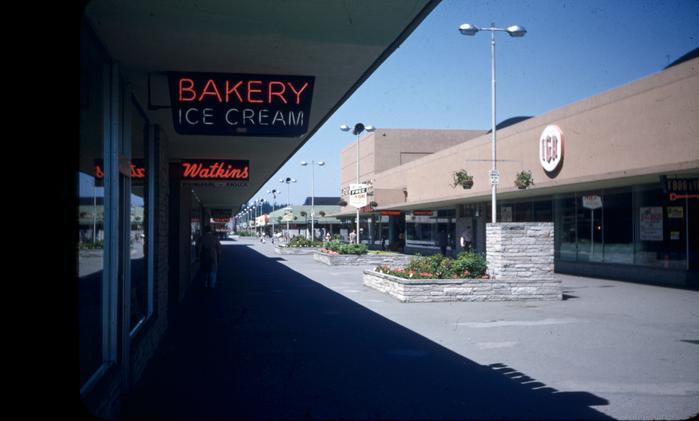
Wednesday, August 27, 2008

Bellevue, Washington's
Bellevue Shopping Square


A circa-1948 physical layout of BELLEVUE SHOPPING SQUARE. The
fledgeling shopping area had been built on the site of the Cheriton
Fruit Gardens, a strawberry farm. At the time, there was only one
anchor store...a rather small, single-level Frederick and Nelson.


A 1948 aerial view of BELLEVUE SHOPPING SQUARE, looking westward.
The complex's first Frederick and Nelson is seen in the center of the
photo. It was joined by a larger store in 1956.
Photo from Eastside Heritage Center (Bellevue)


The SQUARE is 1961. The new, 3-level Frederick and Nelson is in the
left center. J.C. Penney's original store is in the lower right.
Photo from Eastside Heritage Center (Bellevue)


With its official name shortened to BELLEVUE SQUARE, the center
was expanded throughout the 1950s and '60s. Here we have a composite
plan, covering the years between 1956 and 1967. J.C. Penney had
opened a dry goods only store in 1955. This was followed by a second
(larger) Frederick and Nelson. The third anchor of the original shopping
center, Nordstrom Best, came inline in late 1967.


Clark's Crabapple Restaurant, a circa-1946 charter tenant. This shot was
taken in 1969.
Photo from Eastside Heritage Center (Bellevue)


Another 1969 shot. Here we see two of the businesses that fronted on
Bellevue Way...on the east side of the shopping center.
Photo from Eastside Heritage Center (Bellevue)


A precursor to today's Seattle-based, upper-tier department stores.
The BELLEVUE SQUARE location seen here was rebranded as a
Nordstrom in 1973. It was replaced with a new, 180,000 square
foot store in 1981.
Photo from Eastside Heritage Center (Bellevue)


The Mamselle and Mr. Paul's Hair Design salon.
Photo from Eastside Heritage Center (Bellevue)


America's oldest Post-War shopping center becomes a bona-fide "mall"!
A total rebuild of the previous open-air complex, initiated in 1980, was
dedicated May 7, 1984. The venue now spanned over one million
leasable square feet, with a roster of one hundred and forty-five stores
and services.


A yuletide shot of the Fountain Court and Bon Marche / Macy's.
Photo from www.realtor.com / "Seamark"


One of the many concourses in the double-decked shopopolis.
Photo from Flickr / "Hideki Saito"


The Center Court's Clock Tower. It was removed
during the 2007-2008 facelift renovation.
Photo from Flickr / "Jeslu"


Crate and Barrel, and the CORNER AT BELLEVUE SQUARE, were
a year 2000 addition.
Photo from www.crateandbarrel.com


The new building occupied by the Bellevue Arts Museum was dedicated
in 2001. It sits across the street from BELLEVUE SQUARE.
Photo from Wikipedia / Gary Minnaert


Today's very upscale shopping center, the crown jewel of Kemper
Development's "BELLEVUE COLLECTION". Three urban shopping /
office / entertainment complexes are situated on three adjacent city
blocks. These developments are BELLEVUE SQUARE, BELLEVUE
PLACE and LINCOLN SQUARE.
BELLEVUE SHOPPING SQUARE
Bellevue Way and Northeast 8th Street
King County, Washington

The oldest retail entity that will be inducted into the MALL HALL OF FAME held its official grand opening August 20, 1946. Known at the time as BELLEVUE SHOPPING SQUARE, the open-air, cluster complex was the nation's first Post-World War II shopping center. It occupied a 34.3 acre site, located 9 miles east of center city Seattle.

Construction had begun in 1945, before the end of the conflict. Kemper Freeman, Sr. and his brother Miller wrangled permission out of the US government to build a new, morale-building movie theater...utilizing the scarce construction materials available.

The first BELLEVUE business to begin operation, the 560-seat Bel-Vue Theatre, opened March 20, 1946. By the end of the year, sixteen stores were inline, including a 1-level, Seattle-based Frederick and Nelson. This store was the first suburban shopping center branch of Chicago-based Marshall Field's (Frederick and Nelson had been a subsidiary since 1929).

The shopping center became part of the newly-incorporated city of Bellevue in March 1953. Additional stores were added over the following years. J.C. Penney opened a dry goods only location in 1955. Frederick and Nelson expanded into a 3-level (185,000 square foot) anchor store in 1956. Nordstrom's Shoes came inline in 1958.

By the late 1960s, BELLEVUE SQUARE ("shopping" being dropped from the center's official moniker in the early 1950s) had expanded to a fifty store shopopolis.

Stores in operation then included Clark's Crabapple Restaurant (a 1946 charter tenant), Karl Larson's Village Shoes, Florsheim Shoes, Mamselle and Mr. Paul's Hair Design, Uncle Harold's and the Pacific National Bank. Moreover, a second anchor store, Nordstrom Best, had been officially dedicated December 1, 1967.

CROSSROADS CENTER, in Bellevue, was completed in 1962. Subsequent retail rivals for BELLEVUE SQUARE included TOTEM LAKE MALL (1973), in Kirkland, FACTORIA MALL (1975), also in Bellevue, and REDMOND TOWN CENTER (1997) in Redmond.

All of this competition probably prompted Kemper Development Company to embark upon a total rebuild of the existing, open-air complex in 1980. Leaving only the Frederick and Nelson standing, the remainder of the shopping center was demolished.

A bi-level, fully-enclosed mall was constructed, which was designed by George Wrede. In addition to the existing Frederick and Nelson, the new BELLEVUE SQUARE was anchored by three department stores.

A 3-level (180,000 square foot), Seattle-based Nordstrom was built in 1981. A 2-level (180,000 square foot) J.C. Penney was added in 1982. Finally, a 3-level (180,000 square foot), Seattle-based Bon Marche [pronounced "bon mar-shay"] came inline in 1984. With its completion, BELLEVUE SQUARE now encompassed 1,090,000 leasable square feet and one hundred and forty-five inline stores.

The bankruptcy of Frederick and Nelson in late 1991 resulted in a vacant anchor at the mall. Negotiations with New York City-based Saks Fifth Avenue fell through in early 1992.

Eventually, it was decided not to lease the 185,000 square foot space to a single retailer. Instead the area was sectioned into forty-five smaller spaces. The first of these opened for business August 1, 1993.

New stores included F.A.O. Schwarz, Ann Taylor and Brooks Brothers. Moreover, the basement level of the Frederick and Nelson building was refashioned into a 51,000 square foot Bon Marche Home Store.

Anchor stores at BELLEVUE SQUARE were refurbished in the mid-1990s. Nordstrom was expanded by 90,000 square feet (now encompassing 270,000 square feet) and J.C. Penney was enlarged into a 200,000 square foot location.

The most recent expansion of the mall was finished in 2000. A 120,000 square foot, bi-level building, THE CORNER AT BELLEVUE SQUARE, included Crate and Barrel, PF Chang's China Bistro and ZTejas Southwestern Grill. BELLEVUE SQUARE now spanned 1.3 million square feet and housed over two hundred stores and services.

Presently, a 40 million dollar renovation of the shopping venue is underway. No new retail area is to be added, but several of the major inline stores, such as Williams-Sonoma, Banana Republic and Pottery Barn, will expand into previously-existing space.

Likewise, the interior of the mall proper will be given a much-needed facelift, making it into more of an "urban-gardenlike" setting. New flooring, lighting, seating and landscaping will be installed. The project is scheduled for completion in November 2008.

Sources:

Eastside Heritage Center, Bellevue, Washington
"Bellevue Square" article on Wikipedia
www.bellevuesquare.com
www.neighborhoods.com/Bellevue Square History
www.historylink.org/Essay # 4143/Alan J. Stein/February 2003
"Bellevue: Its First 100 Years"/Lucille McDonald/Bellevue Historical Society, 2000
King County, Washington tax assessor website
Seattle, Washington's Northgate Center


Looking in on Burnett Brothers Jewelers, at the circa-1950
NORTHGATE.
Photo from University of Washington Libraries,
Special Collections, Negative DM5345


Here we see the high-end "Mid-Mod" interior of the store.
Photo from University of Washington Libraries,
Special Collections, Negative DM5342

*
An aerial view of the center, circa-1965. J.C. Penney (the large
white anchor store near the center of the photo) was a new
addition.
Photo from Malls of America Blogspot


The original center, at its official completion in 1952. All
eighty store spaces were now leased. The bulk of the
mall proper had opened in 1950. The 4-level Medical
Center and fifteen hundred seat Theatre had come inline
in late 1951.

NORTHGATE CENTER TENANTS (PARTIAL LIST) 1952:

THE BON MARCHE (with Legend Room Restaurant) / Butler Brothers / A & P supermarket / C & H supermarket / F. W. Woolworth 5 and 10 / J.J. Newberry 5 and 10 / Bartell Drug / Ernst Hardware / Bloch's / Nordstrom's Shoes / JK Grill / Burnett Brothers Jewelry / National Bank of Commerce / Firestone Tire


The north end of the complex in the 1960s. The Dudley C. Carter
Totem Pole had been erected in 1952. It was taken down in 2007.
Photo from Malls of America Blogspot


The main mallway in the mid-1960s. The "Sky Shield", installed
in 1962 as a partial protection from the elements, covers the area.
Permission for use of the photo provided by Meredith L. Clausen


The south end of the mall, as it was following the expansion of 1964-'65.
The south portal of the lower level service tunnel may be seen.
Permission for use of the photo provided by Meredith L. Clausen


Site plan of the newly-expanded mall, in 1965. A J.C.
Penney -and twenty-five inline stores- had been added;
some of these built in previously open court areas. The
center, still open-air at this time, had been partially-
enclosed, with the installation of a "Sky Shield", in 1962.
This was removed when the retail hub was completely
roofed-in, in 1974.


The south end of the mall following the Food Court renovation
of 1997.


Exterior and interior views of the Food Court at NORTHGATE
MALL. It replaced a QFC supermarket, added during the 1965
expansion.
Photos from www.coffman.com (engineers)


The latest incarnation of America's first mall. The 1997
Food Court renovation is shown in dark gray. The 2005-
2007 lifestyle expansion appears in lighter gray. This
includes the conversion of the circa-1977 Lamonts (later
Gottschalks) into Bed Bath & Beyond and DSW Shoe
Warehouse.


Junior anchor of the new "urban village" lifestyle expansion at
NORTHGATE, Barnes and Noble opened in November 2007.
Photo from www.simon.com
NORTHGATE CENTER
Northeast Northgate Way and 5th Avenue Northeast
King County, Washington

Seattle's NORTHGATE holds the distinction of being America's first quote / unquote "shopping mall". When construction of the center began in the late 1940s, there were only a few Post-World War II, suburban-style shopping centers in operation in the United States.

These were BELLEVUE SHOPPING SQUARE [August 2008 archive], in King County (nee Bellevue), Washington, BROADWAY-CRENSHAW CENTER [January 2007 archive], in Los Angeles, California, PARK FOREST PLAZA [January 2008 archive], in Park Forest, Illinois, NORTHSHORE CENTER in Beverly, Massachusetts and TOWN AND COUNTRY DRIVE-IN SHOPPING CENTER, in Whitehall, Ohio.

NORTHGATE CENTER was the first to be arranged around a lengthwise mall corridor, with stores facing each other on either side. It was also among the first shopping centers to be promoted as a "mall".

Originally an open-air structure with a single retail level and service basement, NORTHGATE was designed by Seattle's John Graham, Jr. . The complex, developed by New York City-based Allied Stores, was located 7.5 miles north of center city Seattle, on a 62 acre tract in the (then) unincorporated Maple Leaf community of King County.

The grand opening was held April 21, 1950, with the retail hub anchored by a 3-level -3 million dollar- department store, built for Seattle-based Bon Marche. There were seventeen other businesses coming inline then, including an A & P supermarket, Nordstrom's Shoes, and J.J. Newberry 5 and 10. The following year, a 4-level medical and dental clinic joined the directory.

NORTHGATE was the first shopping venue in the nation to have a "mall movie house". It had a single screen, seating for an audience of one thousand five hundred and opened in September 1951.

New stores at NORTHGATE opened in groups of five or so, with much fanfare. By 1952, all eighty spaces were leased. At this time, local sculptor Dudley C. Carter completed work on a 59 foot tall totem pole. This was installed in a fountain / plaza area -the mall's Main Entrance- along NE 110 Street. In 1954, the mall and its surrounding area were annexed into the Seattle city limits.

A "Sky Shield" roof was installed over the mall's courts and concourse in 1962. This was not a full-scale enclosure of the mall, but merely provided a bit of shelter from the elements. In 1965, the Interstate 5 expressway was completed to points north, with an interchange installed at NE Northgate Way (formerly NE 110 Street).

This spurred construction of a 10 million dollar -twenty-five store- addition, which included a 2-level (168,000 square foot) J.C. Penney and 4-level (Nordstrom-owned) Best Apparel. This 124,300 square foot store, along with an expansion of the existing Bon Marche, filled in the open Central Court area of the mall.

In 1967, the Best store was rebranded a Nordstrom Best. It became a full-fledged Nordstrom with a subsequent rebranding in 1973. Soon after, the structure was enlarged

NORTHGATE was fully-enclosed and climate-controlled in 1974...officially becomong a quote / unquote "mall". Soon after, a portion of the northeast section of the original structure was torn out. A fourth anchor store, Bellevue-based Lamonts, opened in this location in 1977. With these renovations, the mall housed over one hundred and twenty-three stores.

The first commercial competitor of NORTHGATE had been completed in 1960. AURORA VILLAGE CENTER [August 2008 archive] was located north of NORTHGATE, in the Shoreline area. Next came ALDERWOOD MALL, in Lynwood, and EVERETT MALL, in Everett. Both of these malls opened in 1979.

At the turn of the century, NORTHGATE MALL was going through more changes. Lamonts was rebranded by the Fresno-based Gottschalks chain in 1995, who closed the location in 2006.

Following the trend toward a central, coast-to-coast retail entity, the 308,800 square foot Bon Marche was rebranded under the Bon-Macy's moniker in 2003. In early 2005, the entire Seattle-based chain was "Macy-ated".

In late 2005, the theatre and medical clinic buildings were razed. In their space, part of an open-air, lifestyle component was constructed. This 100,000 square foot addition was built on the western side of the mall complex and included ten new stores and eateries, as well as a multi-level parking garage.

The old Lamonts / Gottschalks building was also gutted and rebuilt into a new DSW Shoe Warehouse (lower level) and Bed, Bath and Beyond (upper level). This latest group of renovations increased the GLA of NORTHGATE to 984,000 leasable square feet.

Seattle's center, due to its long history, is surely the "grandaddy of theMALL". The shopping center is owned and operated by the Indianapolis-based Simon Property Group, who acquired the property in 1987.

Sources:

"Northgate Mall" article on Wikipedia
"Bon Marche' " article on Wikipedia
"Gottschalk's" article on Wikipedia
www.historylink.org:Essay # 3186 / "Northgate Shopping Mall Opens On April 21, 1950" / David Wilma /August 2, 2001
Essay # 228 / "Northgate Beginnings: Jim Douglas Remembers" / Jim Douglas /Jan 1, 1999
http://www.northgateshoppingctr.com/
www.cinematreasures.com / "Northgate Theatre" article
http://www.simon.com/
King County, Washington tax assessor website
King County, Washington's
Aurora Village Center

Photo from Malls of America Blogspot


A circa-'62 physical layout of the open-air shopping venue. The center
was the second to be developed by the Continental West Company. The
first, UNIVERSITY VILLAGE (in Seattle), was completed in 1956. The
third, WESTWOOD VILLAGE (also in Seattle), came inline in 1964.


The fully-enclosed version of AURORA VILLAGE, around 1979. A
second anchor -Nordstrom- had been built on the west end. It was
completed in 1974 and was the first store in the chain to open with
a Nordstrom nameplate. The mall now encompassed 550,000 leas-
able square feet, with a retail roster of sixty stores.
AURORA VILLAGE CENTER
Aurora Avenue North and North 205th Street
King County, Washington

Metropolitan Seattle's fourth mall-type shopping center was located in the city's northern environs. AURORA VILLAGE CENTER sat upon 35 acres, 13.9 miles north of Seattle's downtown area. The site, then in unincorporated King County, was adjacent to Snohomish County's southern boundary.

Originally an open-air mall of fifty stores, AURORA VILLAGE CENTER was developed by the Continental West Company and opened in 1960. It featured a 40,000 square foot F.W. Woolworth, 30,000 square foot (dry goods only) J.C. Penney, 21,000 square foot Pay 'n Save Drug and a Lucky supermarket.

Other inline stores were Nordstrom's Shoes, Ernst Hardware, Joy Jacobs, Buster Brown Shoes, Turner Jewelers and Kinney Shoes. A 3-level (180,000 square foot), Seattle-based Frederick and Nelson opened, on the east end of the main concourse, in 1962.

Commercial competitors of AURORA VILLAGE included NORTHGATE CENTER / MALL (1950), in King County / Seattle and ALDERWOOD MALL (1979), in Lynnwood.

As a "keep up with the malls" measure, AURORA VILLAGE was fully-enclosed in 1979. By this time, a 2-level (71,000 square foot) full-line Nordstrom had been added, along with a small parking deck. The newly-renovated center, now going as AURORA VILLAGE MALL, encompassed 550,000 leasable square feet and sixty stores and services.

Between 1985 and 1990, the Aurora Village IV cinema was in operation at the mall, taking the place of the shuttered Lucky supermarket. By this time, the shopping center was in a downward spiral of decline. This was exacerbated by the closing of Frederick and Nelson in early 1991. The final nail in the proverbial coffin came on May 30, 1992, when Nordstrom closed its doors for good.

The redevelopment of the struggling retail hub had been on the drawing board for several years. The plan was to raze the mall, with its two anchors left standing. These were to be worked into a new 777,000 square foot complex with two levels of retail, a food court, multiplex cinema and over one hundred and forty stores and services.

However, financing for the project was never secured. The mall fell into disrepair and became a haven for crime. It changed hands three times between 1987 and 1992. The final proprietor, New York City-based Citicorp, acquired the property by default in October 1992. With its anchor stores -and most of the mall- sitting vacant, they decided to raze the entire structure. Demolition commenced in late 1993.

A 370,000 square foot power center, known as AURORA VILLAGE CENTER, debuted in June of 1994. It included a 1-level (156,000 square foot) Costco, 1-level (130,000 square foot) Home Depot and Big 5 Sporting Goods (a tenant of the original mall).

Sources:

Malls of America Blogspot / Keith Milford webmaster
Seattle Times
Cinema Treasures
Tacoma, Washington's Tacoma Mall


Photo from Malls of America Blogspot


A composite site plan of TACOMA MALL, in its earlier stages. The
1964-1966 center is indicated in black. The West Wing expansion,
completed in 1973, appears in medium gray. Additions done in the
1980s are shown in darker gray.


The center's central anchor store, Seattle-based Bon Marche. Its out-
parcel Auto Center appears in the lower left.
Photo from Malls of America Blogspot / Tyler Kaye


Circa-'60s shot of the Center Court Fountain.
Photo from Malls of America Blogspot


Another vintage photo, taken in the East Court. A "new look" J.C. Penney
nameplate is barely visible in the background.
Photo from Malls of America Blogspot


A circa-2000s shot of the original Main Entrance, a Mid-Mod
architectural gem. It has been razed...and is being replaced by
yet another "urban-garden-like" lifestyle-format addition.
Photo from www.simon.com


The mall's Central Court, once called "The Columnarium".
Friedlander's Jewelers, which was the last remaining charter
tenant, is seen on the far left. The store has since been
replaced by Kay Jewelers.
Photo from www.simon.com


Exterior and interior views of the TACOMA MALL Food Court.
It replaced the old Lucky supermarket in 2000.
Photos from www.simon.com


Two renderings of the new lifestyle expansion at TACOMA MALL.
Simon says the three-phase project will be completed in the fall of
2009.
Renderings from www.simon.com


A circa-2009 physical layout of TACOMA MALL, as it will be configured
following the completion of its latest renovation. The vacant Liberty
House / Frederick and Nelson / Mervyn's (on the west end) has been
replaced by a new Nordstrom. The old Nordstrom is gone, with its
space devoted to a portion of the new "urban garden" lifestyle addition
(indicated in medium gray).
TACOMA MALL
South 47th and South Pine Streets
Tacoma, Washington

The first fully-enclosed shopping center in the Sea-Tac metropolis was built on a 79 acre plot, lying 34 miles southwest of downtown Seattle.

TACOMA MALL was designed by John Graham, Jr. . It was the second Seattle area mall developed by New York City-based Allied Stores (the parent company of Seattle-based Bon March). The shopping center was anchored by a 3-level (205,500 square foot) Bon Marche, which opened in August 1964.

A 2-level (135,000 square foot) J.C. Penney came inline -with the bulk of the original mall- in October 1965. The last of the charter anchors, a 2-level (Nordstrom-owned) Best apparel, opened in August 1966. The store was refitted with a Nordstrom Best nameplate in 1967 and a Nordstrom nameplate in 1973.

The single-screen -1,200 seat- Tacoma Mall Theatre opened, as a northeast parking area outparcel, in 1968. It was twinned in 1974, shuttered in July 2002 and razed soon after.

The first expansion at TACOMA MALL was completed in 1973, with the addition of a West Wing and 2-level (72,000 square foot), Honolulu-based Liberty House department store. This became a Seattle-based Frederick and Nelson in 1979 and a Mervyn's in 1992.

The second mall expansion, in 1981, brought additional stores and a 2-level (179,300 square foot) Sears. Two years later the existing Nordstrom was expanded to 134,000 square feet. A third level was also built onto the existing J.C. Penney in 1986, increasing its GLA to 200,000 square feet.

TACOMA MALL was acquired by the Indianapolis-based Simon Property Group in 1987. The venue's closest competing shopping center was VILLA PLAZA (1957), in Lakewood, which became LAKEWOOD MALL in 1989. There was also SEA-TAC MALL (1975), in Federal Way, SOUTH HILL MALL (1988) in Payallup and SUPERMALL OF THE GREAT NORTHWEST (1995), in Auburn.

After the shuttering of the TACOMA MALL Mervyn's in February 2007, a third major renovation of the center got underway. Mervyn's was razed, with a 2-level (144,000 square foot) Nordstrom being built on the spot. It is scheduled to open October 3, 2008.

The entire complex is also being renovated, with its remaining "Mid Mod" sections being ripped out. A 105,000 square foot, open-air "lifestyle expansion" will be built on the south-facing front of the mall, replacing the old Nordstrom in the process.

This it to open in two phases; the first came inline in the spring of 2008, the second will be completed in the fall of 2009. The shopping venue will then encompass 1,329,000 leasable square feet.

Sources:

Malls Of America Blogspot / "tkaye" comment
Comment post by Mark Bozanich
Pierce County, Washington tax assessor website
www.simon.com
www.cinematreasures.com
Tukwila, Washington's Southcenter Mall


A circa-'68 SOUTHCENTER site plan. At its inauguration in July, it
was the Evergreen State's largest enclosed shopping center.


The south-facing facade of the mall, as it appeared in 1968. The
Penney's was the largest store in the chain until being trumped
by the location in Chicago's WOODFIELD MALL, which opened
in 1971.
Photo from Malls of America Blogspot


The original mall's west side, with Mount Ranier towering in the back-
ground. SOUTHCENTER was the first Seattle mall to include both of the
Jet City's premier department stores; The Bon Marche and Frederick
and Nelson (seen here).
Photo from Malls of America Blogspot


The stunning atrium at SOUTHCENTER, known as the "Columnarium".
It was very similar to one at TACOMA MALL.
Photo from www.dshistory.com


East Court, which was nearly identical to the one at SOUTHCENTER's
sibling mall in Tacoma. The only visible difference between the two
was the ornate chandeliers which hung from the vaulted ceilings. The
one at SOUTHCENTER (seen here) was larger.
Photo from Malls of America Blogspot


An auto show, taking place in the East Court in the late 1960s.
Photo from www.westfield.com


SOUTHCENTER, circa-1993. Several changes had been made since
the mall opened, twenty-five years before. Nordstrom Best was
expanded into a full-line Nordstrom in 1973. The Lucky supermarket,
closed in 1989, was rebuilt into a Food Court. In 1992, Frederick and
Nelson closed, soon reopening as a Sears. Also, Mervyn's was added as
part of a northeast section of stores.


A present-day site plan of the recently-expanded mall. The southeast
portion of the original, single-level structure (indicated in black) was
razed, being replaced by part of the three-level addition (shown in
medium gray), that was dedicated in 2008...six days after the 40th
anniversary of the mall's inauguration.


A rendering showing the south-facing facade of Westfield's SOUTH-
CENTER expansion. Ground was broken for the 240 million dollar
project in May 2006. The grand opening took place in July 2008.
Rendering from www.westfield.com


A blending of the old and new. Here we see the original, circa-'68
"Columnarium" entrance...viewed from the second level of the
new South Wing.
Photo from www.thesledgehammer.wordpress.com / Brian Lutz


The "Cove" Entrance at WESTFIELD SOUTHCENTER
leads into the "Valley", the mall's new South Wing of
boutiques and bistros. A 16-screen AMC multiplex
comprises the third level of the addition.
Photo from Wikipedia / "J Winters"


An interior view of The Cove, showing the second level "Dining Terrace".
Photo from Wikipedia / "J Winters"
SOUTHCENTER MALL
Strandler Boulevard and Andover Park West
Tukwila, Washington

The third Seattle shopping center developed by Allied Stores was dedicated July 31, 1968. SOUTHCENTER MALL, designed by John Graham, Jr., occupied 30 acres, at the confluence of the Interstate 5 and 405 expressways, lying 12 miles southeast of center city Seattle.

At the time the state's largest retail venue, SOUTHCENTER featured one hundred and sixteen stores on a single level. Its anchors were a 3-level, Seattle-based Bon Marche, 2-level (240,000 square foot) J.C. Penney...the largest in the chain. There was also a 2-level, Seattle-based Nordstrom Best and 2-level (170,800 square foot), Seattle-based Frederick and Nelson.

Some of the inline stores at the original mall were Richardson's apparel, Heidi's Chocolates, Tinder Box Tobacconist, Paris Hats, Florsheim Shoes, Friedlander's Jewelers, Pay 'n Save Drug and a Lucky supermarket.

Southcenter Theatre, a northwest parking lot outparcel, opened April 1, 1970. It seated one thousand two hundred and twenty-eight and was the last Cinerama-capable venue built in the United States. It closed August 5, 2001 and was demolished in the following year.

The first expansion of the mall involved the enlargement of the existing Nordstrom Best into a full-line, 165,900 square foot Nordstrom, in 1973. The next augmentation of retail area occurred in 1992, when a 2-level (86,000 square foot) Mervyn's was added as an anchor of a twenty-store, northeast addition. By this time, Bon Marche had been enlarged into a 250,400 square foot location.

SOUTHCENTER lost Frederick and Nelson as an anchor when that store was shuttered in May 1992. Soon after, Sears moved into the vacant space. The mall now encompassed 1.5 million leasable square feet and one hundred and thirty-six stores and services.

Retail rivals consisted of SEA-TAC MALL (1975), in Federal Way, FACTORIA MALL (1975), in Bellevue and SUPERMALL OF THE GREAT NORTHWEST (1995), in Auburn.

Australia-based Westfield acquired the mall in April 2002, saddling it with WESTFIELD SHOPPINGTOWN SOUTHCENTER as its official name; "Shoppingtown" being dropped in 2004.

The most recent anchor store rebranding at WESTFIELD SOUTHCENTER was finalized in January 2005, when Bon Marche (going under the Bon-Macy's moniker for two years) was "Macy-ated".

A large-scale expansion got underway May 11, 2006. The 240 million dollar construction project was to include 300,000 square feet of new mall space. Seventy-five stores opened (or relocated from the existing mall), a "Dining Terrace" replaced the existing Food Court, a 16-screen AMC multiplex was built and two parking garages were added.

The new three-level South Wing included toney retailers, such as H & M, White House / Black Market, Mark Ecko Cut and Sew and Banana Republic. It was dedicated July 25, 2008, increasing the mall's size to 1.7 million leasable square feet, with more than one hundred and seventy-five stores and services.

Sources:

"Westfield Southcenter" article on Wikipedia
www.westfield.com
Malls of America Blogspot / Keith Milford webmaster

Friday, August 15, 2008

Lincoln, Nebraska's Gateway Center


The open-air mall's expansive Central Court. Montgomery Ward is on
the right.
Photo from Malls of America Blogspot


The original, open-air GATEWAY CENTER. The 450,000 square foot
retail hub opened in September 1960...the same month that Omaha's
CROSSROADS MALL was completed.


GATEWAY CENTER became a quote / unquote "mall" during its early
'70s renovation. A fully-enclosed concourse (indicated in dark gray) was
added to the east side. It featured a lower level parking deck and fourth
anchor store. A third (Omaha-based Brandeis) was also built on the
northwest corner of the circa-'60 center (indicated in black).


Sears, a component of the 1970-1971 expansion.
Photo from Lancaster County, Nebraska tax assessor website


A Christmas ad from the mid-1970s. The shopping
center's old logo may be seen in the lower left corner.
Photo from Malls of America Blogspot


The mall's second J.C. Penney. This full-line store replaced a
much smaller outparcel location in 1995.
Photo from Lancaster County, Nebraska tax assessor website


A circa-1996 site plan. The mall had just emerged from a second large-
scale expansion, which included the addition of a 57,000 square foot
Northeast Wing and 125,800 square foot Penney's. The original, open-
air section (on the west side) had also been fully-enclosed.


The exterior of the mall's new Food Court, dedicated
in November 2005.
Photo from Lancaster County, Nebraska tax assessor website


An interior view of the Food Court. It was the second culinary complex
installed in the mall. An earlier version, in the newly-enclosed Center
Court, was dedicated in the summer of 1996.
Photo from www.westfield.com


A contemporary aerial view of WESTFIELD GATEWAY, looking eastward.
Younkers is the structure in the lower left, Sears is at the upper right.
Photo from www.westfield.com


The WESTFIELD GATEWAY of 2008. The new Food Court is shown
in light gray. The 2005 renovation also included a new Steve and
Barry's and Qdoba Mexican Grill (in the old Ward's space). The old
Auto Center had been razed and replaced with Granite City Food
and Brewery.


GATEWAY CENTER
O Street / US 17 and North 66th Street
Lincoln, Nebraska

As work was nearing completion on Omaha's CROSSROADS CENTER [November 2007 archive], the Corn Husker State's first enclosed shopping mall, the state capital was also inaugurating its first -and only- mall-type shopping center on a 76.2 acre parcel, located 3.7 miles east of the center city.

GATEWAY CENTER, developed by Lincoln-based Bankers Life Insurance Company of Nebraska, opened in 1960. It was an open-air format complex, consisting of an upper retail level, with a small basement area of store spaces and offices.

Originally encompassing 450,000 leasable square feet, the shopping venue was anchored by a 3-level (156,800 square foot), Lincoln-based Miller and Paine and 2-level (109,700 square foot) Montgomery Ward.

The existing mall was expanded in 1970-1971. Omaha-based Brandeis (pronounced "bran-diys") added a 2-level (101,700 square foot) store on the center's northwest corner.

In addition, a fully-enclosed concourse was built on the east side of the mall structure, which was anchored by a 2-level (120,600 square foot) Sears. Enclosed parking was provided on the lower level of this new wing.

Moreover, a separate parking garage was also constructed adjacent to the Miller and Paine and Brandeis stores. Now officially known as GATEWAY MALL, the shopping venue housed 803,000 leasable square feet.

Anchor store alterations began in 1987, when Younkers (then headquartered in Des Moines) bought out the Brandeis chain. In the following year, Miller and Paine was rebranded by Dillard's.

GATEWAY MALL had no real commercial competitors until SOUTHPOINTE PAVILIONS (1998), an open-air lifestyle center, opened. This was followed by SHOPPES AT PRAIRIE VILLAGE, also a lifestyle center, which came inline in 2008.

The second expansion of GATEWAY MALL got underway in 1994. This project entailed the addition of a thirteen-store Northeast Wing and 2-level (125,800 square foot) J.C. Penney. The original, open-air mallway was also fully-enclosed, with a Food Court installed in the newly-created Center Court area. Work was completed in the summer of 1996.

With the new century came the shuttering of Montgomery Ward. In 2001, the retail complex was acquired by the Australia-based Westfield Group [March 2008 archive]. Taking on the standard Westfield mall moniker WESTFIELD SHOPPINGTOWN GATEWAY, the center received a truncated title -WESTFIELD GATEWAY- in mid-2005.

The third major renovation of the mall was dedicated November 4, 2005. A new 10-bay Food Court had been installed and the Center Court was renovated, with a carousel added to the north end.

Moreover, the 45 million dollar remodel gave the exterior a new "prairie-style" facade. Likewise, the old Ward's spot was refitted with a Steve and Barry's University Sportswear and Qdoba Mexican Grill.

With these -and other- renovations, WESTFIELD GATEWAY encompassed 969,300 leasable square feet, with one hundred and twenty-two store spaces.

Sources:

"Westfield Gateway" article on Wikipedia
www.westfield.com/gateway
Lancaster County, Nebraska tax assessor website
www.eyecorp.com
Malls of America Blogspot / Keith Milford webmaster
Cedar Rapids, Iowa's Lindale Plaza


The shopping center's second anchor, a 148,000 square foot Sears.
Photo from Linn County, Iowa tax assessor website


LINDALE PLAZA, as it was situated in the 1960s. The complex officially
became LINDALE MALL after its 1980 enclosing renovation.


The mall's north-facing facade was expanded, with an 8-bay Food Court
and seven new inline stores, in 1996-1997.
Photo from Wikipedia / "IowaHighwayman"


A 2008 physical layout of the 693,000 square foot center. The two
original anchors are the same as they were in 1960. The smaller
junior anchor spot was taken over by Iowa-based (Petersen Harned)
Von Maur in 1981.
LINDALE PLAZA
Collins Road Northeast and 1st Avenue Northeast / US 151
Cedar Rapids, Iowa

Iowa's City of the Five Seasons was the site of one of the Midwest's early Post-World War II shopping centers. The parent company of today's General Growth Properties [March 2008 archive] opened their TOWN AND COUNTRY SHOPPING CENTER there in 1954. Six years later, the city's first shopping mall came inline.

LINDALE PLAZA occupied a 40.8 acre plot, 6.8 miles northeast of downtown Cedar Rapids. Developed by Chicago-based Bernard Greenbaum and Associates, the open-air venue consisted of a single retail level, with a basement that included a small group of retail spaces and offices.

Originally housing thirty-five stores, the retail hub was dedicated September 15, 1960. Its anchors were a 2-level (200,000 square foot) Des Moines-based Younkers and 1-level (148,000 square foot) Sears. A 1-level (59,500 square foot), Cedar Rapids-based Killian's served as a junior anchor.

Inline stores included Bishop's Buffet, Craemer's College Clothes and an S.S. Kresge 5 and 10. An Eagle Food Center was a west parking area outparcel. This was followed by the single-screen Plaza Theatre, a south parking area outparcel, which was completed in 1967.

The shopping complex was fully-enclosed in 1980, becoming LINDALE MALL. This renovation was done as a response to the new WESTDALE MALL, that had opened -in southwest Cedar Rapids- in October 1979.

The first -and only- anchor store rebranding at LINDALE MALL took place in 1981, when Davenport-based Petersen Harned Von Maur assumed the Killian's space. The name of the aforementioned retail chain was shortened to simply Von Maur in 1989.

The only physical expansion of the shopping venue was completed in August 1997. An 8-bay Food Court -and seven-store North Wing- were built on the front of the existing structure, with a multi-level parking deck being constructed on the northwest. With this fifteen million dollar addition, the mall encompassed 693,400 leasable square feet and ninety store spaces.

By the late 1990s, the mall had changed hands on two occassions. The third sale was transacted in March 1998, when the Indianapolis-based Simon Debartolo Group (now Simon Property Group) [March 2008 archive] entered into a joint venture with the Santa Monica-based Macerich Company [March 2008 archive].

Twelve malls were acquired. These were located in Iowa, South Dakota, Colorado, Indiana, Pennsylvania and Virginia. Simon assumed management at six centers; Macerich took control of the other six...which included LINDALE.

A renovation of the mall's interior spaces took place in 2003; completed that December. During this project, the basement of Younkers was refitted into a lower mall level, with eleven new retail spaces. LINDALE MALL now housed one hundred stores and services.

Sources:

"Lindale Mall" article on Wikipedia
www.macerich.com
Linn County, Iowa tax assessor website
http://www.cinematreasures.com/
Fort Smith, Arkansas' Central Mall


Photo from Sebastian County, Arkansas tax assessor website


The shopping center in 1986. The original, circa-1971 structure
is indicated in black. The expansion of the mid-'80s is shown in
gray.


CENTRAL SHOPPING CENTER, considered a peripheral structure
of the mall, actually predated it by two years.
Photo from www.loopnet.com


The 126,000 square foot Dillard's was added to the mall in 1985-
1986.
Photo from Sebastian County tax assessor website


The center's 8-bay Food Court was installed in 1999.
Photo from www.joneslanglasalle.com


The Malco Mall Trio Cinema, occupying the northwest corner of the
mall proper.
Photo from www.malco.com


A present-day physical layout of CENTRAL MALL. The 863,300
square foot complex assumes the position of the largest mall in the
state following the 2008 demolition of Little Rock's 1,210,000 square
foot UNIVERSITY MALL.
CENTRAL MALL
Rogers Avenue and South 54th Street / Waldron Road
Fort Smith, Arkansas

The fourth shopping mall in the Natural State was built on a 54 acre site, lying 3.6 miles southeast of the Fort Smith CBD. This fully-enclosed retail hub was situated south of the CENTRAL SHOPPING CENTER, a 197,600 square foot strip complex that had opened in 1969.

Developed by Fort Smith-based Warmack and Company, CENTRAL MALL was dedicated in 1971. Encompassing 690,800 square feet of retail area, the center was comprised of a Main Level of stores, with a Second Level devoted to leased office spaces.

Original anchors of the shopping venue were a 2-level (180,200 square foot) J.C. Penney and 1-level (108,000 square foot) Sears. It is likely that the circa-'71 mall also had a 1-level (35,700 square foot) Dillard's as a junior anchor.

An expansion of the mall proper was completed in 1986. A 2-level (126,000 square foot) Dillard's was added as an anchor of a 3-level (ten-store) Northeast Wing.

The inline store segment of this expansion featured a Second Level of leased office spaces. Moreover, the basement of the entire addition (including the new Dillard's) included an underground parking deck and a small suite of offices.

It appears likely that, with the addition of the full-line Dillard's, the 35,000 square foot junior anchor of the mall became a Dillard's Men's Store.

As the preeminent shopping center in the region, CENTRAL MALL had no sizable commercial competition. PHOENIX VILLAGE MALL (1970), was a 489,000 square foot community-type center and MASSARD CROSSING (1997), consisted of a 300,700 square foot, open-air strip center.

Subsequent renovations of CENTRAL MALL were carried out in 1999 and 2002. During the first remodeling, previously-existing store space in the center of the structure was gutted and expanded into an 8-bay Food Court.

The second project entailed the addition of a four-store, expanded Main Entrance, which also included a facelift of the front-facing facade of the mall. With these renovations, CENTRAL MALL encompassed 860,000 leasable square feet and ninety stores and services.

CENTRAL MALL was acquired by Atlanta-based Gregory Greenfield and Associates in August 2005. At this time, Chicago-based Jones Lang LaSalle was recruited to manage the complex. In May, 2007, Gregory Greenfield and Associates became a subsidiary of Australia-based Babcock and Brown.

Sources:

"Central Mall" article on Wikipedia
Sebastian County, Arkansas tax assessor website
www.centralmallfortsmith.com
www.joneslanglasalle.com
Tulsa, Oklahoma's Woodland Hills Mall


The original Dillard's Court at WOODLAND HILLS. The fountain was
removed during a 1995 renovation.
Photo from www.greatamericaparks.com / Steven Wilson


A circa-1977 site plan of the Phase I structure. The three-anchor, bi-
level shopopolis was the third mall-type retail center in the Tulsa
metropolitan area.


The east end of the original shopping complex. Here we see
the northern half of the John A. Brown Court and the East
Mall Entrance...as it existed before the construction of the
Phase II expansion, that got underway in the early 1980s.
Photo from www.greatmericaparks.com / Steven Wilson


The shopping center, following the completion of its Phase II expansion,
in 1982. The addition brought a 16-bay Food Court, approximately thirty
inline stores and a 152,800 square foot Sanger-Harris.


Today's WOODLAND HILLS MALL. After thirty-two years and two
renovations, it retains its status as the largest mall in Oklahoma, a
title it has held since 1982. It has 72,500 more leasable square feet
that the next contender, Oklahoma City's QUAIL SPRINGS MALL.
WOODLAND HILLS MALL
East 71st Street South and South Memorial Drive
Tulsa, Oklahoma

UTICA SQUARE, one of Oklahoma's earliest Post-World War II shopping centers, opened in May 1952. At the time, the venue was considered to be on the suburban outskirts of Tulsa.

Development of the southern environs of the city progressed through the late 1950s and early 1960s. In 1965, TULSA PROMENADE (nee SOUTHLAND CENTER), the region's first shopping mall, was dedicated. This was followed by SOUTHROADS MALL (1967), which was located north of (and adjacent to) SOUTHLAND.

By the mid-1970s, the outskirts of Tulsa had extended to the site of the city's newest shopping mall, being developed by the Minneapolis-based Dayton-Hudson Corporation [August 2008 archive].

WOODLAND HILLS MALL was situated on an 86 acre plot, 10.8 miles southeast of the center city. The first phase of the venue was dedicated in August 1976.

The 2-level, fully-enclosed complex was anchored by a 3-level (274,100 square foot) Dillard's, 2-level (156,100 square foot) Sears and 2-level (126,300 square foot), Oklahoma City-based John A. Brown (by then, a Dayton-Hudson subsidiary).

Inline stores included Casual Corner, Athlete's Foot, Gifts III, Musicland, B. Dalton Bookseller, Florsheim Shoes, Regal Shoes and a Piccadilly Cafeteria. The Woodland Hills IV cinema was dedicated in 1979, as a northern outparcel of the mall proper. It remained in business till 2001 and was demolished in January 2002, being replaced by a Wal-Mart SuperCenter.

A second phase of the WOODLAND HILLS MALL came inline in 1982. This addition was anchored by a 2-level (152,800 square foot), Dallas-based Sanger-Harris. The expansion increased the leasable square footage of the center to 1.2 million, making it the Sooner State's largest shopping mall.

The first anchor store rebranding took place in 1984. Dillard's acquired the John A. Brown chain, but already had a location at WOODLAND HILLS. The center's now-defunct John A. Brown reopened as a J.C. Penney. In 1987, Sanger-Harris received the nameplate of Houston-based Foley's. This was replaced by a Macy's moniker in September 2006.

By the 1980s, WOODLAND HILLS had been positioned as the mall in Tulsa. Commercial competition was attempted. Construction started on EASTLAND MALL in the 1970s, but stalled-out soon after. The project sat unfinished for several years, but was completed in 1986.

In the same year, KENSINGTON GALLERIA, a rather upscale, mixed-use complex, came inline. However, it -and EASTLAND- proved to be no match for WOODLAND HILLS.

The interior of the mall proper received a facelift renewal in 1995. During this project, the circa-'70s chrome and natural wood finishes were modernized. New skylights and flooring were also installed.

A new owner for WOODLAND HILLS came on the scene early in the 21st century. Three major American Real Estate Investment Trusts [see March 2008 archive] fought for control of the financially-troubled, Rotterdam, Holland-based Rodamco Corporation.

Eventually settling on dividing up the assets of the concern, Westfield Holdings (now the Westfield Group), the Simon Property Group and Rouse Company each acquired a portion of Rodamco's substantial real estate portfolio. Simon's share -consisting of thirteen malls- included WOODLAND HILLS. The company assumed control of the property in January 2002.

In 2008, the 1.2 million square foot shopping center, still the state's largest, houses one hundred and sixty-five stores and services.

Sources:

www.simon.com
www.greatamericaparks.com / Steven Wilson webmaster
www.losttulsa.com / Tom Baddeley webmaster
www.cinematreasures.com

Tuesday, August 05, 2008


One could call the Minneapolis metropolis the Mother City of the American Mall. The nation's very first regional-class, fully-enclosed shopping center opened there, in suburban Edina, in October 1956.

SOUTHDALE CENTER, built by the Minneapolis-based Dayton Company, was the first of four DALE-designated shopping malls. The second, BROOKDALE, in Brooklyn Center, was dedicated in 1962. ROSEDALE, in Roseville, came along in 1969.

The final foray for the company, by then known as the Dayton-Hudson Corporation, was Minnetonka's RIDGEDALE, completed in 1975.

The harsh Minnesota winters surely had a lot to do with the proliferation of climate-controlled shopping centers in and around the Twin Cities. By 1962, with interior malls still seen as a new-fangled novelty, there were five such centers in the metro area.

As a for-instance, in 1962 there were no interior malls in Washington, D.C., Atlanta, Los Angeles, Boston, Seattle, San Francisco-Oakland, Denver, St. Louis or even Milwaukee. Inclement weather or not, the Minnesota metropolis was quite trend-setting...shopping mall-wise.


Click on the image for a larger view.
The map above, circa-2008, shows the locations of the four "Dales", as well as some other major shopping centers of Minneapolis-St. Paul. These include the first, completed in 1956, up to the latest lifestyle format complex, which will open in 2009.

Two of the early-era malls no longer exist...at least not as fully-enclosed shopping centers. APACHE PLAZA (1961) [September 2007 archive] was demolished in April-May 2004. It was replaced with a rather mundane power center, dedicated in 2005.

SIGNAL HILLS MALL originally opened as a strip center in 1959. It was roofed-in in 1961. The enclosed section, and the department store that anchored it, were demolished in 1999. Today, this moribund mall is also a power center.

So, dust to dust. Let us now focus on the Dayton / Dayton-Hudson "Dales".
Edina's Southdale Center


A composite upper and lower level site plan of the original 1956 mall.
The shopping center was situated around its dramatic, bi-level
Garden Court, with fountains, tropical plantings, a bird aviary and
sidewalk cafe.


After fifty-two years and three expansions, SOUTHDALE hardly
resembles the mid-20th century mall it started out as. The circa-
1956 structure is indicated in black. The additions of 1972, 1992
and 2002 are shown in medium gray. A fourth remodeling, plan-
ned to get underway in the next few years, will add a lifestyle wing
-and possibly a Neiman Marcus- in the place of the vacant
Mervyn's.

Monday, August 04, 2008

SOUTHDALE CENTER
West 66th Street and France Avenue South
Edina, Minnesota

Following the success of his NORTHLAND CENTER [May 2008 archive] project in suburban Detroit, Victor Gruen was on a roll. Soon after its completion in 1954, he was commissioned by the Dayton Company to design a shopping center for metro-Minneapolis. Known as SOUTHDALE CENTER, it opened for business on October 8, 1956, as the first regional-class, enclosed shopping center in the United States.

The revolutionary retail complex was also the first to feature decorative works of art in its interior spaces. Moreover, SOUTHDALE was rather revolutionary in its "introverted" design.

Whereas previous shopping centers faced out, toward their parking lot, most stores in SOUTHDALE faced in...with their entrances and signage on the inside of the mall. The unified "mall aesthetic" of the exterior was not compromised by the sight of several individual storefronts and signs.

Modeled in the idea of a European city center or galleria, the mall was, at the same time, unique. It was a suburban center, a congregating and socializing place fitted to America's emerging car culture. It was to be a new-era, reworked town center of the future.

Gruen's plans for the mall to be the nucleus of subsequent development, which was to include homes, schools and parks, did not come to pass as planned. Nonetheless, SOUTHDALE was a model for the mega-malled America of the 1960s and '70s. This was not what Gruen had had in mind.

The original 20 million dollar, 800,000 square foot center was situated on an 82 acre tract, eight miles southwest of downtown Minneapolis, in the Village of Edina. SOUTHDALE was centered around a 3-story, 100 foot wide, "Garden Court", which had tropical landscaping, statues, a fountain and bird aviary.

There were two retail levels and a subterranean "truck road", connected with tenant stores via elevators, stairs and hallways; all of this out of sight of mall shoppers.

The split-level parking area, and how it was interconnected with the two retail levels of the mall, was innovative in design. Its lots were named for animals, such as "Alligator", "Rooster" and the like. This was done to make it easier for shoppers to remember how to get back to their cars, parked somewhere in the five thousand two hundred spaces originally provided.

The main anchor at the 1956 SOUTHDALE grand opening was the 4-level (238,000 square foot), Minneapolis-based Dayton's department store. The initial tenant list of fifty-eight also included a 3-level (179,000 square foot), Minneapolis-based Donaldson's, an F.W. Woolworth 5 and 10, Red Owl supermarket, and Walgreen's pharmacy, as well as a bank, hardware store, seven restaurants and cafes, eleven apparel shoppes, five shoe stores and a US Post Office.

Minnesota's first twin cinema, the Southdale I and II, opened in 1966. The one thousand nine hundred and fifty seat theater was built as an outparcel to the mall and was located in its southwest parking area.

The first renovation at SOUTHDALE added a new northeast wing and 4-level (247,000 square foot) J.C. Penney. The project was completed in 1972.

Regional retail rivals of SOUTHDALE were KNOLLWOOD MALL (1972), in St. Louis Park and EDEN PRAIRIE CENTER (1976), in Eden Prairie. GALLERIA EDINA, situated adjacent to the south side of the SOUTHDALE site, started out in 1959 as a freestanding furniture store. This was expanded into an enclosed shopping center in 1974.

Fearing major competition from the superregional MALL OF AMERICA, which was being built only four miles southeast, the owners of SOUTHDALE started a large-scale expansion in the early 1990s.

This included gutting the old Dayton's anchor, constructing new stores in its space and building a much larger (359,600 square foot) store to the northwest. The Garden Court was doubled in size and a multi-level parking garage added, as well. These improvements were completed in 1992.

The most recent remodel of the mall was done in 2001-2002. A new 16-screen multiplex cinema was added to the southeast, along with more stores and restaurants. A fourth level of shoppes, Trendz On Top, was constructed over those stores which had been built in place of the old Dayton's. Two more parking garages were also added.

These additions increased the leasable square footage at SOUTHDALE to over 1.2 million, with one hundred and forty-eight stores currently on the shopping center's directory.

After three major renovations, the complex does not even resemble the "Mid-mod" mall that it evolved from. The Dayton's store morphed into Marshall Field's in 2001 and was "Macy-ated" in 2006.

The old Donaldson's was rebranded a Chicago-based Carson Pirie Scott in 1987 and Hayward, California-based Mervyn's in 1995. The 179,000 square foot store was shuttered in May 2004 and remains vacant to this day.

The Indianapolis-based Simon Property Group assumed ownership of SOUTHDALE CENTER in April 2007. The company -in a joint venture with San Francisco-based Farallon Capital Management, Limited Liability Company- acquired the Arlington, Virginia-based Mills Corporation. SOUTHDALE had been a Mills property since January 2005.

The latest news concerning the mall tells of a new open-air, lifestyle wing that is to take the place of the shuttered Donaldson's / Carson's / Mervyn's. Rumor has it that Dallas-based Neiman Marcus will anchor the one hundred million dollar expansion, which is slated for completion in 2010.

Sources:

"Southdale" article on Wikipedia
Malls of America Blogspot / Keith Milford, webmaster
Cinema Treasures.com
Southdale Tenant List / Press Release / Ruder & Finn, Inc. / October 7, 1956 http://www.southdale.com/

*************************************************
A more detailed SOUTHDALE article may be found
in the VICTOR GRUEN'S MALLS CAVALCADE
in the May 2008 archive.
*************************************************
Hennepin County's Brookdale Center


The original mall, a rather small counterpart of its much larger
sister center, SOUTHDALE. In 1962, BROOKDALE CENTER
was anchored by just two department stores; a 180,100 square
foot Sears and 80,000 square foot (dry goods only) J.C. Penney.


The mall, upon the completion of its 1966-1967 expansion. New Dayton's
and Donaldson's department stores had been added, complimenting the
existing Sears and newly-expanded Penney's. With these additions,
BROOKDALE became the nation's first fully-enclosed, four-anchor
shopping mall.


A vintage view of the new Dayton's Court, circa-1967.
Photo from Minnesota Historical Society


Present-day site plan of the shopping venue. A 75,000 square foot
Kohl's opened, as an eastern parking area outparcel, August 1, 1988.
This was followed by a total rebuilding of the northwest corner of the
mall proper, completed in 2002. The economic catastrophy of the late
'00s surely contributed to the loss of two anchors at BROOKDALE.
Steve and Barry's (in the old Penney's spot) moved on in late 2008,
followed by Macy's (the old Dayton's) in early 2009.


The newly-remodeled West Entrance.
Photo from www.structuraldesignassociates.com


The West Court in the newly-rebuilt northwest section.
Photo from www.structuraldesignassociates.com


A contemporary view of the Dayton's Court seen above.
Of course, now it's referred to as the Macy's Court.
Photo from www.structuraldesignassociates.com
BROOKDALE CENTER
County Road 10 and Xerxes Avenue North
Hennepin County (Brooklyn Center), Minnesota

The second Dayton Company-developed, Metro-Minneapolis mall was dedicated in 1962. The shopping center was constructed on an 88 acre tract, 9.7 miles northwest of the center city. The site was adjacent to the future route of the Minnesota Highway 100 expressway.

Comprised of a single retail level, the original BROOKDALE CENTER was anchored by a 2-level (180,100 square foot) Sears and 2-level (50,000 square foot) -dry goods only- J.C. Penney.

Like SOUTHDALE, its older sister center, the complex was designed by Victor Gruen [May 2008 archive]. It included an F.W. Woolworth 5 and 10 and octagonal-shaped, outparcel Red Owl supermarket.

A major expansion of the structure began in 1966. The mall proper was doubled in size, with the existing Penney's enlarged into a full-line (140,300 square foot) location. Two anchor stores were added; a 2-level (195,300 square foot) Dayton's and 2-level (140,300 square foot) Donaldson's. The construction project was completed in 1967.

1967 was also the year that the Dayton Company went public, becoming the Dayton Corporation. This concern merged with Detroit's J.L. Hudson Company in 1969, known henceforth as the Dayton-Hudson Corporation. In the same year, the section of Hennepin County where the mall is located incorporated as the city of Brooklyn Center.

A small-scale renovation of BROOKDALE took place in 1970. This was followed by a second facelift-type remodel in 1983. By this time, the shopping venue had three commercial competitors. The first was NORTHTOWN MALL (1972), in Blaine.

The shopping venue's original -Dayton-developed- siblings, ROSEDALE CENTER (1969), in Roseville, and RIDGEDALE CENTER (1974), in Minnetonka, were sold in 1978...thus becoming its retail rivals.

Anchor alterations got underway at BROOKDALE in 1987, with the conversion of Donaldson's into a Chicago-based Carson Pirie Scott. This store was rebranded as a Mervyn's in 1995. It closed for good in May 2004.

The Dayton's store became a Marshall Field's (by then, a subsidiary of the Dayton-Hudson Corporation) in early 2001. It received a Macy's nameplate in September 2006 and closed for good in early 2009.

J.C. Penney pulled out of BROOKDALE February 28, 2004. The store space reopened as a Port Washington, New York-based Steve and Barry's University Sportswear September 14, 2005. This store was shuttered in late 2008.

In the midst of the anchor rebrandings and shutterings, a second major renovation of the shopping venue had been undertaken in 2001. The northwest section of the mall was demolished. A new wing was built, anchored by Barnes and Noble and A.J. Lomax Famous Labels. An 8-bay Food Court was also included. The sixty million dollar project was completed in October 2002.

Today, BROOKDALE CENTER is owned and operated by Coral Gables, Florida-based Brooks Mall Properties, who acquired the venue in July 2005. The center encompasses 984,100 leasable square feet and over seventy stores and services.

Sources:

"Brookdale center" article on Wikipedia
Hennepin County, Minnesota tax assessor website
http://www.brookdaleshoppingcenter.com/
Comment posts by Joe and Andrew
Roseville's Rosedale Center


From Wikipedia / "HayForDoLeary"
[See Non-Free Fair Use Media Rationale]


The developer of ROSEDALE CENTER, the Dayton (nee Dayton-Hudson)
Corporation, opened its very first Target discount mart in 1962. Like the
mall that followed it, the store was located in Roseville, Minnesota (in
fact, just a quarter mile southeast of the mall site).
Photo from www.target.com [See Non-Free Fair Use Media Rationale]


The shiny-new ROSEDALE CENTER, as it was configured at its
official grand opening in 1969. It was the "Dale" mall most like the
original Dayton-developed center, in Edina. Like SOUTHDALE,
ROSEDALE was designed by Victor Gruen. It also featured
Dayton's and Donaldson's anchor stores...at the west and east ends.


A circa-'76 physical layout of the Metro-Minneapolis mall, including
the new, one hundred and fifty six thousand square foot Penney's.


ROSEDALE CENTER, following the 1992 renovation. The newly-built
Dayton's -and its two associated parking garages- were a carbon copy
of those added to sister center SOUTHDALE during the same time
frame.


The Food Court, added in 2002.
Photo from www.joneslanglasalle.com


One of the mall's bi-level concourses.
Photo from www.joneslanglasalle.com


Another view of the interior of the shopping center.
Photo from www.sccregional.com


A pre-2005 aerial view of the mall.
Photo from www.joneslanglasalle.com


Site plan of the present-day shopping center, including the new East
Wing. Officially known as PLAZA AT ROSEDALE, it was dedicated in
November 2006.


The mall entrance of the new PLAZA AT ROSEDALE lifestyle expansion.
The fifty-five million dollar project replaced the old Donaldson's /
Carson's / Mervyn's department store, vacated in May 2004.
Photo from www.joneslanglasalle.com


The new AMC 14-plex, a component of the PLAZA AT ROSEDALE
addition. Due to customer complaints, the outdoor ticket counter
seen here was restyled into an enclosed -and heated- area soon after
the December 2006 grand opening of the venue.
Photo from www.minneapolisohsohandy.com
ROSEDALE CENTER
County Road B2 and Snelling Avenue North
Roseville, Minnesota

The newly-formed Dayton-Hudson Corporation dedicated the third "Dale" shopping mall in 1969. It was situated on a 72.2 acre parcel, lying 7.6 miles northeast of center city Minneapolis, alongside what was then classified as Minnesota Highway 212 (redesignated as Highway 36 in 1983).

Like SOUTHDALE, its sister shopopolis, ROSEDALE CENTER was designed by Victor Gruen [May 2008 archive]. The latter was also a bi-level complex, with two anchor stores; a 2-level Dayton's and 2-level Donaldson's.

The first addition to the existing structure was completed in 1976. A 2-level (155,900 square foot) J.C. Penney was added, along with a 20-store, North Wing.

Retail rival shopping centers included HAR-MAR ["Harold and Marie"] MALL (1961), located a half mile southeast, in Roseville, as well as APACHE PLAZA (1961) [September 2007 archive], adjacent to Minneapolis / St. Anthony, and MAPLEWOOD MALL (1974), in Maplewood.

In addition, the 1978 sale of the Dayton-developed, BROOKDALE CENTER (1962) created a fourth commercial competitor for ROSEDALE. A sixth came along with the completion of PAVILION PLACE (later CROSSROADS MALL) in 1985. This mini-mall was located directly north of ROSEDALE.

Anchor store alterations commenced in 1987, with the conversion of Donaldson's into Carson Pirie Scott, which became Mervyn's in 1995...being shuttered permanently in May 2004.

As with the SOUTHDALE and BROOKDALE Dayton's, the ROSEDALE location received a Marshall Field's nameplate in late 2001 and a Macy's moniker in late 2006.

The original Dayton's at ROSEDALE had been gutted in 1990 as part of a large-scale expansion of the mall. This included the construction of a new, 2-level (259,400 square foot) store, built west of the original location, which was refitted as nineteen new retail spaces.

Moreover, a 2-level (154,000 square foot) Montgomery Ward was built as part of a new South Wing, which included sixteen inline stores. Two parking structures were constructed, as well. These additions, opened in August 1992, increased the GLA of the shopping venue to 1.3 million.

Montgomery Ward was shuttered in August 1998. It reopened as a St. Cloud, Minnesota-based Herberger's in the fall of 1999. Around the same time, ROSEDALE was acquired by the Chicago-based Morgan Stanley Real Estate Prime Property Fund, who enlisted Chicago-based Jones Lang LaSalle as a managing agent in 2000.

ROSEDALE was provided with a new, 5-bay Food Court in 2002. This preceded a third expansion of the retail hub, which commenced with the demolition of the vacant Donaldson's / Carson's / Mervyn's in early 2005.

The store was replaced with an open-air, lifestyle wing, encompassing 182,900 square feet. Fifteen upscale boutiques and bistros came inline, along with a 14-screen, AMC multiplex.

Officially refered to as PLAZA AT ROSEDALE, the 2-level, fifty-five million dollar addition held its grand opening November 1, 2006. The cinema was dedicated the following December. The mall now housed over one hundred and fifty stores and services.

Sources:

"Rosedale" article in Wikipedia
www.labelscar.com
www.myrosedale.com
www.joneslanglasalle.com
www.cinematreasures.com
Minnetonka's Ridgedale Center


Photo from www.themobilephone.com


The original mall, as it stood at its completion in 1975. The four-
anchor complex has never been expanded during its thirty-plus
years in business. This is soon to change, as a new Nordstrom
is to be added, which is slated to open in the autumn of 2011.


The latest incarnation of RIDGEDALE CENTER. General Growth
Properties acquired the mall -along with the Maryland-based Rouse
Company- in 2004. Rouse Company had purchased the property in
January 1989.


A seating area in one of the four mall wings.
Photo from www.minnesotaconstruction.org


Photo from www.ggp.com (General Growth Properties)


Two shots of the Center Court, which was renovated in 2000 and, again ,
in 2007. The redesigned water wall is seen in the distance.
Photo from www.ggp.com (General Growth Properties)
RIDGEDALE CENTER
Ridgedale Drive and Plymouth Road
Minnetonka, Minnesota

The fourth -and final- Dayton-Hudson "Dale" was formally dedicated in August 1974. RIDGEDALE CENTER sat at the center of an 81.3 acre plot, 9.6 miles west of the Minneapolis urban core. The Interstate 394 expressway ran directly north of the property.

The bi-level, 1,037,000 square foot, one hundred and forty store venue was anchored by a 2-level (202,000 square foot) Dayton's, 2-level (124,000 square foot) Donaldson's, 2-level (208,000 square foot) Sears and 2-level (171,000 square foot) J.C. Penney.

Competing shopping centers in the area were KNOLLWOOD MALL (1972), in St. Louis Park and EDEN PRAIRIE CENTER (1976), in Eden Prairie. Following the Dayton-Hudson Corporation's shopping mall sell-off of 1978, previous sister centers SOUTHDALE (1956) and BROOKDALE (1962) became retail rivals.

The standard Dayton-Hudson "Dale" anchor rebranding scenario commenced in 1987....with Donaldson's becoming a Carson Pirie Scott. However, when Carson's closed in 1995, Mervyn's did not take its place, as it did at the SOUTHDALE, BROOKDALE and ROSEDALE locations.

Instead, Dayton's assumed the store space, reopening it as a Dayton's Men's and Home Store. Following the 2001 rebranding of Dayton's as a Marshall Field's, the old Donaldson's / Carson's became a Marshall Field's Men's and Home Store. It evolved into a Macy's Men's and Home Store in 2006.

Unlike its three Dayton-Hudson "Dale" counterparts, RIDGEDALE was never physically expanded. However, this will change in the near future, as a new Seattle-based Nordstrom is to be added to the retail roster.

The store will encompass two levels and 172,000 square feet. Thus far, mall owners, Chicago-based General Growth Properties, are being close-lipped as to exactly how and where the new store is to be incorporated into the existing structure. All that is known is that the RIDGEDALE Nordstrom will open for business in late 2011.

This should keep the thirty-sum-year-old shopping venue competitive with the two lifestyle-format shopping centers in its vacinity; SHOPPES AT ARBOR LAKES (2003), in Maple Grove and the future THE WEST END (2009), in St. Louis Park.

Sources:

"Ridgedale Center" article on Wikipedia
Hennepin County, Minnesota tax assessor website
www.ridgdalecenter.com
www.ggp.com (General Growth Properties)
www.mnconstruction.org
Non-Free Fair Use Media Rationale
Target Logo and Store # 1 / Rosedale, Minnesota Photo:

These are a circa-1962 logo and photo owned by the Target Corporation.

Source:
The logo and photo may be obtained from Target Corporation .
Article:
The Dales of Minneapolis-St. Paul / Mall Hall of Fame Blogspot
Portion used:
The entire logo and photo are used to convey the meaning intended and avoid tarnishing or misrepresenting the intended image.
Low resolution?:
The logo is a size and resolution sufficient to maintain the quality intended by the company or organization, without being unnecessarily high resolution.
Purpose of use:
The images are used to identify the organization Dayton/Dayton Hudson/Target Corporation, a subject of public interest. The significance of the logo and photo are to help the reader identify the organization, assure the reader they have reached the right article containing critical commentary about the organization, and illustrate the organization's intended branding message in a way that words alone could not convey.
Replaceable?:
Because they are a logo and an historic photo there is almost certainly no free equivalent. Any substitute that is not a derivative work would fail to convey the meaning intended, would tarnish or misrepresent its image, or would fail its purpose of identification or commentary.