Thursday, December 27, 2007


Long Island's First Malls


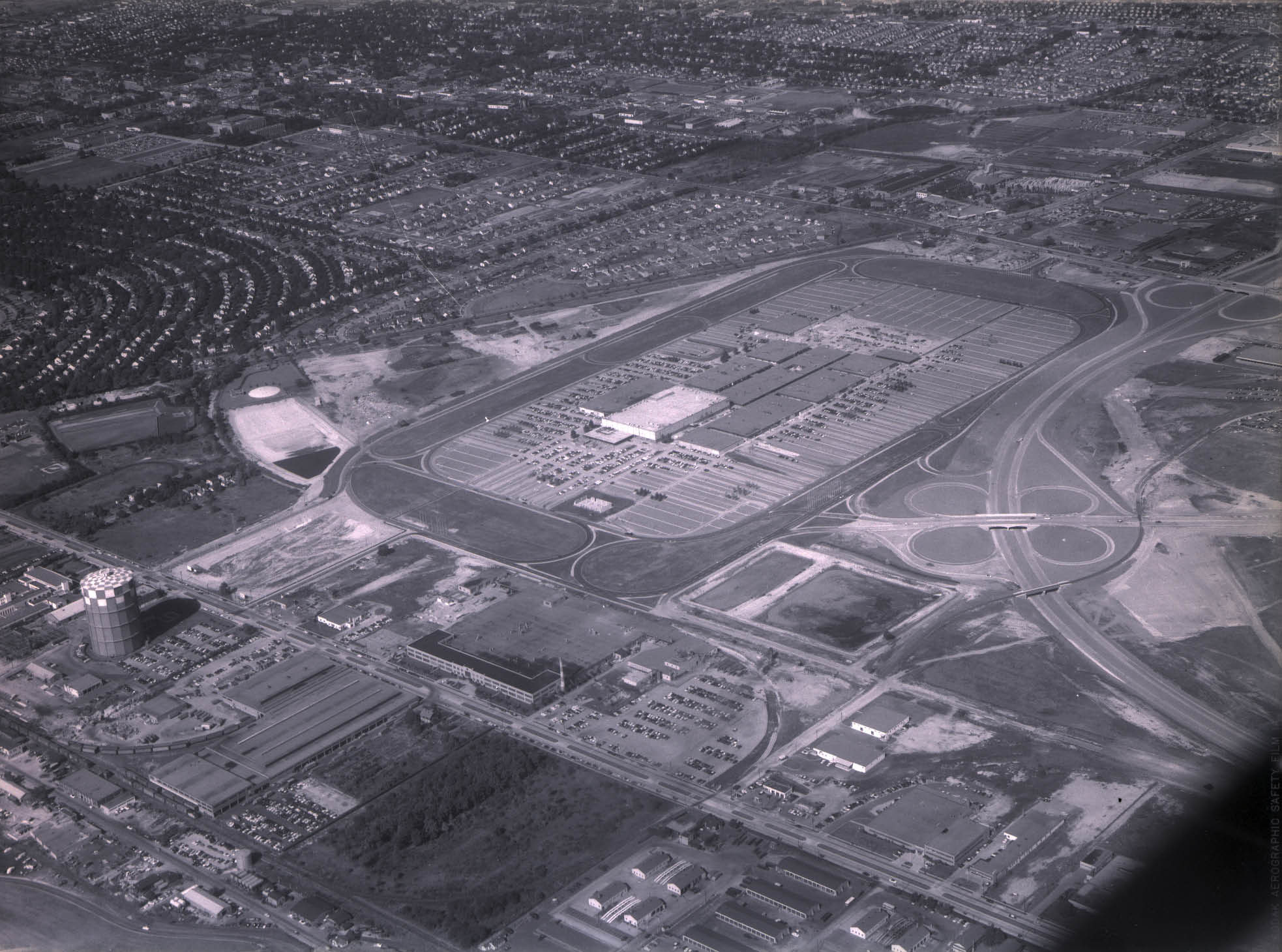
Click on image above for an enlarged view

The first suburban shopping center:

Great Neck Plaza (1951)

The first shopping malls:

Roosevelt Field Center (1956)
Green Acres Center (1956)
Mid-Island Plaza (1956)
Walt Whitman Mall (1962)
South Shore Mall (1963)

Great Neck Plaza


Photo from Library of Congress


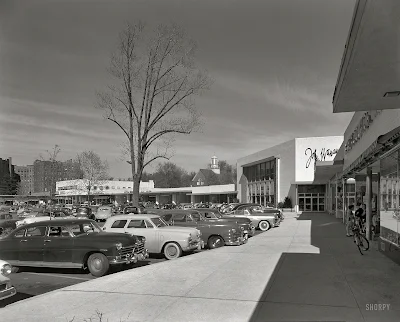
Circa-1952 views of Long Island's GREAT NECK PLAZA,
Metro-New York City's first suburban shopping center.
Photos from Library Of Congress


A physical layout of Long Island's GREAT NECK PLAZA,
as it was situated in 1951.

Metropolitan New York City's first quote / unquote "suburban shopping center" was built in the Long Island community of Great Neck Plaza. Also known as GREAT NECK PLAZA, it was located on a small land parcel, 18.3 miles northeast of Times Square.

The open-air, "strip center" was developed by New York City-based Sol Atlas, who broke ground on the project in June, 1950.


The complex opened for business in 1951, and was anchored by a 3-level (Philadelphia-based) John Wanamaker; the retail chain's first suburban New York City store. It featured a huge show window in front and had two elevators. This was an impressive feature at the time!

Wanamaker's was rebranded by New York City-based Stern's in 1955 and (eventually) by Queens-based Gertz. The shopping center -itself- remains in business to this day and has not been structurally altered over the years...only the tenants have changed.
THE SECOND TIME AROUND

The next major shopping center in -or around- New York City was also developed by Sol Atlas. Constituting what was New York's first shopping mall, CROSS COUNTY CENTER [October 2006 archive] was dedicated -in suburban Yonkers- in 1954.

Back on Long Island, three major shopping malls (albeit, open-air ones) were under construction. A new tax loophole for real estate developers had been passed. It allowed for "accelerated depreciation" on commercial properties built on previously undeveloped land.

ACCELERATED DEPRECIATION

In a nutshell, shopping center builders were now allowed to factor in "loses" -due to such depreciation- with profits from new shopping complexes. Hence, their tax bills were substantially reduced. In turn, it was feasible to build many more shopping centers than would have been possible under the pre-1954 tax code.

This windfall resulted in the plethora of brand-new shopping centers which opened from coast to coast during 1956 alone. Three of these were on Long Island; ROOSEVELT FIELD CENTER, GREEN ACRES CENTER and MID-ISLAND PLAZA.

Two subsequent, Long Island shopping centers, WALT WHITMAN MALL and SOUTH SHORE MALL, came along in the early 1960s. Their development could also be attributed to accelerated depreciation.


Sources:

"Great Neck Plaza Walking Tour" / Long Island Traditions / Nancy Solomon
"Great Neck Plaza" article on Wikipedia
"Accelerated Depreciation" article on Wikipedia

Photos:

From the Gottscho-Schleisner Collection / Repository: United States Library Of Congress Prints and Photograph Division, Washington, D.C. / Taken by Gottscho-Schleisner, Inc., 1952 / Photographs are in the public domain: no known restrictions on publication / www.loc.gov/rr/print/catalog.html
Roosevelt Field Center


An early '60s physical layout of Long Island's first
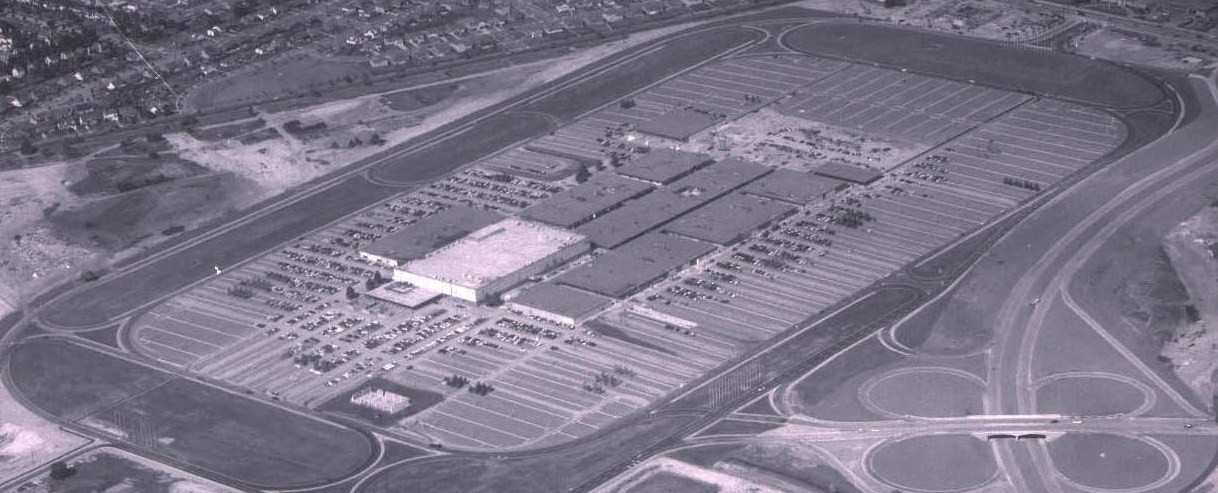
mall. Originally anchored by just Macy's, the center
had a second anchor -Gimbels- come inline in 1962.
The turf war rivalry between these two retailers was
legendary. When Gimbels was signed to co-anchor the
mall, the existing Macy's was expanded with a new
third level. It was imperative that the store be made
substantially larger than its competitor on the north
end of the complex.


An early '60s rendering of a proposed intermodal station for the Long
Island Railroad commuter train, with ROOSEVELT FIELD CENTER
in the background. By the way, the rail terminal was never built.
Photo from www.photobucket.com / John Harold Barry, A.I.A.


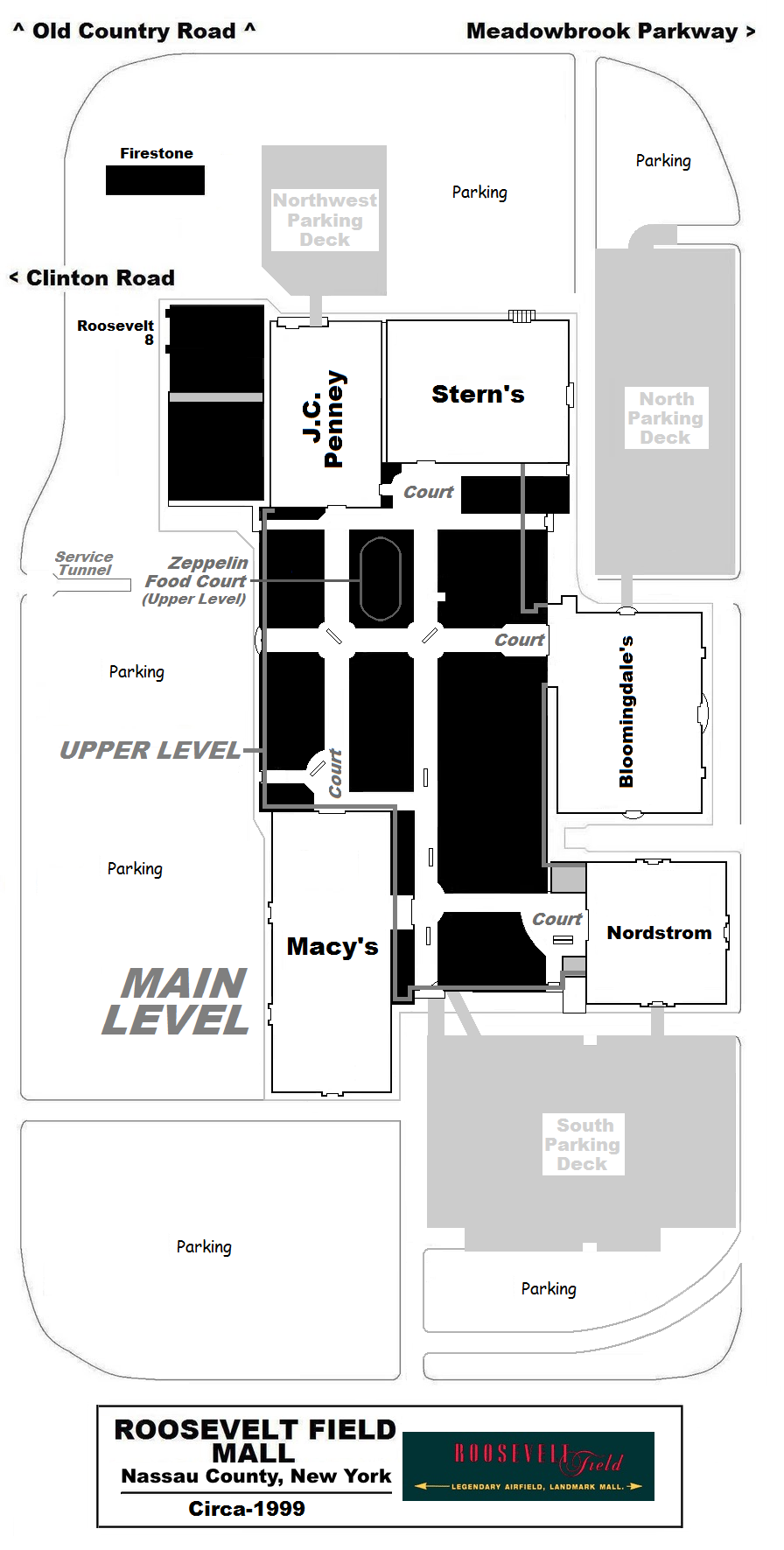
A 1990 physical layout. The mall, enclosed in 1968,
had Penney's and Alexander's stores added in 1971-
72. Gimbels had been rebranded as a Stern's in 1987.


A 1990s aerial view of ROOSEVELT FIELD.
Photo from www.photobucket.com


The mall's second anchor store, which started out as a Gimbels in 1962.
When this picture was taken, it was in its Stern's stage, which ran
between 1987 and 2001.
Photo from www.occulude06.tripod.com


One of the few Macy's stores that has always been a Macy's. This
location, originally encompassing 2-levels (with basement) and
343,000 square feet, was expanded to 3-levels -and 428,000 square
feet- in 1963.
Photo from Nassau County, New York tax assessor


The mall's fourth anchor store opened, as a Big Apple-based
Alexander's, in 1971. It was remodeled, as an Abraham and
Straus, during 1991-1992. This store lasted only three years.
It reopened as the Bloomingdale's seen here in late 1995.
Photo from http://www.occulude06.tripod.com/


The ROOSEVELT FIELD Nordstrom came inline in August 1997.
Photo from Nassau County, New York tax assessor


Shots of the present-day mall. The one directly above was taken in
the mid-'00s.
Photos from www.simon.com


The footprint of America's fifth-largest shopping
mall, as it was configured in 2008. The "Future
Lifestyle Addition", indicated in light gray, may
be nothing more than a pipe dream. Details are
unavailable and the beginning of its construction
has not been announced.
THE LARGEST OPEN-AIR SHOPPING
MALLS IN THE UNITED STATES, 1956:

1. NORTHLAND CENTER, Southfield, MI
2. ROOSEVELT FIELD CENTER, Town of Hempstead, NY
3. OLD ORCHARD CENTER, Skokie, IL
4. LAKEWOOD CENTER, Lakewood, CA
5. CROSS COUNTY CENTER, Yonkers, NY

THE LARGEST OPEN-AIR SHOPPING
MALLS IN THE UNITED STATES, 1960:

1. GARDEN STATE PLAZA, Paramus, NJ
2. NORTHLAND CENTER, Southfield, MI
3. LLOYD CENTER, Portland, OR
4. ROOSEVELT FIELD CENTER, Town of Hempstead, NY
5. BERGEN MALL, Paramus & Maywood, NJ

THE LARGEST ENCLOSED SHOPPING
MALLS IN THE UNITED STATES, 1973:

1. WOODFIELD MALL , Schaumburg, IL
2. ROOSEVELT FIELD MALL , Town of Hempstead, NY
3. METROCENTER MALL, Phoenix, AZ
4. CINDERELLA CITY MALL, Englewood, CO
AND
4. YORKTOWN CENTER, Lombard, IL
5. SUNVALLEY MALL, Concord & Pleasant Hill, CA


THE LARGEST ENCLOSED SHOPPING
MALLS IN THE UNITED STATES, 2008:

1. MALL OF AMERICA, Bloomington MN
2. AVENTURA MALL, Dade County, FL
3. THE GALLERIA, Houston, TX
4. SAWGRASS MILLS, Sunrise, FL
5. ROOSEVELT FIELD MALL, Town of Hempstead, NY


ROOSEVELT FIELD CENTER
Meadowbrook Parkway and Old Country Road
Town Of Hempstead, New York

The land on which Long Island's first shopping mall was built had served as various airfields between 1917 and 1951. One of these, Roosevelt Field, was the departure point for "Lucky Lindy's" historic transatlantic flight in 1927.

ROOSEVELT FIELD SHOPPING CENTER was developed by New York City's William Zeckendorf and designed by I.M. Pei. It was situated on a land parcel encompassing 88 acres, located 24.5 miles east of Times Square. Ground was broken for the 35 million dollar project in April 1955.

The single-level, open-air center included an F.W. Woolworth 5 & 10, Walgreen Drug, Food Fair supermarket, Buster Brown Shoes, public auditorium, indoor ice rink and an enclosed gallery of shops.

The anchor of the original mall was a 2-level (with basement), 343,000 square foot Macy's. Its grand opening was held August 22, 1956. A 2-level (with basement), 250,000 square foot Gimbels opened August 20, 1962.

With this addition, the retail complex housed over 1 million square feet of store space and was one of America's largest shopping centers.

A major expansion was completed in 1963. Macy's had an 85,000 square foot third level added. Moreover, a second supermarket was constructed, along with several new stores. The Century Roosevelt Field Cinema was in operation by 1968. The mall and its concourses were enclosed at this time, as well.

A second expansion of the shopping venue, now known as ROOSEVELT FIELD MALL, was completed in 1972. This added a 2-level (260,000 square foot) J.C. Penney and 2-level (314,000 square foot), New York City-based Alexander's.

The mall remained competitive over the following decades, with several upgrades and additions. An Upper Level of stores was dedicated in April 1993, which included a 14-bay Food Court and sixty new "luxury retailers".

Alexander's was shuttered early in 1991. The store was gutted and remodeled into a New York City-based Abraham and Straus, which came inline in October 1992. This store was in operation until April 30, 1995. New York City-based Bloomingdale's opened in this location on November 2, 1995.

The Gimbels anchor was leased by New York City-based Stern's between 1987 and 2001. After Stern's closed, the spot was taken by Galyan's Sporting Goods which was bought by Pittsburgh-based Dick's Sporting Goods in 2004.

At this time, the building was divided, with Dick's occupying the eastern section and Bloomingdale's Furniture setting up shop in the western.

A 3-level (225,000 square foot) Nordstrom, added to the southeast corner of the complex, opened in August 1997.

Today, the mall houses 2,209,000 square feet of retail space, with over two hundred and twenty stores and services. It is the fifth-largest enclosed shopping mall in the United States and the largest in the New York City metropolitan area, as well as in the state of New York.

The center is owned and operated by the Indianapolis-based Simon Property Group, who took ownership the shopping center when it acquired Corporate Property Investors in February 1998.

Sources:

www.airfield-freeman.com / thefreemans@hotmail.com
"Roosevelt Field" article on Wikipedia
"Macy's" article on Wikipedia
"Bloomingdale's" article on Wikipedia
Comment post by Jimmy B.
Comment post by "Dea41396"
Nassau County, New York Tax Assessor website
"Roosevelt Field Theatres" article / Cinema Treasures website
Green Acres Center


Photo from Vornado Realty Trust website


A site plan of Long Island's second shopping mall. The center operated with a single anchor (Gimbels) for its first four years. A Lane's opened, on the east end, in 1960.


GREEN ACRES' Sears, built with the North Wing in 1982-83.
Photo from Nassau County tax assessor


Macy's Men's, built as a Big Apple-based Lane's. The building is a
contender for the American mall anchor store that has had the most
nameplates. So far, the building has housed Lane's, Love's, S. Klein,
Korvette's, Gertz, Stern's and Macy's Men's; a total of six rebrandings.
On the horizon may be a seventh. Rumor has it that J.C. Penney plans
to move into the store space. Thus far, this hasn't happened.
Photo from Nassau County tax assessor


The brand-new, Best Buy big box. It replaced a building originally
occupied by a National Foods supermarket.
Photo from Nassau County, New York tax assessor


Today's GREEN ACRES. There are several new big box boutiques,
such as Best Buy, Levitz Furniture and B.J.'s Wholesale Club. In
March 2007, a thorough interior facelift was completed.
GREEN ACRES CENTER
Sunrise Highway and Green Acres Road
Village of Valley Stream and Town of Hempstead, New York

Plans for the second shopping mall on "The Island" were announced in mid-1954. A 57.6 acre plot, previously the Curtiss Airfield, became the construction site for a 30 million dollar, open-air mall.

GREEN ACRES SHOPPING CENTER was developed by the New York City-based Chanin Organization. The single-level complex was adjacent to the New York City corporate limits (the Queens borough). It was originally anchored by a 4-level (266,600 square foot), New York City-based Gimbels.

There were seventy-two other retailers in the original shopping venue, which opened October 7, 1956. These included J.J. Newberry and F.W. Woolworth 5 and 10s, Lerner Shops, Regent Men's Shop and Oppenheim Collins.

A 1-level (with basement), dry goods only J.C. Penney was at the center of the center, with a 38,000 square foot National Foods supermarket as a western outparcel and 40,000 square foot Grand Union supermarket on the eastern periphery.

A 3-level (216,400 square foot), New York City-based Lane's department store was added to the east end of the mall. The store, dedicated in May 1960, shared space with Dime Savings And Loan.

The single-screen, Century's Green Acres Cinema opened for business on September 15, 1961. It was located at the front of the shopping center site, adjacent to Sunrise Highway. Moreover, a 320,000 square foot, New York City-based Alexander's was constructed in the front (north) parking area, as well. This store came inline September 18, 1967.

GREEN ACRES' retail rivals included ROOSEVELT FIELD SHOPPING CENTER (1956) [December 2007 archive], in Garden City/Hempstead, KING'S PLAZA (1970) in Brooklyn and QUEENS CENTER (1972) in Queens.

In order to keep up with its climate-controlled competitors, the venue was roofed-in in 1970, known -henceforth- as GREEN ACRES MALL. In 1982, a second major renovation of the center began. One of the nine store blocks was demolished to make way for a 2-level (235,000 square foot) northeast wing.

This new mall space included a 2-level (150,000 square foot) Sears [with parking garage and Auto Center], several new stores, and a 14-bay Food Court. The wing was dedicated in 1983. With its completion, the mall encompassed 1,627,400 square feet and over one hundred stores and services.

By the mid-1980s, the two anchor stores at GREEN ACRES MALL had been rebranded. At the west end, Gimbels morphed into a New York City-based Abraham and Straus in 1986 and was "Macy-ated" in 1995.

On the east end, Lane's was vacated and reoccupied by a long list of stores over the next four decades. The Lane's store closed in the late 1960s, was rebranded as a Love's, and then reopened as a New York City-based S. Klein. This store operated into the mid-1970s.

Klein's was replaced by a New York City-based E.J. Korvette discount mart. This became a Queens-based Gertz department store in the early 1980s that was subsequently rebranded as a New York City-based Stern's. Stern's closed shop in 2001 and reopened soon after as a Macy's Men's and Home Store.

Meanwhile, the outparcel Alexander's had closed in June 1992. Its building was demolished, with a 1-level (240,000 square foot), Norwalk, Connecticut-based Caldor discount mart built nearby. It was completed in June 1994. A Home Depot, situated on the mall's southwestern periphery, had begun business in May.

More changes occurred during the late 1990s. The entire mall was sold to the New York City-based Vornado Realty Trust in December 1997. Caldor went bust in 1999. Its space was eventually taken by Target.

A K-Mart, located in an associated strip center, THE PLAZA AT GREEN ACRES (1991), went out of business. Wal-Mart occupied its spot in 2003.

In March 2008, GREEN ACRES MALL emerged from a remodeling project...which included the addition of a new Best Buy, Levitz Furniture and 122,000 square foot B.J.'s Wholesale Club. The interior of the mall had been updated during 2006 and 2007.

Sources:

"Green Acres Mall" article on Wikipedia
Nassau County, New York tax assessor website
Comment posts by "RichR"
Cinema Treasures
www.vno.com (Vornado Realty Trust)
www.greenacresmallonline.com
Mid-Island Plaza

Photo from Library of Congress


The original, circa-'56 PLAZA, as it existed before anything was added.
Truck tunnels extended out in three directions. One of these was sealed
off by a new Target in 2004.


Gertz Long Island, fronting on Center Court at MID-ISLAND PLAZA.
Photo from Library of Congress


The east-facing facade of Gertz, at the western edge of the
East Wing.
Photo from Library of Congress


The East Wing, with Gertz at mall's center.
Photo from Library of Congress


A northward view of MID-ISLAND'S Center Court.
Photo from Library of Congress


Center Court and Gertz. The East Wing extends in the distance.
Photo from Library of Congress


The East Wing, with Bond's apparel on the left.
Photo from Library Of Congress


The Hicksville, New York Sears, which is located across the North
Broadway thoroughfare from the mall.
Photo from www.pleasantfamilyshopping.blogspot.com


A circa-'70 site plan of MID-ISLAND PLAZA. The center had just
been enclosed. A huge, new S. Klein now anchored the northwest
corner and there was a new-fangled twin cinema in the rear. The
complex's official name change -to BROADWAY MALL- would be
instituted in 1989.


The East Entrance facade.
Photo from www.labelscar.com / "Caldor"


The ginourmous Macy's...originally a Queens-based Gertz...then a
Manhattan-based Stern's.
Photo from http://www.labelscar.com/ / "Caldor"


Ikea, which came along in 1991.
Photo from Nassau County, New York tax assessor


B'WAY MALL'S stunning North Court.
Photo from www.labelscar.com / "Caldor"


A "then and now" montage. The first view is circa-1957. The second
is the same spot (the east side of center) fifty years later. The truck
tunnel, a feature of many Mid-Mod malls, is seen in the center.
Photos from Library Of Congress / Nassau County, New York tax assessor


The center in the late '00s. The changes over its half-century are
many. It remains a viable mall among the many in its vacinity.
MID-ISLAND PLAZA
North Broadway and Mid-Island Boulevard
Hicksville, New York

Long Island's third shopping mall was developed by the New York City-based Stackler Frank Company. It occupied a 68 acre site -previously a boys' orphanage- 27.3 miles east of Times Square, in the suburb of Hicksville.

MID-ISLAND PLAZA originally housed 800,000 leasable square feet. It was anchored by a 5-level (300,000 square foot), Queens-based Gertz department store, which opened October 12, 1956.

The 40 million dollar, open-air shopping complex also included J.G. McCrory and J.J. Newberry 5 and 10s, National Foods and Pathmark supermarkets, Bonds apparel, Maternally Yours apparel, Oppenheim Collins, Atlantic Book Shops and Famous Fashions. All eighty stores were inline by late October 1956.

The first addition to the existing shopping center came in the way of the Fox Plaza North and South Cinerama, an early twin-plex theater, which opened in 1964.

Next in line was a 2-level (230,000 square foot), New York City-based S. Klein department store, built onto the mall's northwest corner in 1969. This was the centerpiece of a renovation project, undertaken in 1968, which enclosed the mall concourses and entryways.

By this time, there were several competing shopping centers in the immediate vacinity; ROOSEVELT FIELD MALL (1956) [December 2007 archive], in Garden City / Hempstead, WALT WHITMAN MALL (1962) [December 2007 archive], in Huntington Station and SUNRISE MALL (1973), in Massapequa Park.

S. Klein ceased operations in the 1974-1975 time frame. The store space soon reopened as a New York City-based E.J. Korvette discount mart. This location was shuttered, along with the Korvettes chain, in 1980.

A major mall remodeling project got underway in 1989. First, the official name of the shopping center was changed to BROADWAY MALL. The now vacant Food Fair structure was razed with a new J.C. Penney built to replace it. The vacant Pathmark supermarket -on the opposite side of the corridor- became the mall's first Food Court.

In addition, the twin cinema was demolished. Its replacement was a 2-level (235,000 square foot), Stockholm-based Ikea, which opened for business March 13, 1991. A multi-level parking garage (adjacent to the new Ikea) was also built at this time.

A further refurbishment of BROADWAY MALL came inline in 1995. The vacant Klein's / Korvette's / Alexander's was gutted and rebuilt into a 12-screen multiplex. Two large retail spaces -and a new, 9-bay Food Court- were included in the construction project.

Anchor rebrandings had begun in 1982, when Gertz became a New York City-based Stern's. This store, in turn, was "Macy-ated" in 2001. J.C. Penney moved on in 2002. The store was razed, with a 1-level (140,500 square foot) Target opening on its spot in 2004.

The most recent change at BROADWAY MALL occurred in late 2005, when the 1.1 million square foot shopping center was acquired by the New York City-based Vornado Realty Trust.

Sources:

"Broadway Mall" article on Wikipedia
Nassau County, New York tax assessor website
www.labelscar.com
Cinema Treasures
www.vno.com (Vornado Realty Trust)
www.broadwaymallonline.com
Walt Whitman Mall


North Court, fronted by Abraham and Straus, in the 1962 center.
Photo from Malls of America Blogspot


1962 view of South Court and its Macy's.
Photo from Malls Of America blogspot


The original layout of WALT WHITMAN MALL. Over the years, the
Macy's has jumped to the other end of the center. The McCrory 5 and
dime suffered a devastating fire in 1991. It never reopened and was
eventually replaced by a concourse of twelve inline stores, connecting
to a newly-constructed Saks Fifth Avenue.


The main entrance at WALT WHITMAN MALL.
Photo from Wikipedia/"Sullynyflhi"


The South Court. In the present, this has Bloomingdale's as its focal
point. In the original mall, the Court was fronted by Macy's.
Photo from www.labelscar.com / "Caldor"


Contemporary view of the North -Macy's- Court.
Photo from www.labelscar.com / "Caldor"


Late '00s aerial shot of the mall. The Macy's and Bloomingdale's
buildings are original anchor boxes. The center (Saks) and northern-
most (L & T) were added on in the '90s.
Photo from Simon Property Group website


Circa-2008 site plan of the main mall level. The old Whitman Theatre,
on the south end of the complex, has given way to new, sit-down
bistros. An ambitious renovation and expansion, consisting of a new
upper level of retail and parking garage, has been mothballed due to
the stagnant economy.
WALT WHITMAN MALL
Walt Whitman and Detroit Roads
Huntington Station, New York
Sources:

Long Island's fourth shopping mall was also the first interior mall in the New York City metropolitan area. It was designed by Welton Becket and Associates and developed by New York City-based Winston-Muss Incorporated. The center occupied a 66.4 acre tract, 35.6 miles east of Times Square, in the hamlet of Huntington Station.

When originally proposed in March 1960, WALT WHITMAN SHOPPING CENTER was to have been an open-air complex, anchored by a Macy's and New York City-based Abraham and Straus, with a 2-level J.G. McCrory 5 and 10 at the center of the center. However, its developer, David Muss, decided to alter plans and install a roof over the concourse early in 1962.

The first store to open, the 2-level (220,000 square foot) Abraham and Straus -occupying the north anchor spot- came inline in March of 1962. The 2-level (230,000 square foot) Macy's -on the mall's southern end- held its grand opening September 18, 1962.

Sixty-five stores were in operation by November of the year, including Lerner Shops, Parklane Hosiery, Crown Drug, Sam Goody and Flagg Brothers Shoes. There was also the single-screen Walt Whitman Theatre.

The full complement of seventy-five stores was in business by early 1963. The completed mall encompassed 890,000 leasable square feet and was one of the largest fully-enclosed shopping centers in the United States. It was comprised of a single retail level, with a service basement beneath.

The regional retail rivals of WALT WHITMAN MALL included MID-ISLAND PLAZA (1956) [December 2007 archive] in Hicksville, SOUTH SHORE MALL (1963) [December 2007 archive] in Bay Shore and SMITH HAVEN MALL (1969), near Smithtown.

The first alteration of WALT WHITMAN MALL was complete by the mid-1960s. A multi-level parking garage was built on the north end of the center, which was adjacent to Abraham and Straus.

The physical structure of the shopping venue was not changed appreciably during the 1970s and '80s, save for a few minor facelifts of the interior, a third floor addition to Abraham and Straus (increasing its floor area to 302,700 square feet) and repairs of fire-related damage to the mall structure in 1984.

A second, more devastating, fire roared through the McCrory 5 and 10 in May 1991, resulting in two fatalities and severe damage to the store. It was permanently shuttered in the aftermath.

A major upgrade and renovation of the mall was proposed in 1997, which was to include double-decking the main concourse, for an expanded GLA of 1.5 million square feet. However, fierce community opposition halted the renovation project.

In February 1998, the mall owner, New York City-based Corporate Property Investors, was acquired by the Indianapolis-based Simon Property Group. A scaled down renovation of the mall -sans the additional, second retail level- had been undertaken by CPI and was completed over the following two years.

Abraham and Straus, shuttered in 1995, reopened as a Macy's in November 1996. The store had been given a 21 million dollar overhaul.

The original Macy's (on the mall's south end) closed, was renovated and reopened as a 230,000 square foot Bloomingdale's in August 1998. Also, on the mall's northwest corner was built a 2-level (120,000 square foot) Lord and Taylor. It came inline in November 1998.

Lastly, the vacant McCrory was gutted. A short mall concourse was constructed, with twelve new retail spaces. This led into a 2-level (100,000 square foot) Saks Fifth Avenue, dedicated in March 1999.

A renovation of the 1,035,000 square foot, eighty-eight store shopping venue has been proposed. This project is to include the construction of a second retail level (originally proposed in 1997), as well as a bi-level parking structure along the west-facing front of the mall.

However, the economic downturn of the late '00s has delayed the beginning of construction indefinitely.

Sources:

"Walt Whitman Mall" article on Wikipedia
Comment post by "Anonymous"
Cinema Treasures
www.labelscar.com
www.simon.com
Comment posts by John and Dan H.
South Shore Mall Center

*
An architectural rendering of the shopping center's Loew's Theatre.
It was completed three years after the mall proper, in 1967.
Photo from Tobacco Documents.org website


The original, open-air, SOUTH SHORE MALL.
Stores in its initial construction phase opened
between 1963 and 1967. Here is one of the few
mid-century malls where the original anchors
have not been rebranded.


An aerial view of WESTFIELD SOUTH SHORE.
Photo from www.westfield.com


A shot of the mall's interior.
Photo from http://www.eyecorp.com/


A contemporary physical layout of WESTFIELD
SOUTH SHORE, showing the late 1990s addition
on the north end of the structure.
SOUTH SHORE MALL CENTER
Sunrise Highway and North Bedford Avenue
Bay Shore, New York

The fifth shopping mall on Long Island, the last of its newly-built, open air centers, was located on an 85 acre tract, 46.6 miles east of Times Square, in the community of Bay Shore.

SOUTH SHORE MALL CENTER was developed by New York City-based R.H. Macy, who anchored their shopping venue with a 3-level (318,800 square foot) Macy's. This location, the eighth in the chain, held its grand opening August 30, 1963.

The original, seventy store center also included Bonds apparel, F.W. Woolworth, Record Town, Lerner Shops and Captree Corners, a bizarre-type area occupying the mall's northwest corner.

The first phase of the complex was complete by 1967...when its 3-level (202,100) square foot J.C. Penney (the first "new look"/full line Penney's on "The Island") came inline. This was soon followed by the dedication of the outparcel Loew's South Shore Mall Theatre.

Mall-type competitors for the SOUTH SHORE center included WALT WHITMAN MALL (1962) [December 2007 archive], in Huntington Station, SMITH HAVEN MALL (1969), near Smithtown, and SUNRISE MALL (1973), in Massapequa Park.

To compete effectively with these -and other- area shopping centers, SOUTH SHORE MALL was fully-enclosed in 1975. The next major renovation began in 1996, around the time that the mall was acquired by the Australia-based Westfield Group.

The northern end of the center was gutted. 40,000 square feet of retail area was added, along with a newly-built, 3-level (216,300 square foot) Sears, which opened in September 1997. A 2-level (120,000 square foot) Lord and Taylor was dedicated in late 1998.

Presently, WESTFIELD SOUTH SHORE houses 1,165,000 leasable square feet, with over one hundred and twenty-five stores and services.

Sources:

www.westfield.com
Suffolk County, New York tax assessor website
Cinema Treasures

Saturday, December 08, 2007


SOUTHERN CALIFORNIA'S
FASHION SQUARES

Between 1958 and 1968, Bullock's Realty Company, a subsidiary of Los Angeles-based Bullock's Department Stores, dedicated four open-air FASHION SQUARE MALLS in Southern California.

The first, originally referred to as BULLOCK'S FASHION SQUARE, was located in the central Orange County suburb of Santa Ana. The second was built within the corporate limits of Los Angeles, in the San Fernando Valley community of Sherman Oaks.

The third FASHION SQUARE, was developed in the southern environs of Los Angeles County, in Torrance. The fourth -and final- of these So-Cal centers was placed in northern Orange County, just over the "line", in La Habra.

FASHION SQUARES in So-Cal were relatively small when originally built; usually encompassing around 400,000 leasable square feet and thirty-two to forty inline stores. They would have been anchored by a 200,000+ square foot Bullock's, with a smaller (junior anchor) I. or Joseph Magnin, as well as a selection of other high-fashion apparel and accessory shoppes.

In their original incarnations, the FASHION SQUARE centers did not have tenants such as supermarkets, 5 and 10s or pharmacies.

Over the years, two of the original shopping venues were enclosed (those in Sherman Oaks and Torrance). These are the two that still exist, in varying degrees of structural integrity, to this day.

The earliest FASHION SQUARE -in Santa Ana- was demolished, except for its Bullocks, in the mid-1980s. La Habra's held on until its date with the wrecking ball in 1994.


The locations of the four FASHION SQUARES of Greater Los
Angeles. In order of their construction, they were

1 BULLOCK'S FASHION SQUARE [1958], Santa Ana
2 SHERMAN OAKS FASHION SQUARE [1962], Los Angeles
3 DEL AMO FASHION SQUARE [1966], Torrance
4 LA HABRA FASHION SQUARE [1968], La Habra
Bullock's Fashion Square


An exterior shot of the northeast corner of the original mall. The huge
Bullock's anchor store is seen in the upper left.
Photo from the Orange County Archives


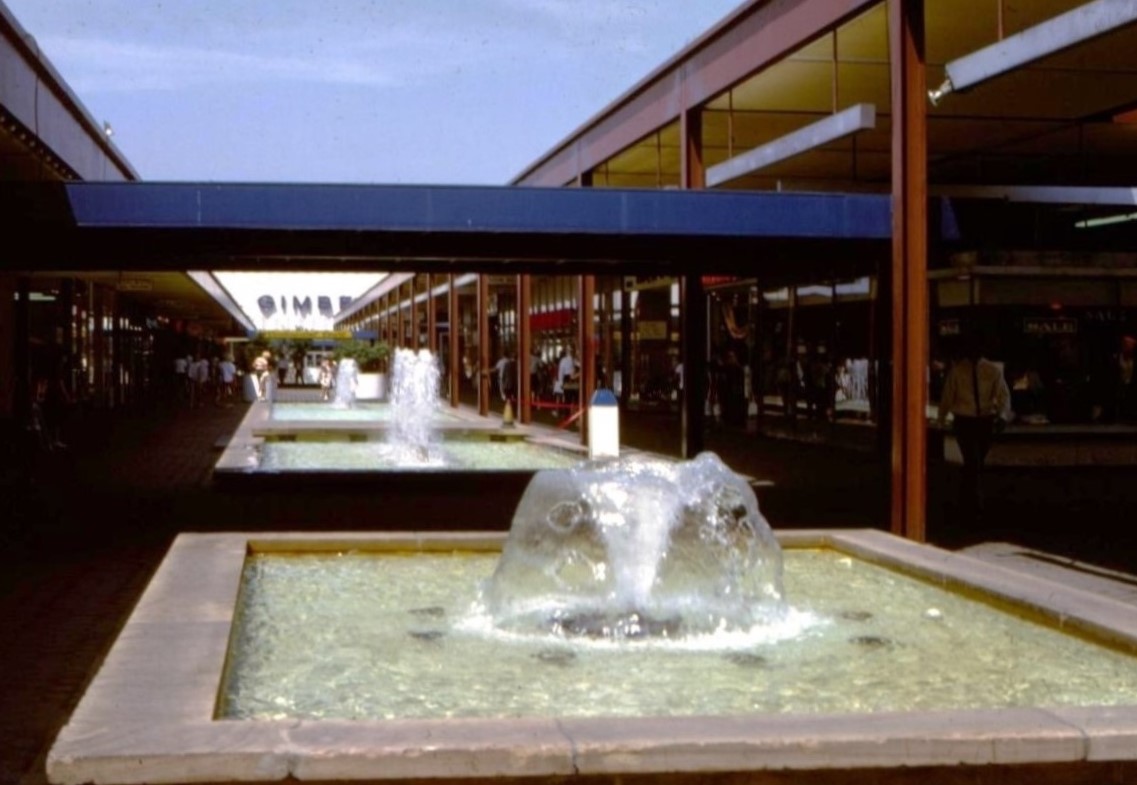
The Mid-Mod fountain that graced the original, open-air mall. The
grounds at this -and the three So-Cal FASHION SQUARES that followed-
were meticulously-maintained by landscape architect Ruth Shellhorn,
who also designed the planters at the circa-1955 Disneyland.
Photo from Malls Of America Blogspot


So-Cal's first FASHION SQUARE, the second shopping mall in
Orange County. In this circa-1968 site plan, we see the ten
year old shopping venue and the Garden Grove Freeway, which
had been dedicated in 1967.


MAINPLACE SANTA ANA, upon the completion of its new north
anchor store, circa-1991. This dual level, fully-enclosed mall was built
around the old FASHION SQUARE Bullock's. It encompassed over
1 million leasable square feet and one hundred and ninety stores and
services.


The concourse at MAINPLACE MALL.
Photo from Wikipedia / "Arnold C."


A present-day tenant in the mall, Planet Funk apparel.
Photos from http://www.jjbuild.com/


Circa-'08 site plan of the mall now known as WESTFIELD MAINPLACE.
It is rumored that Macy's plans to consolidate its two stores into the
Men's and Home location and tear down the circa-1958 Bullock's. This is
to be replaced by -you guessed it- a "lifestyle component". Thus far,
these plans are just that...plans.
BULLOCK'S FASHION SQUARE
North Main Street and West Town and Country Road
Santa Ana, California

Bullock's Realty Company decided upon Orange County for the site of their first FASHION SQUARE shopping center. It was located in the northern corporate limits of Santa Ana, 31 miles southeast of downtown Los Angeles.

The center occupied a 45 acre land parcel adjacent to the Santa Ana Freeway, which had been completed in 1956. Designed by William Pereira, the open-air complex consisted of three store block structures, with an additional 3-level (225,000 square foot) Bullock's as its anchor. This was to be the seventh branch of the Los Angeles-based chain.

At its official grand opening on September 17, 1958, FASHION SQUARE featured thirty-two stores, including a 60,000 square foot I. Magnin, Harris and Frank apparel, Desmond's apparel, J.J. Haggerty's apparel and See's Candies.

A multi-level parking garage was eventually added, sometime after the 1967 completion of the Garden Grove Freeway, which passed directly north of the shopping center.

Competing regional shopping centers included BROADWAY CENTER / ANAHEIM PLAZA (1955) [February 2008 archive], in Anaheim, HONER PLAZA (1959) in Santa Ana, SOUTH COAST PLAZA (1967) [May 2008 archive], in Costa Mesa and MALL AT ORANGE (1971), in The City Of Orange.

The two western store blocks at FASHION SQUARE were demolished in the mid-1980s in anticipation of a 100 million dollar redevelopment of the shopping venue.

This project was a joint venture between the Henry J. Segerstrom family (developers of Orange County's SOUTH COAST PLAZA), the Chicago-based JMB Realty Corporation and the Santa Ana Redevelopment Agency.

A 2-level, fully enclosed mall was built, with a connection into the existing Bullock's. The parking structure, built as a part of FASHION SQUARE, was left standing, with two new parking facilities constructed.

The I. Magnin location, in the remaining (eastern) store block of the original shopping center, closed February 14, 1987. The building was soon demolished, with its area paved over to provide additional parking for the mall-to-be.

The new shopping center, dubbed MAINPLACE SANTA ANA, was dedicated September 26, 1987. In addition to its previously-existing Bullock's, the complex included a 3-level (150,500 square foot) Nordstrom, 3-level (142,500 square foot) J.W. Robinson, a second level Food Court and third level, MainPlace Theatre 6 multiplex.

During 1991, a fourth anchor store was completed; a 3-level (150,000 square foot) May Company. There were also twenty new stores added. The center now encompassed 1,158,000 leasable square feet with one hundred and ninety inline stores.

Anchor rebrandings occurred later in the decade. The May Company and J.W. Robinson came under the Robinsons-May nameplate in 1993. The old May Co. became a clearance center with the former Robinsons reopening as a full-line Robinsons-May location. Bullock's was "Macy-ated" in 1996.

By 2000, the mall was owned by the North American subsidiary of Rotterdam, Holland-based Rodamco. With the dissolution of this corporation in December 2002, the shopping venue was acquired by the Australia-based Westfield Group. It was renamed WESTFIELD SHOPPINGTOWN MAINPLACE, shortened -in 2005- to WESTFIELD MAINPLACE.

The most recent changes at the mall took place in 2006. The north Robinsons-May location closed late in the year and was sold to Westfield. It reopened as a J.C. Penney in April 2007. The south Robinsons-May became a Macy's Mens and Home Store in late 2006.

The 6-plex cinema, which had closed and reopened (under new management) during 1999, closed and reopened (again, with new management) in October 2006.

Sources:

Westfield Mainplace" article on Wikipedia
www.westfield.com
Cinema Treasures
www.lw.com
Sherman Oaks Fashion Square


Main entrance to Bullock's / Macy's at the SHERMAN OAKS center. The
store was severely shaken by the '94 Northridge temblor. It was closed
for repairs for nine months, reopening in October 1994.
Photo from Vicki Funes /
http://www.family-vacation-getaways-at-los-angeles-theme-parks.com/


Southern-facing facade of the Bullock's / Macy's at WESTFIELD
FASHION SQUARE.
Photo from Vicki Funes /
www.family-vacation-getaways-at-los-angeles-theme-parks.com


Bullock's second FASHION SQUARE was built in the southern environs
of the San Fernando Valley. This 1962 plan shows the original, single-
level, open air plaza, with its sole anchor -L.A.- based Bullock's- sitting
at the east end.


A present-day physical layout of Level 1 at WESTFIELD FASHION
SQUARE. The original, circa-'62 center is shown in black. The 1988-1990
addition is indicated in medium gray. The 42,000 square foot expansion
of The Broadway / Bloomingdale's came inline during 1996.
SHERMAN OAKS FASHION SQUARE
Riverside Drive and Woodman Avenue
Los Angeles, California

The second in the succession of Bullock's-built FASHION SQUARES was located in Los Angeles' San Fernando Valley, 14 miles northwest of the city center, in the community of Sherman Oaks.

SHERMAN OAKS FASHION SQUARE, an open-air venue, was situated on a 20.7 acre site, previously occupied by the McKinley Home For Boys. The plot was adjacent to the Ventura Freeway / US 101, which had been completed through "The Valley" in 1960.

The first stores in the 422,900 square foot -thirty-three space- shopping venue were dedicated April 14, 1962. A 4-level (360,000 square foot) Bullock's, the sole anchor at the time, came inline April 30, 1962. Inline stores in the fully-completed, single-level complex included I. Magnin, Desmond's and La Casita Fashions.

A 3-level (178,000 square foot), Los Angeles-based The Broadway opened, on the western end of the center, November 5, 1977. Moreover, two parking garages were built. This increased the leasable area of SHERMAN OAKS FASHION SQUARE to 600,900 square feet.

A 35 million dollar renovation and expansion was announced in 1988. The shopping center structure was fully enclosed, with a second level of retail stores added.

Open areas between the existing mall and Bullock's and The Broadway were built-in and three old entryways closed off, with thier area made into additional stores.

The newly-refurbished shopping venue was dedicated in September 1990. The mall now housed over 850,000 leasable square feet and one hundred and forty stores, including Ann Taylor, Limited Express, Williams-Sonoma and a second level Food Court.

The center suffered major damage from the Northridge quake of January 19, 1994. The upper level of Bullock's collapsed and The Broadway had extensive damage from ruptured water mains.

The Broadway was the first of the anchor stores to reopen, in July 1994. Bullock's went back in business the following October.

By this time, SHERMAN OAKS FASHION SQUARE had become one of L.A.'s most trendy shopping malls...eclipsing all of the competing shopping centers in its vacinity.

VALLEY PLAZA (1951), the second regional shopping center in Southern California, had been unable to compete effectively for several years. Moreover, it never recovered from damage it incurred from the quake of 1994.

Likewise, SHERMAN OAKS GALLERIA (1980) was done in by competition from FASHION SQUARE and the '94 quake. It was demalled between 1999 and 2002.

Meanwhile, back at FASHION SQUARE, new nameplates had been installed during 1996. Bullock's became Macy's. The Broadway, recently expanded to 220,000 square feet, reopened as a Bloomingdale's.

With the dissolving of Rotterdam, Holland-based Rodamco, in December 2002, the Australia-based Westfield Group acquired a fifty percent share in SHERMAN OAKS FASHION SQUARE. The co-owner, London-based Prudential PLC, retained their half interest in the shopping center.

As expected, Westfield renamed the venue. It became WESTFIELD SHOPPINGTOWN FASHION SQUARE......and then WESTFIELD FASHION SQUARE in 2005.

Following their renovation of the CENTURY CITY [July 2007 archive] and TOPANGA PLAZA [May 2008 archive] properties, Westfield announced a similar remodeling project for FASHION SQUARE, in February 2007. However, these plans have apparently been shelved due to community opposition.

Sources:

"Westfield Fashion Square" article on Wikipedia
http://www.family-vacation-getaways-at-los-angeles.com/ / Vicki Funes, webmaster
Los Angeles County tax assessor website
Del Amo Fashion Square

*
The newly-inaugurated "outdoor promenade"...built onto the old
FASHION SQUARE in Torrance. It replaced a circa-1971 expan-
sion, that was demolished in 2005.
Photo from www.simon.com


The nucleus of the FASHION SQUARE at Torrance. This often-
expanded shopping complex was originally anchored by only one
full line department store...L.A.-based Bullock's. Its I. (for Issac)
Magnin junior anchor held its grand opening in March 1967.


A mid-'70s site plan, showing the recently enclosed -and expanded-
FASHION SQUARE. The complex now had three full-size anchor
stores, a 2-level Woolco and 4-plex cinema.


A contemporary site plan of the northern section of DEL AMO FASHION
CENTER. This shows the original FASHION SQUARE, joined with the
neighboring DEL AMO CENTER in 1981. The most recent renovation of
this marriage of malls was completed in September 2006, with the dedi-
cation of the "outdoor promenade" (indicated in light gray).
DEL AMO FASHION SQUARE
West Carson Street and Hawthorne Boulevard
Torrance, California

Ground was broken for the Bullock's Realty Company's third FASHION SQUARE project in July 1965. DEL AMO FASHION SQUARE, like the two sibling centers that preceded it, was an open-air venue. It occupied a 57 acre site, 20.5 miles southwest of center city Los Angeles, in the suburb of Torrance.

The original, thirty-five store center was based around a 3-level (250,000 square foot) Bullock's and dedicated in September 1966.

The standard FASHION SQUARE junior anchor, I. Magnin, came inline in March 1967. Desmond's apparel, another retailer present in the two other Southern California FASHION SQUARES, was a charter tenant at DEL AMO, as well.

In 1970 the complex was sold to Los Angeles-based developer Guilford Glazer, who soon initiated a redevelopment project, during which the existing center was enclosed.

An East Wing was built, with a 2-level (150,000 square foot), New York City-based Ohrbach's, 2-level (160,000 square foot) Montgomery Ward, Woolco, Del Amo 4 multiplex and forty-nine inline stores. The refurbished and expanded mall was dedicated August 9, 1971.

A subsequent renovation and expansion, completed in November 1981, linked DEL AMO FASHION SQUARE with DEL AMO CENTER, which was south of the complex, across West Carson Boulevard. The amalgamated mall was renamed DEL AMO FASHION CENTER [see October 2007 archive].

Sources:

"Del Amo Fashion Center" article on Wikipedia
www.delamofashioncenter.com
Los Angeles County tax assessor website
La Habra Fashion Square

*
Pleasanton, California-based Ross Dress For Less,
one of the anchors of LA HABRA MARKETPLACE,
which replaced the FASHION SQUARE mall in 1990
and '91.


So-Cal's fourth FASHION SQUARE was built in northern Orange
County. It was the largest of the original FS venues and featured
two anchor stores, including a Bullock's designed by Welton Becket.


The original mall was knocked down in stages between 1990 and 1995.
It was replaced by the LA HABRA MARKETPLACE strip center seen
above. The three remaining outparcel structures from the old FASHION
SQUARE are surrounded in blue.
Photo from http://www.google.com/


LA HABRA FASHION SQUARE
West Imperial Highway and South Beach Boulevard
La Habra, California

Bullock's final foray in Southern California FASHION SQUARE shopping centers was located in northern Orange County, on a 37.2 acre parcel, 21 miles southeast of downtown Los Angeles, in suburban La Habra.

LA HABRA FASHION SQUARE was to be the largest of the original four sibling centers, with forty inline stores and 460,800 leasable square feet. Ground was broken for the 14 million dollar complex in September 1966; its grand opening was held April 15, 1968.

Unlike the three previous FASHION SQUARES, LA HABRA was to feature two full-fledged anchor stores; a 3-level (208,100 square foot), Los Angeles-based Bullock's and 2-level (80,200 square foot), Long Beach-based Buffums'.

Naturally, there was also a Magnin specialty store, in this instance a 2-level (34,200 square foot) Joseph, as well as Judy's apparel.

Another dissimilarity between LA HABRA and its three predecessors was that it was to feature -in its original incarnation- a motion picture theater. The outparcel La Habra Cinema 4, one of the nation's first 4-plex movie houses, opened August 27, 1969.

Regional retail rivals included WHITTWOOD CENTER (1955) in Whittier, LA MIRADA CENTER (1959), in La Mirada, PUENTE HILLS MALL (1974), in the City Of Industry, and BREA MALL (1975), in Brea.

Eventually, the proliferation of enclosed shopping centers in its immediate vacinity had an effect on the open-air LA HABRA FASHION SQUARE.

By the late 1980s, the complex was in a major state of decline. Its Buffums' was shuttered and the rear parking area commandeered by local car clubs and gangs....being utilized as a drag racing spot. Customers stayed away in droves.

The "antiquated and out-positioned" venue was purchased by a joint venture of the Irvine, California-based Hopkins Real Estate Group and La Habra Redevelopment Authority. It was demolished, leaving Bullock's, the cinema and three smaller outparcels standing.

Stores in a new strip-type complex, LA HABRA MARKETPLACE, opened between December 1990 and April 1991. The existing Bullock's was in business until 1992. It had a destiny date with a wrecking ball in 1995.

The cinema went through a succession of owners before it was razed and replaced, by the La Habra Stadium 16 megaplex, in 2000.

San Jose-based DJM Capital Partners acquired the 227,600 square foot property in 2004. Today, it is tenanted by such retailers as Ross Dress For Less, Drug Emporium, Office Max, L.A. Fitness and Sports Authority.

Sources:

Mall memories of Jeff Arellano
http://www.hopkinsgroup.com/
http://www.djmrealty.com/
http://www.cinematreasures.com/