Friday, March 30, 2007

Biloxi's Edgewater Plaza Shopping City


A 1960s aerial of the Mississippi coastline mall. At this time, the
Edgewater Park Hotel was still standing. It was eventually demolished
to make space for the first expansion of the shopping center.
Photo from Malls of America Blogspot


An interior view of the South Court, as it was in the original, circa-
'63 center.
Photo from Malls of America Blogspot


A second view of the vintage South Court. This time, looking toward
the Gayfer's anchor store.
Photo from Malls of America Blogspot


The shoreline shopping center, in the late 1960s. There were
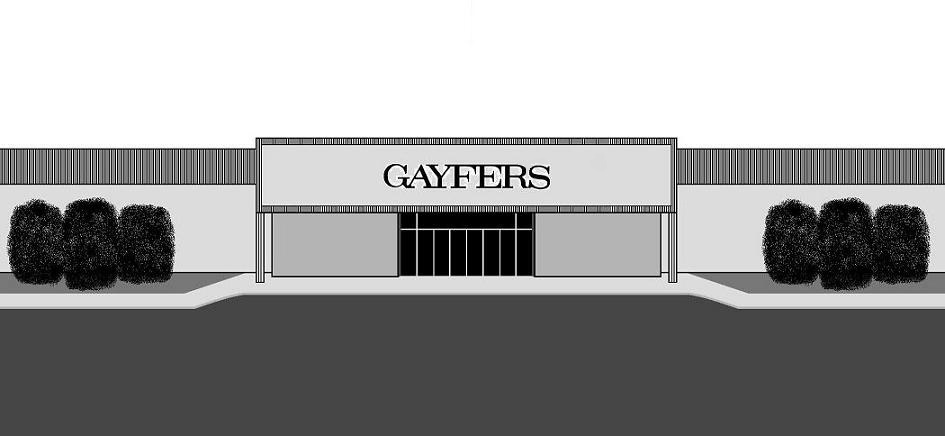
three anchors by then; Gayfer's, Goudchaux's and J.J.
Newberry.


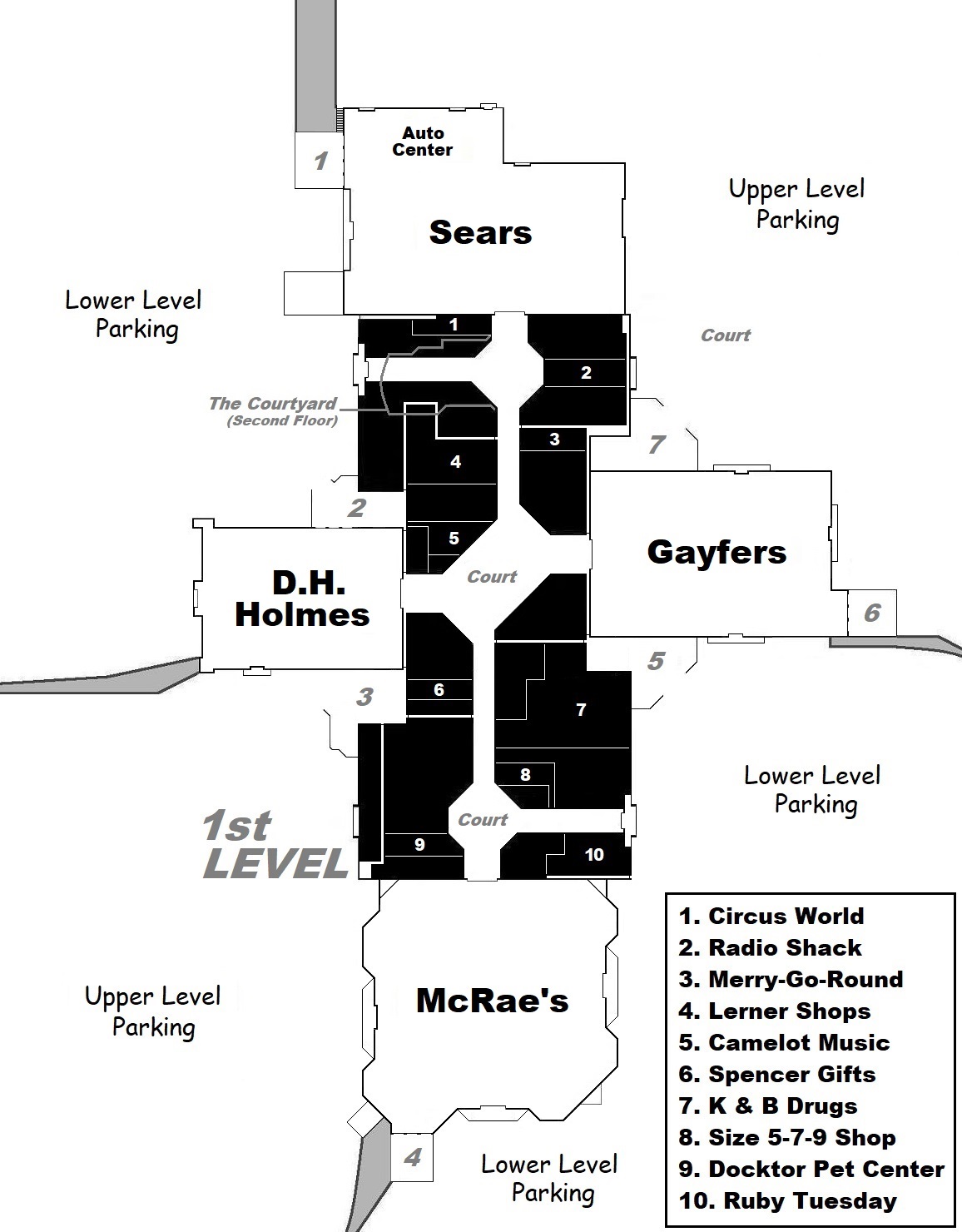
A circa-1973 physical layout. The old Edgewater Park Hotel
(to the right of the existing mall) had been razed. The new
forty-three store Sears Wing now occupied the site.


EDGEWATER MALL, present day. The complex survived
its hurricane hit of August 2005 and is Mississippi's third-
largest shopping venue. Jackson's 1,154,000 square foot
METROCENTER is the state's largest.


The exterior of EDGEWATER MALL received a facelift in the
early 1990s.
Photo from Jim Wilson and Associates website


A contemporary aerial view of the complex. Two expansions, in
1973 and 1997, doubled the GLA of the shopping venue.
Photo from Jim Wilson and Associates website
EDGEWATER PLAZA SHOPPING CITY
Beach Boulevard / US 90 and Edgewater Drive
Biloxi, Mississippi

Mississippi's first shopping mall was located directly on the Gulf Of Mexico shoreline, on a land parcel 6 miles west of downtown Biloxi. Going under the mid-century mall moniker EDGEWATER PLAZA SHOPPING CITY, the single-level center was built as an enclosed structure and opened in 1963.

The Biloxi-based Holcomb Company developed the thirty-four store complex, which was anchored by a 2-level (163,400 square foot), Mobile-based Gayfer's and single-level, Baton Rouge-based Goudchaux's.

There were also Walgreen Drug, Bookland, Hobbyville, Gordon's Jewelers, Thornberry's Toys, Lerner Shop, Dipper Dan's Ice Cream Parlor and a supermarket. J.J. Newberry opened a single-level (62,400 square foot) 5 and 10, as the mall's new north anchor, in the late 1960s.

A major renovation was completed in 1973. This included the addition of a 1-level (72,800 square foot) Sears, Jackson-based Waldorff's apparel and forty-one other stores.

Five years later, J.C. Penney renovated the vacated Newberry's and adjoining supermarket into a 1-level (86,000 square foot) store. By this time, the center was known as EDGEWATER MALL.

During a renovation in the 1980s, the mall's interior was modernized. Its early 1960s, "Mid-Mod" design embellishments were ripped-out. A subsequent remodel in the early 1990s replaced the (by then) defunct Goudchaux's with a 13-bay Food Court.

Another expansion of the mall took place in 1996-1997. A 2-level (164,700 square foot), Jackson-based McRae's, eight new stores, and a dual-level parking garage were added. The Sears had a second level built, for a total of 125,900 square feet. Gayfer's was also expanded to 190,000 square feet.

With this renovation, EDGEWATER MALL encompassed 975,000 square feet and housed over eighty stores. In September 1999, Montgomery, Alabama-based Jim Wilson and Associates assumed management and leasing duties for the mall's proprietors, the League, Texas-based American National Insurance Company.

Gayfer's had been rebranded by Little Rock-based Dillard's in 1998. McRae's became a Charlotte, North Carolina-based Belk in March 2006.

The mall took a major hit from Hurricane Katrina in August 2005. Some stores in the complex opened soon after the disaster, but it was four months before most retailers were back in business. Dillard's, on the beach-facing front of the center, was the hardest hit. After some major repairs, the store reopened March 5, 2008.

Sources:

Mall Hall Of Fame Blogspot / "Edgewater Plaza" postings by Keith Milford / Comments by "David", "Cora" and "Wes W."
www.jwa.malls.com
www.edgewatermall.com
Albuquerque's Coronado Center


The 185,000 square foot Sears, one of two original anchors at
Albuquerque's second shopping mall.
Photo from www.pleasantfamilyshopping.blogspot.com


The original footprint of the 450,000 square foot, single-level, open-
air shopping center. In March, 1965, it housed twenty-nine stores
and services, with a Sears Auto Center as a northwestern outparcel.

CORONADO CENTER TENANTS 1965:

SEARS (with outparcel Auto Center) / RHODES BROTHERS / FREMONT'S FINE FOODS / PAYLESS DRUG / Accents By Ann / Alcon Barbers / Bank of New Mexico / Berland's Shoes / Dan's Boots and Saddles / Dan Judd's Jewelry / Dorothy Gray's for Ladies / Fashion Fabric Center / Given Brothers Shoes / Weleck's Hallmark / Hardy Shoes / Henry's Fine Men's Wear / Kurt's Camera Corral / Lynn's Apparel for Ladies / Mandell's Sportswear for Men and Women / Margo La Mode Women's Fashions / Plaza Books / Red Carpet Gifts / Richman Brothers Men's Wear / Sewing Nook / Sweetbriar Shops Women's Wear / Unique Boutique for Ladies / Vip's Coffee Shop and Restaurant / Wyatt's Cafeteria / Zen's Gifts


The mall following its 1975-1976 expansion. The original 450,000
square foot center was nearly doubled in size, making it into a super-
regional complex. Two new anchors came inline, for a grand total of
four. A fifth was added in 1984.


A contemporary shot of the Northwest Entrance at CORONADO CENTER.
Photo from Wikipedia / "Allen S"


New Mexico's largest mall in 2008. Macy's moved into the former
Foley's in 2006. The news for the past few years has been that Target
is going to redevelop the site of the old The Broadway / Macy's into a
new anchor store. However, the old store building still stands. Another
vacant anchor spot came about in early 2009, with the shuttering of
Mervyn's.


Interior views of the present-day shopopolis.
Photo from General Growth Properties website


CORONADO CENTER
Menual and Louisiana Boulevards, Northeast
Albuquerque, New Mexico

Mall maven Victor Gruen designed New Mexico's first mall-type shopping complex. Known as WINROCK CENTER [May 2008 archive], it was completed in March 1961. The Chicago-based Homart Development Company, a Sears subsidiary, opened a competing mall, one half mile northwest of WINROCK.

Known as CORONADO CENTER, it was built on an 84 acre plot, located 4 miles northeast of downtown Albuquerque. The center, which was originally an open-air complex of 450,000 square feet, held its grand opening March 17, 1965.

There was a single-level (173,500 square foot) Sears as its north anchor and 2-level (118,000 square foot) Tacoma-based Rhodes Brothers as its southeast.

The original mall featured an Albuquerque-based Fremont's Fine Foods, Wyatt's Cafeteria, Hardy Shoes and Payless Drug...a total of thirty stores and services.

A major expansion was done during 1975 and 1976. The open-air structure was enclosed and a 2-level, 568,000 square foot addition built on its west end.

Included were a 2-level (116,000 square foot) Phoenix-based Goldwater's and 3-level (159,000 square foot) Los Angeles-based The Broadway. A subsequent expansion in 1984 added a 2-level (135,000 square foot) Dallas-based Sanger-Harris.

Over the ensuing years, four of the five anchor stores at CORONADO CENTER were given new nameplates. Rhodes Brothers was rebranded a Honolulu-based Liberty House in 1974 and Hayward, California-based Mervyn's in the late 1980s.

Sanger-Harris was a Houston-based Foley's between 1987 and 1988, and became a J.C. Penney in 1990.

Goldwater's closed in 1986. It reopened as a Denver-based May Daniels and Fisher (May D & F) in 1989 and Houston-based Foley's in 1993. Eventually, the store was expanded to 146,000 square feet. It was "Macy-ated" in 2006.

The Broadway location (which had come under the Phoenix-based Broadway Southwest banner in 1979) was rebranded by Macy's in 1996 and closed for good in 2006, when Macy's moved into the former Foley's.

The building was bought by Target in mid-2006, who announced plans to replace it with a newly-built store. Thus far, the old structure has not been demolished. The word is that Target Corp. is seeking city approval to replace the multi-level The Broadway / Macy's with a 1-level structure...

With the decline of the neighboring WINROCK CENTER in the late 1990s, CORONADO CENTER was positioned as the premier shopping venue in Albuquerque. The 1999 opening of COTTONWOOD MALL, located 8 miles northwest, did not phase it.

In 2008, the 1,154,000 square foot retail hub is New Mexico's largest shopping mall. It is owned and operated by Chicago-based General Growth Properties who acquired it in May 2003.

Sources:

"Albuquerque's Environmental Story, Educating For a Sustainable Community, The Built Environment - A Sense of Place Mid-Heights" / by Phyllis Taylor
Malls Of America Blogspot / "Winrock Center" posting / Comment by "Mapper"
www.fremont'sfinefoods.com
"Foley's" article on Wikipedia
"Macy's" article on Wikipedia
Bernalillo County, New Mexico Tax assessor website
www.ggp.com (General Growth Properties)

Friday, March 16, 2007

North Dakota's Kirkwood Mall


A vintage aerial view of Bismarck's first regional-class retail complex.
The original mall housed thirty-nine stores and services, with Woolworth,
Montgomery Ward and Herberger's as it anchors.
Photo from State Historical Society of North Dakota Archives


An interior view, also from the early '70s. At the end of the mallway, a
Woolworth nameplate is clearly visible. This ends -once and for all- the
confusion over whether the mall's northeast anchor was a Woolworth or
Woolco. It was definitely a Woolworth.
Photo from State Historical Society of North Dakota Archives


Bismarck's largest shopping mall, as it was layed out at its grand
opening in 1971. The original complex housed thirty-nine stores
and services, including Osco Drug, Spencer Gifts and Wilson
Leather.


KIRKWOOD in 1985. By this time, Woolworth (at the
northeast corner) was gone. The store space had just
re-opened as a Minnesota-based Dayton's. in 1980,
Herberger's had experienced its first expansion and a
triplex cinema was added to the mall directory.


KIRKWOOD MALL, as it was situated in 2007. This shows the
the final footprint of the Herberger's store, which was expanded,
for a second time, in 1994. Scheels moved into a larger store, in
the former Target space, in July 2007. The cinema, which closed
in 2001, has since re-opened as the MidDakota Clinic.


That well-known Minneapolis merchandiser opened a newly-built store
at KIRKWOOD in November 2006.

KIRKWOOD MALL
East Bowen Avenue and South 7th Street
Bismarck, North Dakota

The first regional shopping mall to open for business in North Dakota was the 243,400 square foot SOUTH FORKS CENTER [October 2009 archive], which began business, in Grand Forks, in 1964. At the present time, the largest shopping complex in the state is the 990,000 square foot WEST ACRES MALL [December 2008 archive], which opened in Fargo in 1972.

However, the most uniquely-designed shopping center in North Dakota is surely KIRKWOOD MALL, with its curving corridors and angled anchor stores. The retail hub was developed by Bismarck's Wachter Real Estate and named after Robert Kirkwood, Executive Director of the New York City-based Woolworth-Woolco chain.

KIRKWOOD was located in the southwestern fringes of Bismarck's central city area, 1.7 miles south of the North Dakota Capitol. The first stores in the fully-enclosed complex opened in April 1971, with the official dedication being held May 14.

The original mall was anchored by 2-level (133,600 square foot) Montgomery Ward, 1-level (23,700 square foot), Saint Cloud, Minnesota-based Herberger's and 1-level (130,000 square foot) Woolworth.

A major expansion was completed in 1980. The mall was extended southward, taking out a section of East Arbor Avenue in the process. Herberger's was expanded into a 58,800 square foot store and the Plaza III Theatre was added.

At the end of the new South Wing were a 1-level (105,600 square foot) J.C. Penney and 1-level (95,500 square foot) Target. With this addition, KIRKWOOD MALL encompassed 850,000 leasable square feet and housed ninety-five stores.

Fargo-based Scheels Sporting Goods opened a 29,000 square foot store in KIRKWOOD in 1984. This was the first of many changes that were to follow.

The northeast anchor store was shuttered in 1983 and re-opened as a Minneapolis-based Dayton's in 1985. Herberger's was expanded, into a 92,000 square foot location, in the early 1990s.

In 2001, Montgomery Ward went bankrupt. Its store space was eventually taken by Minot-based I. Keating Furniture World. Soon after, the Dayton's was rebranded as Marshall Field's.

This store closed in mid-2005, and was demolished. It was replaced by a 1-level (137,600 square foot) Target, which opened in late 2006. The old Target, on the southwest corner of the mall, was refitted as a much larger Scheels All Sports. This new location was dedicated in July 2007.

KIRKWOOD, currently the state's second-largest mall, is owned by New York City-based Met Life Insurance and managed by Chicago-based Urban Retail Properties.
Sources:

"Bismarck Pride"
"Kirkwood Mall" article on Wikipedia
Comment post by "TenPoundHammer"
"Dayton's" article on Wikipedia
"Scheel's All Sports" article on Wikipedia
Burleigh County, North Dakota Tax Assessor website
www.urbanretail.com
"Anonymous" comment post
Portland's Maine Mall


*
Jordan Marsh, which opened as a free-standing location in 1969. A
sixty-two store mall was added two years later.


The circa-'71 center. Maine's third shopping mall was built on a
former pig farm, located near the convergence of Interstates
95 and 295. The area was rural then, but it now has the highest
concentration of retail in the state.


A turn of the century view of MAINE MALL. The original structure
is indicated in dark gray, with the 1983 expansion in medium gray.
The 1994 renovations are shown in light gray.

Thursday, March 15, 2007


The epicenter of the 1971 mall, looking northeast, into the Macy's concourse.
Photo from General Growth Properties website

MAINE MALL
Gorham and Maine Mall Roads
South Portland, Maine

It appears that Maine's first shopping mall was an enclosed one. The 232,000 square foot AIRPORT MALL -in Bangor- opened in 1969, with over thirty store spaces.

In August of the same year, a freestanding, Boston-based, Jordan Marsh began business in South Portland. The 2-level (188,000 square foot) store was situated on a 65 acre parcel, 3 miles southwest of center city Portland.

In 1971, an enclosed mall was added to the southwest side of the Jordan Marsh. Known as MAINE MALL, it was developed by Massachusetts-based Julian Cohen and had twenty stores in its first phase.

These included a supermarket, Spencer Gifts, 1-level (40,000 square foot) Woolworth 5 and 10 and 1-level (102,000 square foot) Sears. The fully-leased center housed sixty-two retailers.

A major expansion of MAINE MALL was completed in 1983. Over 400,000 square feet of retail space was added to the east side of the existing mall.

Three new anchor stores came inline; a 2-level (120,000 square foot), Boston-based Filene's ["fiy-leenz"], 2-level (79,000 square foot), Portland-based Porteous, Mitchell & Braun and 1-level (80,000 square foot) J.C. Penney. The newly-expanded mall now housed one hundred and twenty stores and services.

A second renovation took place in 1994. A 16 slot food court was created in the space between Porteous and Penney's and a 1-level (45,000 square foot), Woburn ["woo-burn'] , Massachusetts-based- Lechmere ["leech-meer'] was built in front of the original mall's west entrance. The center now had one hundred and forty stores.

Porteous closed in 1994. The building was subdivided, with an Englewood, Colorado-based Sports Authority taking its top level and Filene's Men's and Home Store occupying the lower. These buisinesses opened during 1996. Also during 1996, the Jordan Marsh was rebranded as a Macy's.

Woolworth was shuttered in 1997 and replaced by a Clifton, New Jersey-based Linens 'N Things in 1998. Lechmere also closed in 1997 and reopened as a Richfield, Minnesota-based Best Buy in late 1998.

The turn of the century brought on even more changes. The 1.2 million square foot mall -by then the largest in the state- was purchased by Chicago-based General Growth Properties in October 2003. Two years later, the Filene's chain was dissolved in the Federated / May merger. Its MAINE MALL locations closed in March 2006.

For years, reports circulated concerning prospective anchor changes at MAINE MALL. The vacant Filene's was going to be razed and replaced by a 16-screen Regal multiplex cinema and five restaurants.

The Best Buy was to relocate to a newly-built, outparcel store on the site of the Maine Mall Cinema 7 (which operated between 1975 and 2002). The present-day Best Buy was slotted to be torn down. Rumor had it that GGP wanted to utilize the space as a new lifestyle-type courtyard and mall entrance.

However, the economic crash of 2007-2008 -and GGP's resultant financial woes- caused these projects to be abandoned. However, in late 2008 and 2009, several vacant spaces at the mall were filled.

The old Filene's Men's and Home became Forever 21 and H & M. Other new stores included Gymboree, Zumiez, Teavana, Brighton Collectibles and Delia's.

Sources:

www.labelscar.com / "Maine Mall' article / Posted by "Caldor"
www.labelscar.com / "Maine Mall" article / Post comment by "Justin"
www.geocities.com / "Airport Mall" and "Maine Mall" articles / Posted by "Zayre88"
www.usm.maine.edu / "A Study Of Retail Sprawl & The Lives of People In Greater Portland, Maine" / Posted by Kevin Burke
www.cinematour.com / "Maine Mall Cinema 7" article / Submitted by Scott Norwood
Wikipedia
Providence's Warwick Mall


Rhode Island's second shopping mall, around the time of
its grand opening in 1972. At the time, the complex
encompassed over 836,000 leasable square feet.

*
A 110,000 square foot J.C. Penney was added to the existing
mall in 1980.
*


The center in 1984. The vacant Outlet Company spot
had reopened as a Connecticut-based Caldor discount
mart.


The Carousel Food Court was built in the old Peerless store space
in 1991.
Photo from City Of Warwick Tax Assessor


Jordan Marsh -the mall's south anchor- became the Macy's seen
here in 1996. This store closed when Macy's moved into the former
Filene's -the mall's north anchor- in 2006. The ginormous, 300,000
square foot, Marsh-Macy's building has since been subdivided into
Target and Sports Authority stores. These opened in 2008 and
2009.
Photo from City Of Warwick Tax Assessor


The original Filene's was expanded by over 50,000 square feet
in 1996. The store was "Macy-ated" in 2006.
Photo from City Of Warwick Tax Assessor


A circa-2008 depiction of WARWICK MALL. In July, a
140,000 square foot Target had opened on the first level
of the old Jordan Marsh / Macy's. It was followed (in mid-
2009) by a 40,000 square foot Sports Authority, on the
second level of the old store.

Wednesday, March 14, 2007

WARWICK MALL
West Natick Road and New London Avenue
Warwick, Rhode Island

The completion of Interstates 95 and 295 through Providence, in 1966 and 1968, respectively, created some prime Rhode Island retail real estate. An area at the junction of these freeways, 7.5 miles southwest of the Rhode Island State Capitol, in the suburb of Warwick, became the site of the state's first 2-level, enclosed mall.

MIDLAND MALL [May 2008 archive] opened in October 1967 and featured Sears and the Providence-based Shepard Company as anchors.

By 1972, another single-level, enclosed center had opened, which was located on a 59.8 acre tract -previously a farm and gravel pit- directly northeast of MIDLAND MALL. This new complex was known as WARWICK MALL.

It featured a 3-level (309,000 square foot), Boston-based Jordan Marsh on its southern end and a 2-level (135,000 square foot), Boston-based Filene's ["fiy-leenz"] on the north.

There was also a 2-level, Providence-based Outlet Company in the center spot, as well as a Providence-based Peerless department store and F.W. Woolworth 5 and 10.

A 2-level J.C. Penney was added -in front of the original main entrance- in 1980. Two years later, the Outlet Company store closed. It reopened in 1984 as a Norwalk, Connecticut-based Caldor.

By 1991, a major renovation of the shopping center had been completed. The defunct Peerless store space was made into the Carousel Food Court, vaulted ceilings were installed over the two mall corridors, and the circa-1970s interior spaces were brought up-to-date. The original fountains and recessed seating areas in the mall were removed and the exterior was also given a facelift.

The Jordan Marsh was rebranded as Macy's in 1996. At this time, the Filene's was almost doubled in size, with its existing exterior being given an upgrade.

In 1999, the Caldor chain went out of business. Its WARWICK MALL space became a San Francisco-based, Old Navy apparel store. The Woolworth closed in 1997. It was replaced by a Columbus, Ohio-based Bath and Body Works.

The Filene's chain went defunct as a result of the the Federated/May merger of 2005. Its WARWICK MALL location closed in 2006, with the Macy's (that had operated for ten years in the old Jordan Marsh anchor) moving into the smaller -179,000 square foot- Filene's space.

The enormous -300,000 square foot- Jordan Marsh / Macy's sat vacant while several plans for its reuse were considered. The first would have had the entire building being re-leased to a single retailer. The second involved razing the structure and replacing it with an open-air "lifestyle component".

The third plan proposed that each of the store's 3 levels could be leased seperately...creating 3 "junior anchor" spaces. This was, basically, the plan that was adopted.

In late 2007, it was announced that Target would retant the first level of the old Jordan Marsh. The first 2 levels of the store structure were gutted, with the 140,000 square foot Target opening in July 2008.

A 40,000 square foot Sports Authority opened (on the second level) in the spring of 2009. Thus, far, remaining spaces in the building have not been leased.

Today, WARWICK MALL encompasses over 1 million leasable square feet, and over seventy store spaces . The center is owned and operated by Providence-based Bliss Properties, a joint venture of the Bliss, Brennan and Lanes familes.

Sources:

www.labescar.com / "Warwick Mall, Warwick, Rhode Island" article / Posted by "Caldor"
www.warwickri.gov (City Of Warwick website)
"Warwick Mall' article on Wikipedia
"Jordan Marsh" article on Wikipedia
www.projo.com
www.quahog.org / "Outlet Company, Providence" / Posted by Michael Bell
www.warwickmall.com
Louisiana's Alexandria Mall


ALEXANDRIA MALL, circa-1973. The original 527,000 square
foot complex was anchored by Sears and Penney's, with Wellan's,
Weiss & Goldring and Beall-Ladymon as its junior anchors.


The mall in 2009. The 1986 expansion (which added over 300,000
leasable square feet) is shown in light gray. With three major tenants
vacating in 2006, the mall needed a turnaround. New Burlington
Coat Factory and Bed Bath and Beyond stores come as a welcome
addition to the retail roster.


Apparently, the Sam Goody at ALEXANDRIA MALL is among the
locations that have not -thus far- been rebranded as an FYE.
Photo from www.ggp.com (General Growth Properties)


ALEXANDRIA MALL
Memorial and Masonic Drives
Alexandria, Louisiana

Louisiana's fourth regional shopping mall was located near the geographic center of the state, in the city of Alexandria. ALEXANDRIA MALL was situated 1.5 miles southwest of the city center and opened, as a fully-enclosed complex, in 1973.

The 527,000 square foot retail hub was entirely a single-level structure. It was anchored by a 1-level (109,000 square foot) Sears and 1-level (145,000 square foot) J.C. Penney.

There were also Alexandria-based Weiss and Goldring apparel, Shreveport-based Beall-Ladymon apparel, Caplan's apparel, Wellan's mercantile and a Piccadilly Cafeteria. In addition, a single-screen cinema operated inside the mall proper.

A major expansion of the original shopping center was completed in 1986. This project added over 342,000 square feet of retail area. Included were a 1-level (102,000 square foot), Little Rock-based Dillard's, 1-level (63,000 square foot), Hayward, California-based Mervyn's and a 13-bay Food Court.

With this addition, ALEXANDRIA MALL encompassed 869,000 leasable square feet and housed ninety-seven stores and services.

In 1994, Beall-Ladymon was rebranded as a Houston-based Stage apparel. This was the first of many changes that took place over the following fifteen years.

A major vacancy resulted when Mervyn's closed in 2006. Soon after, Jacksonville, Florida-based Stein Mart, which had taken much of the old Wellan's space, shuttered its ALEXANDRIA MALL store. Then, Weiss-Goldring, an original tenant, moved to an outparcel location.

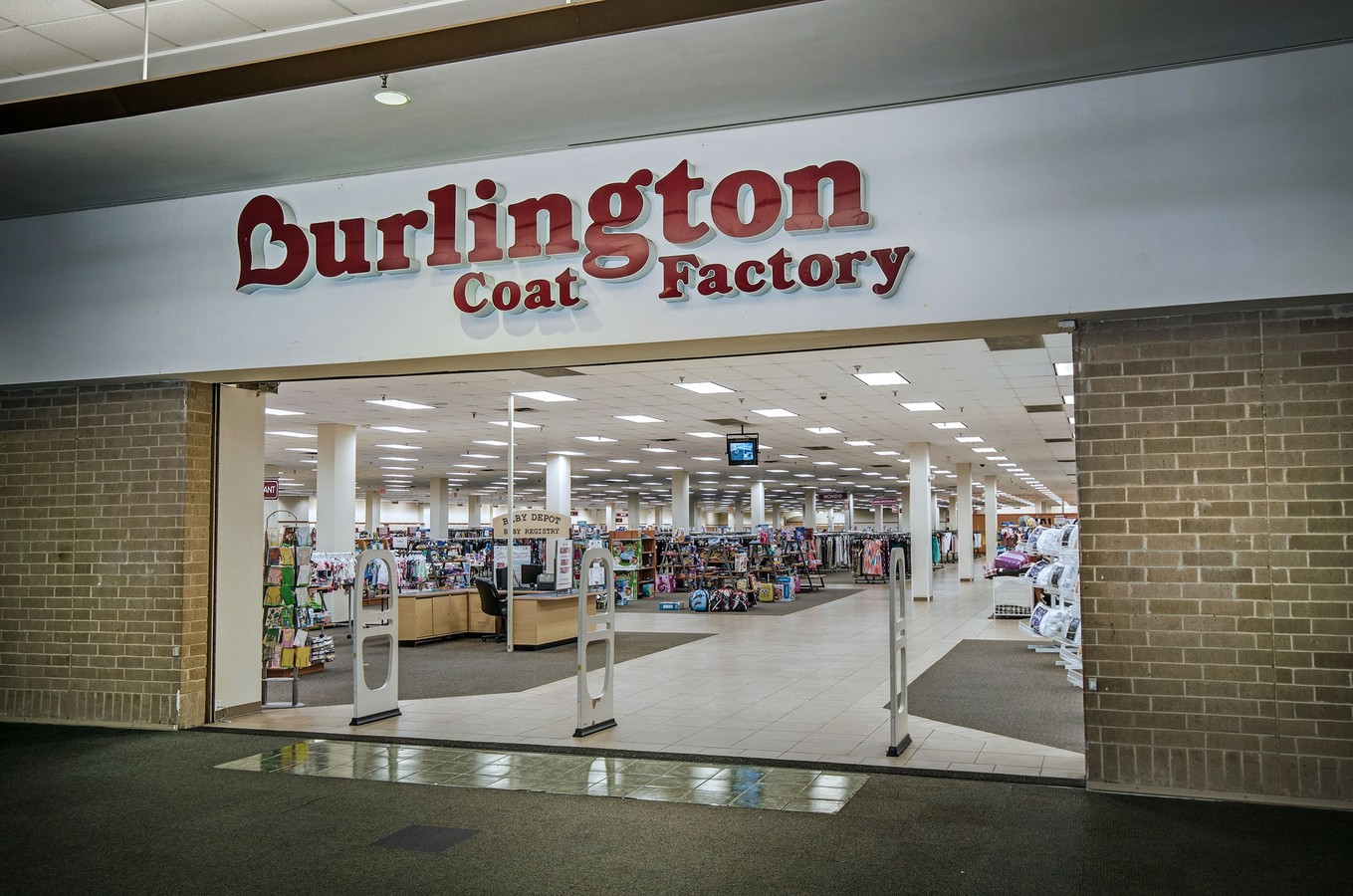
Burlington, New Jersey-based Burlington Coat Factory leased the vacant Mervyn's space, with their store opening in March 2007. Moreover, The vacant Weiss-Goldring spot re-opened as a Bed, Bath and Beyond in 2009.

J.C. Penney, which took a major hit from Hurricane Gustav in September 2008, closed for repairs. The refurbished store came back inline in July 2009. It was joined by new tenants The Children's Place, The Buckle and McAlister's Deli.

Today, ALEXANDRIA MALL is owned by New York City-based Radiant Partners and managed by Chicago-based General Growth Properties.

Sources:

"Alexandria Mall" article on Wikipedia
Comment post by Scott
www.alexandria-louisiana.com / "Alexandria Retrospective"
"Dillard's" article on Wikipedia
www.ggp.com (General Growth Properties)
Juneau's Nugget Mall


How's that for background scenery?
Photo from www.nuggetmall.com


An inside shot of the center.
Photo from www.nuggetmall.com


Alaska's second shopping mall, as it stood in 2008. The vacant anchor
box on the right was previously leased by Bellevue, Washington-based
Lamonts and was rebranded, as a Fresno-based Gottschalks, before
it closed in 2002.
NUGGET MALL
Glacier Highway and Old Dairy Road
Juneau, Alaska

Alaska's oldest shopping mall is UNIVERSITY CENTER [October 2009 archive], which opened, in Anchorage, in 1972. The state's largest mall is the 728,000 square foot, two hundred store, DIMOND CENTER [November 2007 archive], which opened, also in Anchorage, in 1977. The most upscale center in the state would be 5TH AVENUE MALL, in business in Anchorage since 1987, featuring Alaska's only Nordstrom.

Closer to the "Lower Forty-Eight", in the state's capital city of Juneau, is a little-known enclosed shopping mall that has been in operation since November, 1974. NUGGET MALL was originally developed by Juneau's Bill Flint. It was built on a 12 acre tract, located 8.5 miles northwest of the center city of Juneau.

The single-level center was originally anchored by a 13,000 square foot Nugget Department Store. By early 1975, there was Pay 'n Save Drug and inline stores such as Martha's Flowers, Pizazz, Kinney Shoes and Zales Jewelers.

The only commercial competitor, MENDENHALL MALL, opened in 1977. This strip-format complex was situated .7 miles northwest.

A 1-level (21,500 square foot), Bellevue, Washington-based Lamonts joined NUGGET MALL in the 1980s. By this time, the Nugget store had morphed into Nugget AK Outfitters. Pay 'n Save became a Hudson, Ohio-based Jo-Ann Fabrics.

Lamonts was rebranded, as a Fresno-based Gottschalks, in September 2000. This store was shuttered in 2002, when it relocated to MENDENHALL MALL.

Today, there are thirty-eight store spaces in the enclosed portion of NUGGET MALL and an additional ten in peripheral structures. The gross leasable area of the mall proper is 210,085 square feet.

The center is currently owned and operated by Redmond-Washington-based Loveless / Tollefson Properties.

Sources:

www.juneaualaska.com / history
Borough of Juneau website
Municipality of Anchorage website
www.dimondcenter.com
www.simon.com (5th Avenue Mall)
"Bobby" comment post
Sally Norgaard / Manager Mall Marketing / 5th Avenue Anchorage Mall
Vermont's Green Mountain Mall


A present-day layout. The physical structure
of the 195,400 square foot center has not
changed appreciably since its 1974 grand open-
ing. However, as expected, there have been
many changes in stores and nameplates over
the years.


That well-known, Plano, Texas retailer has maintained a presence
at the mall since 1980. Recently, they moved from a 35,300 square
foot store -on the north end- to a 60,500 square foot space on the
south.
Photo from www.greenmountainmall.com
*


A GREEN MOUNTAIN MALL tenant since 1981, Sears recently
relocated to a new store in sales tax-free New Hampshire.
Photo from http://www.greenmountainmall.com/

GREEN MOUNTAIN MALL
Memorial Drive and Sanger Circle
Saint Johnsbury, Vermont

Information available on shopping malls in Vermont is sketchy at best. It appears that its first such shopping center, GREEN MOUNTAIN MALL, was built on a 15 acre plot, 2.4 miles north of the town center of the hamlet of Saint Johnsbury.

The single-level (195,400 square foot), community-type retail structure was built by Boston's Bernard Healy and completed in 1974. It was anchored by a 1-level (35,300 square foot) New York City-based W.T. Grant variety store, 1-level (30,400 square foot) A & P supermarket and 1-level (60,500 square foot) Framingham, Massachusetts-based Zayre discount mart.

Within two years, a scenario of merchandising musical chairs was underway. A & P closed in 1975 and reopened as a Shop and Save supermarket in 1980. The Grant's chain went bankrupt in 1976, with its store at GREEN MOUNTAIN being leased by J.C. Penney in 1980. A small Sears Catalogue and Appliance store opened in 1981.

By 1988, the Zayre chain was in trouble. Its vacant store was leased by Salem, Massachusetts-based Rich's in 1991. At this time, the president of the Rich's chain, Howard Rich, bought a fifty percent share of GREEN MOUNTAIN MALL, and invested 3 million dollars into renovating it.

By January 1997, the Rich's chain was out of business. Their 60,526 square foot anchor store (the largest in the mall) was occupied by Rocky Hill, Connecticut-based Ames in late 1997. More anchor changes occurred.

The Shop and Save became a Butson's and then a Sav-A-Lot supermarket. This operation lasted until 2006. Meanwhile, the Ames Company went belly-up, with its GREEN MOUNTAIN location going out of business in 2002.

One of the three owners of the mall, William Costa, passed away in November 2006. The remaining proprietors, Bernard Healy and Howard Rich, attempted a turn around at the mall.

The vacant Ames anchor box was occupied by J.C. Penney. A Columbus, Ohio-based Big Lots opened -in the vacated Penney's- in early 2008. The mall's Sears Catalogue and Appliance moved out of the shopping center in 2007.
Sources:

www.greenmountainmall.com
www.geocities.com /zayre88 / plaza-greenmtn.
www.amesfanclub.com The Caledonian Record / "What Now With The Mall?" / Saturday January 6, 2007 / Article By Staff Reporter Taylor Reed
New Hampshire's Belknap Mall


Photo from Malls Of America Blogspot


The circa-1974 physical layout. At the time, the mini-mall encompassed
94,000 leasable square feet.


The center in 1990. The new Zayre, added in 1988, lasted only so
many months. It became an Ames in 1989.


The only enclosed mall in New Hampshire's Lakes Region, a 174,000
square foot community-type complex. Salem's MALL AT ROCKINGHAM
PARK (at 1,020,000 square feet) is currently the state's largest regional
mall.


The main mall entrance and Blockbuster Video, a tenant since
1997.
Picture from Flatley Company website

BELKNAP MALL
Daniel Webster Highway / US 3 and Old State Road
Town Of Belmont, New Hampshire

The first shopping mall in the Granite State, Nashua's GATE CITY MALL, opened for business in 1969. 50 miles north, in the small hamlet of Belmont, another enclosed shopping mall was completed in 1974.

BELKNAP MALL was built on a 16 acre site, located on the south shore of Lake Winnisquam, 1.5 miles southwest of the center of Laconia, New Hampshire. The original mall encompassed 94,000 square feet, and was anchored by a Framingham, Massachusetts-based Zayre discount mart on its east end, and a Shaw's supermarket on the west.

An 81,000 square foot addition to the north end was completed in mid-1988. It included a new 59,000 square foot Zayre and three new store spaces, which were not accessible from the enclosed part of the center. The old Zayre location in the original mall was divided into several smaller stores and an expanded mall corridor area.

Soon after opening in its newly-built location, the Zayre closed. The chain had been acquired by Rocky Hill, Connecticut-based Ames, who reopened the store under their nameplate in late 1989. By 1990, the mall was thriving, with tenants such as Decelle apparel, Foot Locker, Record Town and Radio Shack.

The demise of the Ames chain in late 2002, left BELKNAP MALL's major anchor spot vacant. As a result, several of the national retail chain stores abandoned the center. The complex was given a facelift, with the old-style, "introverted" store configuration changed, so that tenants on the south and east sides of the complex had exterior entrances, accessible from the parking area.

The Shaw's supermarket was also expanded, and the vacant Ames was divided into two stores. The first, with 26,000 square feet, was accessible from the enclosed mall. This was leased to South Hill, Virginia-based Peebles. The second space, with 33,000 square feet, had only an exterior entrance. It became a Columbus, Ohio-based Big Lots. Both stores opened in 2004.

In 2008, BELKNAP MALL encompasses 174,400 leasable square feet, with an additional 35,800 square feet of outparcel space. The center is owned by a joint venture of the Boston-based Wilder Companies and New York City-based O'Conner Capital Partners, who purchased the ten property portfolio of the Braintree, Massachusetts-based Thomas Flatley Company in May 2007.
*
Sources:

www.geocities.com.zayre88/belknapmall
Dead Malls "Belknap Mall" article / Commentary by "Chris S."
www.flatleyco.com
"Zayre" article on Wikipedia
"Ames" article on Wikipedia
www.datavisionappraisal.com / Belmont, New Hampshire Online Database
Arlington, Virginia's Crystal City

*
Photo from Wikipedia / Taken by Aaron Kuhn


A skylit area within Northern Virginia's subterannean
shopopolis, which was known as CRYSTAL PLAZA
in 1986, when the photo was taken. Today, this partic-
ular group of stores is known as SHOPS AT 2100
CRYSTAL DRIVE.

*
An above-the-ground view of the 1986 CRYSTAL CITY complex.


The two primary components of Arlington's underground -and street level- shopping complex, collectively known as CRYSTAL CITY SHOPS. The venue on the left was originally known as CRYSTAL PLAZA. The venue on the right, originally the CRYSTAL CITY UNDERGROUND, now goes by SHOPS AT 1750 CRYSTAL DRIVE.
CRYSTAL CITY
Jefferson Davis Highway / US 1 and 18th Street South
Arlington County, Virginia

Arlington, Virginia's high-rise "urban village" arose from land that had been dumps, factories and flop houses. Development began in 1963, under the auspices of the Charles E. Smith Company.

In fact, what became CRYSTAL CITY had not been envisaged as a planned community, but it evolved into one over the ensuing years. The opulent Crystal House Hotel, the first building to be completed, lent the "Crystal" name to subsequent office towers and condominiums constructed on the site.

These were eventually connected with a system of below-grade shopping areas and connecting corridors, which opened as a retail mall in 1975. Known as CRYSTAL PLAZA and CRYSTAL CITY UNDERGROUND, this subterranean shopopolis hosted over one hundred stores and services.

The CRYSTAL CITY complex became rapid transit-accessible with the opening of the D.C. Metro's Blue Line, in July 1977. Commuter rail access, via the region's new Virginia Railway Express, began in June 1992.

For several years, the underground city in Arlington was seen as a futuristic portent of urban living in America. However, with the decline of the enclosed shopping mall during the 1990s, this vision began to change. In 2001, a plan was put forward to move some of the focus of the retail segment of CRYSTAL CITY up to street level.

A parking structure was demolished, to make way for 134,000 square feet of new -open air- retail and restaurant space, known as The Streetscape. In addition, new sidewalks and landscaping were installed and roadways were reconfigured to serve more as city streets, than merely circulator routes.

Now known as SHOPS AT 2100 CRYSTAL DRIVE and SHOPS AT 1750 CRYSTAL DRIVE, the combination underground and street-level shopping / entertainment center is owned and operated by the New York City-based Vornado Realty Trust.

The complex features over one hundred and thirty stores and services; including two pharmacies, seven banks, and a post office. It is also linked with thirteen full-service hotels and various office towers and condominiums.

Sources:

"Crystal City" article on Wikipedia
www.arlingtonvirginia.com
www.commuterpage.com
Washington Metropolitan Area Transit Authority
Virginia Railway Express
Vornado Realty Trust
Montana's Rimrock Mall

*
Photo from VisitMontana website


Physical layout of the circa-'75 center.


RIMROCK in 1980, after the completion of its southern
expansion. The Denver Dry Goods store was rather
short-lived. It was replaced by J.C. Penney in 1982.


The RIMROCK MALL of the present. During an anchor
store shifting scenario, in 2001, Dillard's established
a dual-store format in the east and south anchor boxes.
J.C. Penney relocated into what had been the first Dillard's
location in the mall, in the north anchor space.
RIMROCK MALL
South 24th Street West and Central Avenue
Billings, Montana

For the 40th MALL HALL OF FAME induction, we head out to the wide open spaces of Montana and the "great indoors" of Billings' RIMROCK MALL. The fully-enclosed complex opened September 11, 1975 and was the second regional shopping center in the Treasure State, following Great Falls' HOLIDAY VILLAGE, which was completed in 1959.

RIMROCK was developed, in a joint venture, by La Jolla, California-based Ernest W. Hahn Incorporated and Bruce Crippen. The center was designed by Los Angeles-based Charles Kober Associates and was situated on a 53 acre parcel, 3 miles southwest of downtown Billings.

The original mall was anchored by a 1-level (97,000 square foot) Montgomery Ward, 1-level (91,000 square foot), Billings-based- Hennessy's and 1-level (33,000 square foot), St. Cloud, Minnesota-based Herberger's.

The list of charter tenants included Casual World apparel, General Nutrition Center, Musicland and forty-five other retailers. There was also an interior-entranced, 4-screen multiplex cinema (eventually replaced by a 10-screen -outparcel- multiplex).

The mall was expanded in 1980, with the addition of a 1-level (62,000 square foot), Denver-based Denver Dry Goods and several new stores; these built onto the south end of the mall. In 1981, "The Denver Dry" was shuttered. It was replaced by J.C. Penney in 1982.

The Little Rock-based Dillard's chain took up shop in the mall's northern anchor store in 1998, which had been leased by Hennessy's.

The year 2001 brought on a game of merchandising musical chairs, of sorts. The Montgomery Ward chain went bankrupt and vacated the mall's east anchor. The spot was taken by Dillard's, who fashioned it into a Dillard's Women's store.

J.C. Penney, in turn, moved into the old Hennessy's / Dillard's on the north end of the complex. The old Denver Dry / J.C. Penney, on the south end, was devoted to Dillard's Men's and Children's wear. Four years later, Herberger's was expanded, taking in four smaller store spaces in the process.

Today, RIMROCK MALL is the largest shopping complex in Montana. It encompasses 599,000 leasable square feet and houses eighty stores and services. It is owned and operated by the Santa-Monica-based Macerich Company, who acquired the property in November 1996.

RIMROCK MALL TENANTS 1975:

HENNESSEY'S / HERBERGER'S / MONTGOMERY WARD / Aileen’s / Bakers Shoes / Big Bear / Bojo's / Calamity's / Casual World / Cattle Company / Clown Town / Coffee Tree / Fashion 88 / First Federal Savings / Foxmoor Casual / GallenKamp Shoes / GNC / Hal's Sportwear / Hatch's / Hipster-Doogan / House of Fabrics / JB's Big Boy / Jeans West / Kinney Shoes / Leonards / Morrow's Nut House / Musicland / Nation's Creations / Noah's Ark / Orange Julius / Rae's Place / Riley & McCormick / Rimrock Camera Center / Rimrock 4 Theaters (inside mall) / Schubach's / Sound World / Squirrel's Nest / Sukins / Sweetbriar Shops / Sweets & Treats / Swiss Colony / The Snooty Cow / The Tinder Box / Tiffany's Bakery / Traci's / Up Your Alley / Waldenbooks / Young Fashions

Sources:

"Rimrock Mall" article on Wikipedia
"Dillard's" article on Wikipedia"Hennessy's" article on Wikipedia
"Herberger's" article on Wikipedia
Billings Gazette / "Rimrock Mall Celebrates 30th Anniversary" / September 11, 2005
http://www.macerich.com/
South Dakota's Empire Mall

*
Photo from www.macerich.com


The original -circa-'75- layout of EMPIRE MALL. At the time, it was
a 600,000 square foot center of forty-seven stores. Major expansions
were to come in 1978 and 1988.


The 1,056,000 square foot EMPIRE MALL, in the present day. The
first expansion of floorspace, completed in 1978, is shown in medium
gray. The second, coming inline in 1988, appears in light gray. The
center is said to be the largest shopping complex between Minneapolis
and Denver.
EMPIRE MALL
West 41st Street and South Louise Avenue
Sioux Falls, South Dakota

In 1975, the Mount Rushmore State's second regional-class shopping complex opened in the environs of Sioux Falls. EMPIRE MALL was situated on a 93 acre tract, located 3 miles southwest of the central business district.

The 599,000 square foot center was developed by Des Moines-based General Growth Companies, a precursor of today's General Growth Properties [March 2008 archive]. The complex opened with forty-seven stores and was anchored by a 1-level (134,000 square foot) J.C. Penney and 1-level (101,000 square foot) Des Moines-based, Younkers.

The first addition was built on the south side of the mall and completed in 1978. It included a 1-level (100,800 square foot), Minneapolis-based Dayton's and approximately twenty-two new stores.

The next expansion, added to the southwest, came online in 1988. This included a 1-level (100,700 square foot) Sears and twenty-seven additional stores. With these renovations, EMPIRE MALL encompassed 1,056,000 leasable square feet.

In 1998, the mall was purchased -in a joint venture- by the Indianapolis-based Simon Debartolo Group and Santa Monica-based Macerich Company [March 2008 archive]. Macerich assumed management duties at the mall.

A smaller (287,000 square foot) shopping center had been built on a tract of land across Louise Avenue, in the mid-1980s. This mini-mall, originally known as NEW TOWN MALL, was also bought by Simon / Macerich. In the present, it is called EMPIRE EAST and is considered a part of the EMPIRE complex.

By 2001, a newly-installed Food Court was in operation in the northwest corner of EMPIRE MALL. Also, the Dayton's had reopened under the Chicago-based Marshall Field's nameplate. In 2006, this store was rebranded by Macy's.

In 2008, EMPIRE MALL / EMPIRE EAST constitutes the largest shopping center between the cities of Minneapolis and Denver. Their combined gross leasable area is 1,343,357 square feet, with a total of one hundred and eighty stores and services.

One hundred and thirty-one of these are EMPIRE MALL retail spaces, twenty-five are kiosks, also in the mall proper. There are eighteen outparcel businesses in -or around- the mall site and six stores within the EMPIRE EAST center.

The latest news in the Sioux Falls metro area speaks of new retail competitors for EMPIRE MALL. The GALLERIA AT RIVER'S BEND, a 1 million square foot, hybrid lifestyle / residential venue was plotted for a 200 acre site, 7.5 miles northeast of the EMPIRE complex. However, as of December 2008, its construction was stalled.

The SHOPPES AT DAWLEY FARM, another open-air venue, is being built 6.2 miles northeast of EMPIRE MALL. A Target store, at SHOPPES AT DAWLEY FARM, opened October 11, 2009. A Kohl's is expected to follow in the near future.

Sources:

"Empire Mall" article on Wikipedia
"Dayton's" article on Wikipedia
"Empire Mall" comment post by **
www.macerich.com
www.simon.com
www.siouxfallsdevelopment.com
Minnehaha County, South Dakota Tax Assessor website
Wyoming's White Mountain Mall


Photo from General Growth Properties website


The mall's Flaming Gorge Harley Store.
Photo from www.rockymountainbikers.com


The Star 8 Cinema occupies a portion of the mall's former Wal-Mart.


WHITE MOUNTAIN, the third-largest of the Cowboy State's three
regional malls. Casper's 567,000 square foot EASTRIDGE holds the
top spot.


Photos from General Growth Properties website

WHITE MOUNTAIN MALL
Foothill Boulevard and Dewar Drive
Rock Springs, Wyoming

The first of Wyoming's three fully-enclosed, regional-class retail complexes, and the state's only Mid-20th century shopping mall, was completed in 1978. WHITE MOUNTAIN MALL was built on a 32.4 acre plot, located 2 miles west of downtown Rock Springs.

The single-level center was designed by Salt Lake City's Don Johnson and Associates and Berkeley, California's Arthur A. Iwata and developed by Salt Lake City-based John Price Associates.

The shopping center was anchored by a 1-level (34,000 square foot) J.C. Penney, 1-level (49,000 square foot) Montgomery Ward and 1-level (37,000 square foot), St. Cloud, Minnesota-based Herberger's. There were also Home Center and Ernst Drug stores in the original shopping venue.

Both the Ward's and Wal-Mart locations closed during 2001, leaving WHITE MOUNTAIN MALL with nearly 137,000 feet of vacant area. This prompted the management to pursue some creative -and even unorthodox- concepts in leasing space at the mall.

First off, the old Ward's became offices for the State of Wyoming. Even more novel was the establishment of the world's first Harley-Davidson motorcycle shopping mall store. Flaming Gorge Harley opened in 2003.

The 43,000 square foot retail outlet features a sales showroom, Harley-Davidson service center and men's and women's shower facilities. There is also RV and tractor-trailer parking adjacent to the store.

The mall's most recent anchor store alteration was completed in the late 2000s, when Herberger's expanded into existing mall space, enlarging their original 37,000 square foot store to over 60,000 square feet.

WHITE MOUNTAIN MALL presently encompasses 313,000 leasable square feet and thirty-nine store spaces, with an additional 12,900 square feet of outparcel retail. It is owned and operated by Chicago-based General Growth Properties, who acquired the shopping center in 2002.

Sources:

"White Mountain Mall" article on Wikipedia
"Herberger's" article on Wikipedia
ggp.com (General Growth Properties)
www.rockymountainbikers.com
www.cinematour.com / Article by Sam Graham
North Dakota's Gateway Mall


Bismarck's secondary shopopolis was renamed a "Fashion Mall" as
part of a renovation started in 2006.
Photo from Wikipedia / "Randy 394"


Site plan of the center soon after its first grand opening in 1979. At
the time, it encompassed 334,000 leasable square feet.


An early 2000s addition, the imposing entrance to GATEWAY's Primecare "Medical Mall". This was installed in the former White Mart / Menard's.


Sears, the one remaining charter anchor at GATEWAY.
Photo from www.gatewayfashionmall.com


The PrimeCare "Medical Mall", which opened in a portion of the former
White Mart / Menard's space.
Photo from www.gatewayfashionmall.com


A circa-2009 physical layout of GATEWAY FASHION MALL, with
editing done by Justin S . As of this writing, the center is being exten-
sively renovated. The old Food Court is being removed, with its area
made into an Atrium. A prospective third anchor store, rumored to be
Macy's, is indicated in gray. Apparently, this store will not be added
to the mall.
GATEWAY MALL
State Street / US 83 and Gateway Avenue
Bismarck, North Dakota

Bismarck's third shopping mall opened in September 1979. Known at the time as GATEWAY MALL, it was built on a 45 acre parcel, located 1 mile north of the North Dakota Capitol.

The fully-enclosed center was developed by North Bismarck Associates and encompassed 334,000 leasable square feet. It was anchored by Sears, a Bismarck-based A.W. Lucas department store and Jamestown, North Dakota-based White Mart discount outlet.

There was also the Midco Theater, a 3-screen multiplex. This was later expanded to 8 screens, and -for a time- was the largest cinema in Bismarck.

GATEWAY coexisted fairly well with its much larger competitor, KIRKWOOD MALL [March 2007 archive], which was 2.5 miles south. However, by the mid-1980s, the smaller center began to experience some difficulty trying to remain fully-leased.

A.W. Lucas -the center anchor- closed and was replaced by St. Cloud, Minnesota-based Herberger's, which was shuttered in 1994. The store was leased to different tenants over the years, but spent much of the time sitting vacant. Presently, it is occupied by Conlin's Furniture.

The White Mart, occupying the northeast corner of the mall, lasted for approximately 10 years before going under. This space was filled by an Eau Claire, Wisconsin-based Menard's Home Improvement store, which relocated away from GATEWAY in the early 2000s.

The spot was then converted into the Primecare Health Network "Medical Mall". The Midco-8 multiplex was eventually purchased by Carmike Cinemas.

GATEWAY changed hands 3 times between 2003 and 2006. The final purchase was made by Encino, California-based Raymond Arjmand, who invested 10 million dollars renovating the facility.

A newly-refurbished shopping center, known officially as GATEWAY FASHION MALL, held a second grand opening in November 2006. It is currently the state's sixth-largest mall, with forty-nine store spaces and five outparcels.

The renovation of the complex is ongoing. The original Food Court is being relocated, with a new, bi-level Atrium area being built in its spot.

It was also speculated that a "major department store" (Macy's) would locate in a newly-built structure, connecting into this Atrium. However, it appears that this will not come to pass.

Meanwhile, an anchor store, Conlin's Furniture, pulled out of the mall. This was followed by the expatriations of Joy's Hallmark and Hansen's Furniture, in 2009.

Sources:

"Gateway Mall" article on Wikipedia
"Herberger's" article on Wikipedia
"Menard's" article on Wikipedia
www.gatewayfashionmall.com
Burleigh County, North Dakota Tax Assessor website
"Anonymous" comment post
Justin S., former Bismarck resident and employee of the mall

Monday, March 12, 2007

Kansas City's Blue Ridge Mall


The southwest corner of the complex, circa-1960. The Blue Ridge
Bowl (bowling alley) was located on the Lower ("Concourse") Level.
Photo from http://www.pleasantfamilyshoping.blogspot.com/


A layout of the original 500,000 square foot shopping venue. Upon its
grand opening, in October 1958, it was anchored by KC-based The
Jones Store and Montgomery Ward.


A vintage view of the Montgomery Ward at BLUE RIDGE MALL, which
was one of the chain's earliest shopping mall-format stores.
Photo from http://pleasantfamilyshopping.blogspot.com


The Kansas City-based Jones Store, which sat at the northeast corner
of the complex. It was a splendid example of "Mid-Mod" style that was
left intact through the mall's many renovations and facelifts. Regretfully,
the historic structure was bulldozed -to make way for a Wal-Mart
SuperCenter- in late 2005.


J.C. Penney, sporting the company's new (post-New Look) logo. Added,
as a western anchor to the existing mall during its roofing renovation
in 1972, the store sat on top of a bi-level parking deck.


The South Entrance, following the enclosing renovation of 1972.


A physical layout from 1972. The new, 3-level Penney's now anchored
the west end and the existing Ward's had been expanded.


Interior views of the latter-day mall. These shots were taken in
2001, four years before the shopping center had its destiny date
with the wrecking ball.
Photos from www.labelscar.com / "Prange Way"
BLUE RIDGE MALL
Blue Ridge Boulevard and East 43rd Street
Kansas City and Independence, Missouri

The second shopping mall in the "Show Me State" straddled the corporate lines of Kansas City and Independence, Missouri. It was built by Kansas City's William Reich on a 63 acre tract, situated 7 miles southeast of The City of Fountain's urban core.

Originally open-air, BLUE RIDGE MALL was officially dedicated October 17, 1958. It encompassed 500,000 leasable square feet and consisted of a main level of retail and lower service level, which had a small concourse of store spaces, including a bowling alley and cafeteria.

Anchors were a 2-level (103,000 square foot) Montgomery Ward and 3-level (183,000 square foot), Kansas City, Missouri-based Jones Store.

There were also a Safeway supermarket, J.J. Newberry and F.W. Woolworth 5 and 10's, Harzfield's apparel, Crown Drug, Lerner Shops and dry-goods-only J.C. Penney. The retail roster listed eighty-two stores and services.

Some years later, the Montgomery Ward location was expanded to 136,000 square feet, which included additional retail space and an Auto Center.

In 1971-1972, BLUE RIDGE MALL was enclosed and climate-controlled. A 3-level (217,900 square foot) J.C. Penney was built, replacing the original store. This new Penney's was part of a bi-level parking structure, added to the west end of the complex.

With this expansion, BLUE RIDGE MALL incorporated 750,900 leasable square feet. There were now nearly ninety inline stores, including Hickory Farms of Ohio, Waldenbooks and Kay-Bee Toys.

Blue Ridge Mall Cinemas I-IV, an eastern outparcel, showed its first features in December 1971. The venue was in operation until 1995.

The first nearby commercial competitor, INDEPENDENCE CENTER, came along in 1974, and was 4 miles east. BANNISTER MALL, 7 miles southwest, opened in 1980.

BLUE RIDGE MALL was given a facelift renovation in the 1980s, with a Food Court installed in space previously occupied by the Newberry 5 and dime.

The center was in decline by the time Woolworth closed, in October 1997. Three years later, Montgomery Ward went out of business. J.C. Penney moved on in 2001, with the Jones Store closing up shop in 2003.

By early 2004, only a few stores were still open. In May, it was announced that the mall was going to be demolished and replaced by a new (197,000 square foot) Wal-Mart Supercenter, which was to be part of a new BLUE RIDGE CROSSING strip center.

This plan created a great deal of controversy, especially when it was revealed that the mega-retailer from Bentonville was to receive a 25 million dollar "tax increment financing" break to aid in demolishing the existing shopping center.

Eventually the plan was approved, with the mall being reduced to rubble between late 2005 and early 2006. The Supercenter opened for business January 19, 2007. It was joined by a 135,000 square foot Lowe's December 26, 2008.

Sources:

http://www.deadmalls.com/ / "Blue Ridge Mall" article / Nick B., Grady Ellis & Kim S. Schinkel, contributors
http://www.rodslair.com/ / Site created and maintained by Rod Shelley
http://www.labelscar.com/ / "Blue Ridge Mall" article / Authored by "Prange Way"
http://www.wai.com/ (Weidlinger Retail)
http://www.cinematour.com/ / "Blue Ridge Mall Cinema" article
http://www.acppubs.com/ / "Wrecking Blue Ridge Mall"
http://www.blueridgecrossing.com/

Saturday, March 03, 2007

New Jersey's Bergen Mall


An aerial of the mall in its early years. The 4-level Stern's stands at the
center of the center, with a freestanding strip complex -including Food
Fair and Penn Fruit supermarkets- on the left.
Photo from Malls of America Blogspot


A circa-1957 plan of the Upper Level of BERGEN MALL, which -by
the way- was the very first shopping center in the nation to be
officially referred to as a (quote / unquote) "Mall". Its basement
included an exterior-entranced bowling alley, as well as a performing
arts center and outdoor kiddie ride area.


BERGEN in 1973, after the enclosure / renovation. An Ohrbach's
department store had been added to the west side of the mall in
1967. Food Fair, by this time rebranded as a Pantry Pride, was
eventually made into an indoor Ice Rink.


An early 2000s view of the West Wing and Value City mall entrance.
Photo from www.myspace.com / bergen mall / Jordan B.


The '70s-style Center Court and Macy's mall entrance.
Photo from www.myspace.com / bergen mall / Jordan B.


The main mallway, as it appeared between 1973 and 2006.
Photo from www.myspace.com / bergen mall / Jordan B.


The quonset hut Penn Fruit supermarket, an eastern outparcel to
the mall proper. It had tenures as Dale's and Shop-Rite markets
before being demolished in 2006.
Photo from www.myspace.com / bergen mall / Jordan B.


The Lower Level's VILLAGE MALL, a fixture of the 1973 roofing
renovation. It was built in enclosed space previously occupied by
an outdoor kiddie ride area.
Photo from www.myspace.com/bergen_mall / Jordan B.


A contemporary shot of the newly-renovated BERGEN TOWN CENTER
Center Court. The mall entrance of Century 21 is seen on the right
Photo from www.bergenonline.com (Vornado Realty Trust)


A rendering of the exterior of Century 21. It occupies the second and
third levels of the old Stern's anchor box. Filene's Basement and
Nordstrom Rack stores are on on the first level of the mall and have
only exterior entrances.
Rendering from www.bergenonline.com (Vornado Realty Trust)


The newly-reconfigured southeast corner of BERGEN TOWN CENTER.
A 77,000 square foot Whole Foods Market uses space previously leased
as inline stores, with some additional square footage added.
Rendering from www.bergenonline.com (Vornado Realty Trust)


The newly-expanded West Wing...where Ohrbach's (Steinbach /
Value City) used to stand. Amazingly enough, the new Target,
seen in the distance, actually has an interior entrance into the
mall.
Rendering from www.bergenonline.com (Vornado Realty Trust)
*
*
A site plan of the remodeled retail hub. Another surprise...the circa-
'57 center has been renovated as an enclosed structure...instead
of being given the standard, post millennium-type demalling. The
Lowe's indicated here is presently under construction.


BERGEN MALL
East Route 4 and Forest Avenue
Paramus and Maywood, New Jersey

The first shopping mall in New Jersey, Paramus' GARDEN STATE PLAZA [May 2008 archive], was completed in phases between 1957 and 1960. The state's second major shopping center, BERGEN MALL, was located a half mile east of GARDEN STATE, straddling the cities of Paramus and Maywood.
*
BERGEN, probably the very first shopping center in the United States to be officially referred to as a (quote / unquote) "mall", held its grand opening November 14, 1957. It was designed by Seattle's John Graham, Jr., developed by New York City-based Allied Stores and constructed on an 85 acre site, 10.5 miles northwest of Times Square.
*
The open-air complex was situated on two levels and anchored by a 4-level (320,000 square foot), New York City-based Stern Brothers department store. There was also a 2-level (47,000 square foot) J.J. Newberry 5 and 10, as well as Lerner Shops, Foxmoor women's apparel, Nelson Furs, A & S Beck Shoes, Brill Hardware, Fanny Farmer Candies, Mallary Furniture, and Thom McAn Shoes.
*
Food Fair and Penn Fruit supermarkets were located in an outparcel strip plaza, "The Bergen Mall Food Center", connected to the east end of the main mall structure via a pedestrian and auto bridge over Forest Avenue.
*
The Lower Level of BERGEN MALL included a bowling alley, performing arts center, "kiddie ride" amusement area and (after 1972) the Carmelite Chapel of St. Therese. In the mid-20th century era of a major, regional shopping center as a one-stop, "everything in one place" place of business and entertainment, BERGEN MALL had it all.
*
A 2-level (135,000 square foot), New York City-based Ohrbach's was added to the west end of the mall, opening August 17, 1967. A freestanding E.J. Korvette discount mart was also built as a peripheral structure at this time.
*
On September 16, 1973, a 1.2 million dollar renovation of the shopping center was completed. The mall had been enclosed and its interior spaces refurbished with 1970s decor. An Early American-theme "Village Mall" area was installed on the Lower Level.
*
This renovation kept BERGEN MALL competitive with other regional-class shopping centers in Paramus. In addition to GARDEN STATE PLAZA, these were FASHION CENTER MALL (1967) and PARAMUS PARK MALL (1974).
*
However, as the years passed, BERGEN MALL became stuck in a time warp, of sorts. There were no more major renovations. New anchor stores came and went. Ohrbach's became an Asbury Park, New Jersey-based Steinbach in 1987 and Richmond, Virginia-based Value City in 1996, which was shuttered in the mid-2000s.
*
Stern's was rebranded by Macy's in 2001 and closed in 2004. Levels 2 and 3 of the 4-level structure reopened as a New York City-based Century 21 discount apparel outlet October 10, 2006. The first level became a Boston-based Filene's ["fiy-leenz"] Basement October 28, 2007.
*
The 1,068,000 square foot center had been purchased by the New York City-based Vornado Realty Trust in late 2003. The firm changed the name of the complex to BERGEN TOWN CENTER and started a 171 million dollar renovation in 2006.
*
This included a complete remodeling of the shopping center. The old Ohrbach's / Steinbach / Value City was gutted, partially-demolished and made into an extension of the West Wing, anchored by a newly-built Target.
*
Inline stores, such as a 35,000 square foot Nordstrom Rack and 77,000 square foot Whole Foods Market, are being created out of previously-existing -and newly-added- mall space.
*
Moreover, new mall entrances and a 5-level parking garage are being built, with completion scheduled to take place in the spring of 2009. An outparcel (167,000 square foot) Lowe's Home Improvement Center is presently under construction.
*
Sources:
*
"Bergen Town Center" article on Wikipedia
www.myspace.com/bergenmall / Site maintained by Jordan B.
Malls Of America blogspot / "Bergen Mall' thread
Comment post by Dan / "Dea41396"
"Ohrbach's" article on Wikipedia
"Steinbach" article on Wikipedia
Iowa's Merle Hay Plaza

*
Photo From Wikipedia / "IowaHwyMan"


The layout of the original MERLE HAY PLAZA. The bowling alley
on the center's Lower Level is still in operation...possibly the only
vintage shopping mall bowling alley in existence.


Des Moines -and Iowa's- first mall-type shopping center, circa-
1959. Here we see the north concourse and Sears anchor.


The shopping center's Plaza Theatre, which opened in 1967.


MERLE HAY MALL upon the completion of its 1974 expansion.
The project doubled the center's GLA, which now measured 1.2
million square feet.


MERLE HAY's southwest anchor, originally a Montgomery Ward,
renovated by Famous-Barr, and now occupied by Younkers.
Photo from Polk County, Iowa Tax Assessor website.


Iowa's first shopping mall, present-day. Two of the four
anchor stores depicted in the circa-'74 plan have changed...
and Younkers jumped from the southeast to the southwest
corner of the complex.
MERLE HAY PLAZA
Douglas Avenue / US 6 and Merle Hay Road
Des Moines and Urbandale, Iowa

Construction commenced on Iowa's first shopping mall in early 1958. Situated on a 40 acre parcel, 6 miles northwest of the Iowa Capitol, MERLE HAY PLAZA opened for business August 17, 1959.

The open-air complex was developed by Chicago's Joseph Abbell and Bernard Greenbaum. Originally to be known as NORTHLAND SHOPPING CENTER, its was renamed in honor of Merle Hay, the first Iowa citizen to be killed in World War 1.

MERLE HAY PLAZA had thirty-one stores in its first phase, including a 2-level (100,000 square foot), Des Moines-based, Younkers ["yunk-erz"], Safeway supermarket, S.S. Kresge 5 and 10 and underground bowling alley.

A 2-level (216,000 square foot) Sears, which anchored the northeast end of the mall, opened in November 1959. At this time, the entire complex encompassed over 600,000 leasable square feet.

A 6-story office building was added in 1966, with the single-screen Plaza Theatre opening in 1967. In 1972, the concourse and breezeways were enclosed. At this time, the name of the shopping center was changed to MERLE HAY MALL.

Land to the west of the mall was acquired, increasing the size of the site to 76.7 acres. A major expansion of the complex was completed in 1974. This increased its GLA to over one million square feet and extended it into the neighboring city of Urbandale.

This addition included a 2-level (150,000 square foot) Montgomery Ward, 1-level (74,000 square foot) Younkers Home Store, a partial second level of retail and a bi-level parking garage.

These renovations were wrapped up in time for the completion of MERLE HAY MALL's first retail competitor, VALLEY WEST MALL. This fully-enclosed complex was located 3.5 miles to the southwest and opened in August 1975.

MERLE HAY MALL was the site of one of the worst fires in the state's history in November 1978. A blaze ignited in the Younkers anchor, killing ten employees. The store was closed for repairs for nearly a year. It reopened in 1979.

The northern section of the mall's land parcel was developed over the following decade. The first major project was the 236,000 square foot HAYMARKET MALL, a ten store mini-center that was completed in 1979.

Silver Cinemas, a 10-screen multiplex, followed in 1986. The Twin Towers, a 6-story office complex, joined the fold in 1989. Also during the 1980s, Sears renovated its anchor spot. Moreover, a second parking garage was built in the mall's south parking area. Following the opening of the outparcel Silver Cinemas, the mall's original Plaza Theatre closed in 1987. It opened again in 1991, as the Merle Hay Cinema.

Anchor stores at MERLE HAY MALL shifted over the ensuing years. The Younkers Home Store went out of business in 1991 and was leased to Wisconsin-based Kohl's in 1993. Montgomery Ward closed their MERLE HAY location in early 1999. This store was renovated by Saint Louis-based Famous-Barr, who expanded the building to over 165,000 square feet. It opened in August 2000, but closed in June 2004.

One month later, Younkers -by then based in Milwaukee, Wisconsin- moved operations to the former Famous-Barr. The old Younkers was razed and replaced by a 1-level (124,000 square foot) Target, which was completed in July 2005.

The mall endured a year of decling sales following the completion of JORDAN CREEK TOWN CENTER. This combination enclosed and open-air complex is located 7.5 miles southwest of MERLE HAY MALL. It opened in August 2004 and is the largest shopping center in the state.

In the late 2000s, Iowa's oldest -and second-largest- mall encompasses 1.2 million leasable square feet, with one hundred and fourteen stores and services. The center is owned by Des Moines-based Merle Hay Mall Limited Partnership, with leasing handled by Chicago-based Urban Retail Properties.

Sources:

"Merle Hay Mall" article on Wikipedia
"Younkers" article on Wikipedia
"Famous-Barr" article on Wikipedia
"Lost Cinemas of Greater Des Moines" blog / Site created and maintained by Mark Heggen
Polk County, Iowa Tax Assessor website / Jamie Fitzgerald, Polk County Auditor
New Plan Realty Trust / Scottsdale, AZ
Oklahoma's Penn Square Center


The original, circa-'60, open-air complex. In those days, it consisted
of a single level of retail, anchored by two, dual-level department
stores.


A contemporary view of the west anchor at PENN
SQUARE. The store, one of the mall's double Dillard's
locations, sells women's apparel. It was originally
occupied by the John A. Brown Company.
Photo from www.dillards.com


The mall's north anchor, during its days as a Houston-based
Foley's. The store was rebranded as a Macy's in late 2006.
Photo from Oklahoma County, OK Tax Assessor website


Photo from www.pricedwards.com


Photo from www.simon.com


Three interior views of today's PENN SQUARE, reflecting the 10
million dollar facelift given the mall in the year 2000.
Photo from www.simon.com


PENN SQUARE as it stands in 2008. Over its forty-plus year
history, the center has evolved from a single-level, exterior mall
of 575,000 square feet into a bi-level, 1 million square foot, fully-
enclosed -very upscale- shopping venue.
PENN SQUARE CENTER
Northwest Expressway and North Pennsylvania Avenue
Oklahoma City, Oklahoma

PENN SQUARE CENTER, the first mall in the Sooner State, opened in 1960. It was situated on a 54 acre tract, adjacent to the future route of Interstate 44, 3.5 miles northwest of the Oklahoma State Capitol.

The 582,000 square foot complex, originally single-level and open-air in format, was designed by Sorey, Hill and Sorey. There were forty-six inline stores and two anchors.

To the west was a 2-level (98,200 square foot), Oklahoma City-based John A. Brown; to the east, a 2-level (150,700 square fooot) Montgomery Ward. Charter tenants included Lerner Shops and Peyton-Marcus.

A taste of commercial competition came to PENN SQUARE in 1964, with the completion of SHEPHERD MALL, which was located 2 miles south. The two shopping centers coexisted peacably through the 1960s and 1970s.

The first nameplate change at PENN SQUARE took place in 1984, when John A. Brown was rebranded by Dillard's. The store was expanded, into a 186,900 square foot location, as a result. Then, in 1986, a 100 million dollar, two year-long renovation of the entire complex got underway.

This project entailed enclosing and expanding the existing structure, constructing a second level of retail stores -including a new Food Court- and building a 2-level (385,000 square foot), Houston-based Foley's on the mall's north side. Moreover, a three-level parking garage was also added, which was adjacent to the new Foley's.

With this renovation, the previously-struggling PENN SQUARE CENTER had reinvented itself as PENN SQUARE MALL, the city's most upscale shopping venue.

The addition of a 2-level (126,000 square foot) J.C. Penney in 1995 increased the mall's gross leasable area to 1,051,000 square feet, making it the third-largest shopping mall in the state; this following Tulsa's WOODLAND HILLS (1976) and Oklahoma City's QUAIL SPRINGS (1980).

PENN SQUARE MALL was given a 10 million dollar facelift in the year 2000, with new flooring, lighting and seating areas installed. The year 2001 saw Montgomery Ward close its store. This became a second Dillard's location in May 2002, which was devoted entirely to men's and children's apparel.

The previously-existing Dillard's was refitted to sell women's clothing and accessories. The Foley's, on the north end of the mall, was "Macy-ated" in September 2006.

PENN SQUARE MALL is currently owned and operated by the Indianapolis-based Simon Property Group, who acquired the center in February 2002.

Sources:

www.simon.com
Dead Malls.com / "Shepherd Mall" article / Submitted by Kent Ahren's
Oklahoma County, Oklahoma Tax assessor website
"Dillard's" article on Wikipedia
"Foley's" article on Wikipedia


Fair use of black and white photo in Penn Square Center article: The photo is from the Oklahoma State University Digital Library. It illustrates a key moment in the mall's history that is described in the article. The image is not replaceable with a free-use or public-domain image. Use of the photo does not limit the copyright owners' rights to distribute the photo in any way. The photo is being used for non-profit, informational purposes only.